"# ***The Tail of Pier 51: How Pete the Puggle Learned That Courage Floats on Love***"🐾

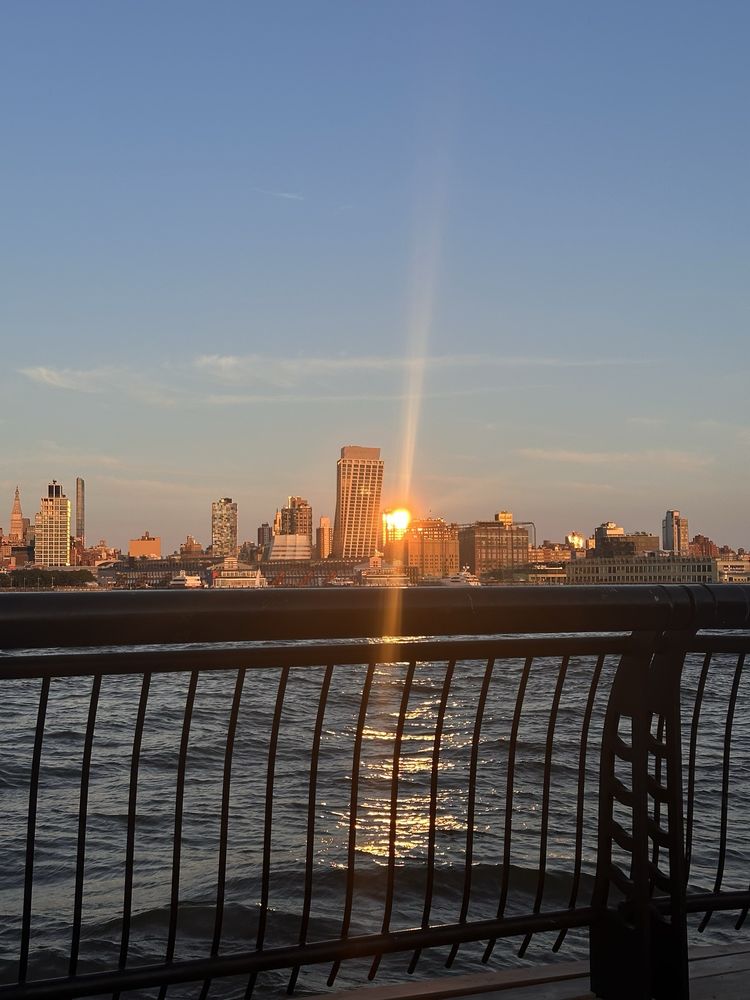
## Chapter One: The Morning the Sun Sang The dawn stretched across Brooklyn like a golden cat waking from a long nap, and I, Pete the Puggle—proud owner of two velvety white paws, ears that could hear a cheese drop from three rooms away, and a heart that beat in story-rhythms—sat perched on the windowsill of our apartment. The morning light painted my short, white fur in honeyed strokes, and I felt, if I may say so myself, quite dashing indeed. "Roman!" I barked, my tail thumping against the windowsill like a metronome set to *excitement*. "ROMAN! The sun is singing and my paws are ITCHING!" My older brother—though human and towering, with the messy brown hair of someone who stayed up too late reading adventure books—shuffled into the kitchen, rubbing his eyes. "Pete, buddy, the sun doesn't sing. That's just... birds. And maybe Mrs. Henderson's wind chimes." I bounded off the windowsill, my nails clicking a rapid-fire Morse code across the hardwood. "The sun SINGS, Roman. It sings *golden* and *warm* and *today-is-the-day*." I paused, performing an elegant spin that would've made any ballerina jealous. "And what day is it?" Roman crouched down, his brown eyes—so like warm earth after rain—meeting mine at proper dog-eye-level. "Pier 51 Playground day," he whispered, as if sharing a sacred secret. I yelped. I spun. I may have briefly become a furry white tornado of pure joy. From the bedroom emerged Lenny-Dad, his presence like a walking campfire—warm, steady, slightly crackling with impending dad-jokes. "Well, well, well," he said, his voice rumbling with amusement, "if it isn't the world's most excited cotton ball." "Lenny-Dad!" I protested, though my tail betrayed me with its frantic wagging. "I am not a cotton ball. I am a Puggle. A PUGGLE. There's a difference. Cotton balls don't have adventures. Cotton balls don't have SOULS." Mariya-Mom appeared then, her dark hair still sleep-tousled, her eyes holding that particular magic she carried—the ability to see wonder in a grocery list, to find poetry in a Tuesday. She knelt and I flew into her arms, burying my nose in her neck, breathing in the lavender and morning-coffee scent of her. "My brave little storyteller," she murmured into my fur. I stiffened slightly. *Brave*, she called me. The word sat in my chest like a stone I'd swallowed. For I, Pete the Puggle, was not entirely brave. Not in all ways. Not in the ways that counted when the world grew large and the shadows stretched long. But I pushed that thought aside, because Roman was packing sandwiches and Lenny-Dad was making his terrible jokes and Mariya-Mom was humming, and outside the world waited green and golden and full of playground-promise. "Who's ready for an ADVENTURE?" Roman shouted, flinging open the door. "I am!" I barked, though my voice cracked slightly, like a bell with a small chip in its bronze. And so we went: four hearts beating in irregular rhythm toward the water, toward the unknown, toward Pier 51 where the Hudson River licked at wooden pilings and the playground rose like a colorful castle against the Manhattan skyline. --- ## Chapter Two: The Playground Kingdom and Its Shadows Pier 51 Playground revealed itself in stages, each more magnificent than the last. First, the approach: the way the wooden walkway curved like a welcoming arm, the railings painted in stripes of red and blue and sun-faded yellow. Then the playground proper—towers of climbing structures connected by rope bridges, slides that twisted like silver eels, swings that hung like ripe fruit waiting to be plucked by laughing children. I trotted between Roman's sneakers, my nose working overtime. The smells! Hot dogs from a distant cart, the chemical-green of fresh-cut grass, the salt-tang of the river, and—most intriguing of all—other dogs. So many dogs. Their scents layered the air like a novel written in perfume. "Pete, stay close," Mariya-Mom called, though not urgently. We had rules, my family and I. Invisible leashes of love and caution. I spotted the water then. The Hudson lay beyond the playground, broad and brown-green, moving with a purpose I didn't understand. It caught the sunlight and shattered it into thousands of moving coins. It lapped against the pier's edge with a sound like slow breathing, like something waiting. My paws stopped. My tail, previously helicopter-blurring with joy, drooped. Roman noticed immediately. My brother had that sense about him—the kind that could feel my heartbeat through the leash, through the air between us. "Pete? You okay, little dude?" I opened my mouth to say *of course, obviously, I am Pete the Fearless*, but what emerged was a small whine, barely audible above the playground's cheerful chaos. "The water," I managed. "It's... it's very... wet." Roman knelt, his knees pressing into the soft rubber ground-covering. "That's usually how water works, Pete." "But it's MOVING," I said, hearing the panic rise in my voice like a tide matching the one I feared. "Roman, it's moving and it's DEEP and what if—" I stopped, the what-if expanding in my chest like a balloon made of nightmares. Lenny-Dad appeared, his shadow falling over us both. "Ah," he said, in that knowing way fathers have. "The Hudson has that effect. When I was Pete's age—" "Dad, you're a human," Roman interrupted, but gently. "You were never Pete's age." "Metaphorically," Lenny-Dad amended, unperturbed. "When I was metaphorically Pete's age, I was afraid of the basement. The way the furnace would CLANK, you know? Like a monster clearing its throat." I tilted my head, momentarily distracted from my water-terror. "What happened?" Lenny-Dad sat right there on the rubber ground, not caring who saw, and scooped me into his lap. I felt his heartbeat through his thin summer shirt, steady as a drumline. "I went down there. With my dad. And we sat with the clanking until it was just... clanking. Not a monster. Just a furnace doing its best." "That's... that's not the same as WATER," I said, but my voice had softened, nestled as I was in the warmth of him. "Fear is fear, Pete," Mariya-Mom said, joining our circle. Her hand found my ear, stroking the soft fold where fur gave way to skin. "It wears different costumes, but it speaks the same language." I wanted to ask what language, but a shadow fell across us—not Lenny-Dad's shadow, not any shadow cast by the sun. This shadow moved wrong, flickered at edges that shouldn't flicker. And from it, or through it, stepped a dog I knew but had never met. --- ## Chapter Three: Laika of the Stars She was golden, this dog, but a gold that seemed borrowed from elsewhere—the gold of old photographs, of lamplight, of something preserved beyond its natural time. Her eyes held depths I couldn't comprehend, starfields I could only glimpse. "Pete," she said, and her voice resonated with harmonics, as if multiple Laikas spoke in imperfect unison. "I am Laika. You know of me." I did. Every dog knew Laika. The one who went up, who rode fire into darkness, who became more than dog—myth, sacrifice, constellation. "You're..." I stammered. "You're supposed to be..." "Gone?" The not-quite-right gold of her fur rippled, though no breeze blew. "I am gone. I am here. Time is... different, where I travel now. I penetrate its fabric as easily as you scratch at a door." Roman's hand tightened on my leash. "Pete, who are you—" He stopped, following my gaze, but his eyes saw only empty playground, shifting shadows of children at play. "Your human cannot perceive me fully," Laika said, her head tilting with something like sympathy. "Not yet. The veil between grows thin today, Pete. Something is coming. Something that feeds on the fears you carry, makes them manifest, makes them—" She vanished. Not gradually, not with drama—simply gone, as if someone had cut her scene from a film mid-frame. But her warning remained, echoing in the space where she'd stood, and I felt it then: the wrongness. The way the playground sounds had dulled, as if heard through water. The way the sunlight seemed suddenly thin, stretched across a distance too great to sustain it. "Roman," I whispered, and my brother—my wonderful, perceptive brother—heard something in my tone. He scooped me up without question, pressing me to his chest where his heartbeat thundered reassurance. "Mom, Dad," he said, turning, but the playground had shifted. Where the entrance had been, where the familiar path home stretched, there was now only mist, only the suggestion of forms that moved with purposes I couldn't fathom. And from the mist, laughter—not a child's laughter, not entirely. Something that wore laughter's shape like a mask. "Pete?" Mariya-Mom's voice, but distant, as if she spoke from the bottom of a well. "Pete, where—" The mist swallowed her words. Swallowed them all—Lenny-Dad's steady presence, Mariya-Mom's magic-seeing eyes, Roman's heartbeat against my fur. I was alone. Or rather: I was alone with whatever came next. --- ## Chapter Four: The Dark Beneath the Pier The mist deposited me somewhere else. I knew immediately, with the certainty of paws on unfamiliar ground, that I was beneath the pier. Above me, wooden beams crossed like the ribs of some great beast, and between them leaked not sunlight but something greener, older, more like the light that reaches the bottom of ponds. Water lapped nearby. Close. Too close. I could smell it now—the Hudson's particular perfume of salt and silt and secrets kept too long. The smell invaded my nose, my throat, became the air I had no choice but to breathe. "Not brave," I whispered to myself, curling into the smallest possible version of me. "Not brave, not brave, not—" "Pete." The voice came from everywhere and nowhere, and I recognized it—the not-laughter, the thing wearing laughter's mask. "You're afraid," it said, and I felt it more than heard it, felt my own fear reflected back at me amplified, distorted, made monstrous. "You're afraid of the water. You're afraid of the dark. You're afraid of being alone. Of being BURIED in the dark, UNDER the water, FOREVER—" Each word found its matching fear in me, and I realized with horrible clarity that this was Laika's warning made manifest. Something that fed on fear, made it real, made it— The water rose. I saw it then, darkening the sand beneath the pier, creeping toward my curled-white paws. It moved wrong, this water, too deliberate, too *hungry*. It was my fear made liquid, my terror given current and purpose. I closed my eyes. I thought of Mariya-Mom's lavender smell. Lenny-Dad's furnace story. Roman's heartbeat. "You're not real," I whispered to the rising dark. "You're my fear. That's all. That's—" The water touched my paw and I SCREAMED, or tried to, but what emerged was more whimper than battle-cry, more surrender than defiance. And then: another scent. Not the wrong-water, but something warm and solid and *here*. Fur brushing mine. A weight pressing against my trembling side. I opened my eyes. A Mastiff stood beside me, her coat the color of autumn evenings, of polished mahogany, of dreams of far countries where they understand the value of a good nap in sun-warmed stone. Her eyes, when they met mine, held the brown of ancient forests, of coffee with just enough cream, of everything steady and good. "I am Luna," she said, and her voice was like her presence: calm, assured, carrying within it the suggestion that storms were simply weather to be waited out. "And you, little white one, are making far too much noise about a little water." "Little?" I managed, indignation warring with relief. "LITTLE? It's rising, it's—" "It's your fear," she said simply. "I see it clearly. You see it... less so." She nudged me with a nose that was surprisingly soft for such a substantial dog. "Shall I teach you to see differently?" Before I could answer, the water surged—and Luna moved, not away from it but into it, her powerful legs carrying her through where I had frozen. And she looked back, that mahogany head turned over her shoulder, and I understood: *follow*. But the water. The dark. The ALONE. "Pete!" A voice from above, barely audible through the wooden ribs. "PETE!" Roman. My Roman, searching. And I thought: he is not afraid. He walks through his fear to find me. They all would. They are. Luna waited in the water, patient as stone, and I thought of Laika's star-travel, of Lenny-Dad's furnace, of all the ways fear could be faced not by absence but by presence, by moving through, by— I stepped forward. The water was cold. That was the first shock. The second was that it didn't swallow me, didn't pull me down to the dark forever-place my imagination had constructed. It was simply... water. Wet, yes. Moving, yes. But also: buoyant, supporting, carrying my weight as I paddled—awkwardly, true, but *functionally*—toward Luna. "Better," she said, and I heard approval. "Now, shall we find your human? Together?" Together. The word rang in my chest like a bell finally struck true. Together, we moved through the dark beneath the pier, and I found that with each stroke, each splashing moment, the water became less monster and more simply... element. Context. Something to navigate rather than avoid. But the pier was vast, a labyrinth of wooden supports and shadows, and Roman's voice had faded, and I felt the old panic rising again—we were lost, we would be lost forever, the dark would have us, the water would— "Tell me a story," Luna said, swimming beside me. "You are the storyteller, yes? The one with tales in his heart? Tell me one now. Distract us both." And so I did, gasping between strokes, my voice thin but PRESENT: "Once... there was... a small dog... who thought his courage... had to be... BIGGER than him..." The story unwound as we swam, and I realized with part of my attention that the water wasn't rising anymore, that the dark had receded slightly, that something in the telling was making it so—my voice, my words, shaping reality as stories always had. "And he learned," I panted, finding the ending, "that courage... wasn't... absence of fear... it was... CHOOSING... despite it..." Luna's bark of approval echoed, and ahead, there was light—real light, sun-light, and a figure silhouetted against it, and a voice I would know through any darkness, any water: "PETE!" --- ## Chapter Five: Roman's Arms and Roman's Heart Roman didn't just find us. He waded into the water—jeans soaked, phone probably ruined, absolutely not caring—and gathered me into arms that shook with relief and terror and love so big it needed no name. "Pete, Pete, Pete," he chanted, pressing his wet face to my wet fur, and I felt his tears mixing with Hudson River water, salt on salt. "I heard you—I heard you talking, I followed your voice—" "You heard me?" I managed, dazed, warm despite everything in the furnace of his embrace. "Talking up a storm, little dude. Something about... courage? And fear? And a..." he pulled back, finally noticing Luna, who had emerged behind me with the dignity of a queen arriving at her own coronation. "Is that... did you make a FRIEND?" Luna sat, her mahogany coat streaming water, and for the first time I saw something like shyness in her steady gaze. "I assisted," she said, with the careful neutrality of someone who wants credit but knows better than to demand it. "She SAVED me," I said firmly, wiggling until Roman set me down on sun-warmed planks. The pier above, the real pier, with people walking and children laughing and the world continuing its ordinary miracles. "She taught me to swim. To face the water. To—" "To shut up and stop panicking," Luna interjected, but her tail gave one slow wag. Roman laughed, that sound like summer coming early, and knelt to offer Luna his hand to sniff. "Any friend of Pete's," he said, and I felt my chest expand with something complicated—pride, yes, but also the particular vulnerability of having someone speak *of* you, *about* you, with love. "Roman," I said, urgency returning as the immediate danger faded. "Mom. Dad. The mist—it took them, it took—" His face changed, the joy draining to serious focus. "I know. I lost them too. The fog came out of nowhere, and suddenly I could only hear you, talking to..." he glanced at Luna, clearly still processing the talking-dog situation. "...someone. So I followed." "We need to find them," I said, and to my surprise, my voice didn't shake. The fear was still there—of course it was, fear doesn't vanish, it simply finds company in courage—but it wasn't driving anymore. I was. We were. "Laika," I said, testing. "Laika, if you can hear me—" The air shimmered at the pier's edge, and there she was, more solid now, or perhaps I was simply better able to perceive her. "The danger isn't over," she said without preamble. "The entity feeds on separation, on the spaces between where love should be. You must find your family, Pete. All of you. Together, you are stronger than any fear made manifest." "Can you—" I started. "I can guide. I cannot intervene directly." Her starfield eyes held apology, or what might be apology in a being so far beyond ordinary dog-experience. "My power is... different here. Disruptive. To use it might tear worse holes in the fabric." "Then guide," I said, and I heard the command in my voice, the leadership that had always been potential becoming actual. "We'll do the rest." Laika's not-quite-solid form seemed to smile. "Follow the laughter," she said, and vanished, but this time I caught the direction—the way her form bent before disappearing, pointing toward the playground's far end, where a climbing structure rose like a castle tower against the sky. "Laughter," I repeated, and then I heard it—faint, distorted, but unmistakable: Lenny-Dad's full-belly laugh, the one that started in his stomach and erupted like a volcano of joy. "That way!" I barked, already moving, Roman's long legs keeping easy pace, Luna's substantial presence flanking me on the other side. We ran toward the sound of love, and the dark that had gathered seemed to recoil before us, not defeated but perhaps... respecting. Acknowledging. The way shadows must always acknowledge light. --- ## Chapter Six: The Tower Where Parents Wait The climbing structure rose twelve feet of painted metal and rope, a castle tower for the modern age. At its summit, visible through the diamond-patterned safety fencing: two figures, holding each other, surrounded by a swirling mist that tried and failed to penetrate their circle of mutual embrace. "MOM! DAD!" Roman's voice cracked with relief. "ROMAN! PETE!" Mariya-Mom's voice, and I heard in it the particular terror of a mother who had lost, however briefly, her world. Lenny-Dad's voice followed, still attempting levity despite everything: "Took you long enough! We were about to start charging rent up here!" I was already at the structure's base, assessing. The ladder: too steep, my paws still uncertain from the water-trauma. The rope net: better, but my claws caught, slipped, caught again. "Pete," Luna said, and I turned to find her positioned beside the net, her substantial body forming a platform, a step, an *offering*. "Together," she said, and I heard in it everything—her teaching, my learning, the way fear diminished when shared. I climbed onto her back, felt her muscles steady beneath me, launched from her shoulders to the net. My claws found purchase. Hand over paw, paw over hand, up I went, the mist reaching for me, whispering: *Alone, alone, you are always alone in the dark, in the water, in the end—* But I wasn't alone. Below, Roman climbed the ladder three rungs at a time. Luna guarded the base, her bark creating ripples in the mist's fabric. And above, waiting, my parents—my family—the ones who had never stopped believing I would come. The top platform was small, crowded with two humans and now me, Roman arriving moments later. The mist pressed against the fencing but couldn't enter, repelled by something I finally understood: the forcefield of togetherness, of *we*, of love made spatial and protective. "Pete," Mariya-Mom breathed, gathering me close, and I felt her tears, her shaking, her absolute refusal to let go. "Pete, my brave boy, my—" "Not brave," I said automatically, the old reflex, but then stopped. Considered. "No," I corrected. "Brave enough. Brave enough to come. Brave enough to try." Lenny-Dad's hand found my head, his fingers scratching exactly where I couldn't reach, his touch steady as bedrock. "That's the only kind there is, Pete. Brave enough. One step, one moment, one breath." The mist screamed—I had not known it could scream, had not wanted to know—and redoubled its assault. The fencing groaned. The platform shook. "It's feeding on our separation," I realized aloud. "On the fear of being apart. We have to—we have to choose—" "Together," Roman said, understanding instantly, reaching for his mother's hand, his father's shoulder. "Together," Mariya-Mom agreed, and her free hand found my fur, my heartbeat, my story. "Together," Lenny-Dad rumbled, and his voice carried something else now, the particular power of a man who had told jokes in darkness, who had turned furnaces into friends. "Together," I said, and I reached out through the fencing, through the mist, toward where I sensed Luna below, and Laika somewhere beyond, and all the connections that made me more than myself, more than fear, more than a small white dog in a large dark world. "Together," said a voice that was Luna's and Laika's and somehow my own, harmonics layering until the word became tone became vibration became— Light. Not dramatic, not explosive. The gentle light of morning after long night, of sun through curtains, of hope that arrives not in trumpets but in the quiet certainty of *continuing*. The mist burned away like morning fog, and we stood revealed on our platform: two parents, two children (one human, one canine, both equally precious), and below, waiting with patient dignity, one mahogany Mastiff who caught my eye and did something with her mouth that might, in a less dignified dog, be called a smile. --- ## Chapter Seven: The Lesson of the Water, The Lesson of the Dark We found the picnic bench where we'd planned to lunch, and somehow our food had survived, or perhaps time had bent around our crisis, Laika's gift of preserved moments. We ate, we drank, we breathed in the ordinary miracle of family intact. Roman sat with me on the bench's edge, our sides pressed together, watching the Hudson move past. The water that had terrified me, that had tried to become my ending, simply... was. A river. Moving toward sea, as rivers do, as all things move toward their becoming. "You're looking at it differently," Roman observed. "I am," I admitted. "It's still... big. Still moving. Still capable of..." I shuddered, the memory of dark water rising. "Of what?" Roman pressed, gentle, patient. "Of taking. Of keeping. Of being the last thing." The words emerged haltingly, each one costing something. "But also... of holding up. Of carrying. Of being the path through, not just the obstacle to." Roman was quiet for a moment, his hand finding my ears, stroking in that rhythm we'd perfected over years. "That's... that's really beautiful, Pete. Did you think of that?" "I think..." I paused, considering. "I think Luna helped me see. And Laika, in her way. And you, Roman. Coming through the water to find me. Not waiting on shore, not calling instructions, but coming THROUGH." "That's what family does," he said simply. Mariya-Mom joined us, her presence like a candle lit in a friendly window. "May I?" she asked, and sat when I wagged acceptance. "Pete, I want to tell you something. About the dark." I listened, because her voice carried that quality, the one that made stories into truths and truths into living things. "When I was small," she said, "I was terrified of the dark. Not just disliking, not just avoiding—terrified. I would lie in bed and feel it pressing against my windows, waiting for me to be alone enough to strike." Her hand found mine, holding my paw with human fingers. "My mother—your grandmother, though you never knew her—would sit with me. Not telling me the dark wasn't real, not dismissing my fear, but simply being present in it. Until gradually, I realized: the dark was just... absence of light. Neutral. Capable of being filled." "Like the water," I said, understanding. "Capable of drowning or carrying. Depending on..." "Depending on how we meet it," Lenny-Dad finished, joining our circle with two cups of something steaming—coffee for them, I assumed, though my nose detected something else, something specially prepared. "Hot chicken broth," he announced, setting a small bowl before me. "For the adventurer. The one who swam through his fear to find his family." I drank, the warmth spreading through me like the light earlier had, like love made liquid and nourishing. "And being separated?" I asked, the last fear, the deepest one. "Being alone?" "That," Mariya-Mom said, and her voice caught slightly, "that is the hardest. Because it's real, Pete. We can be separated. Things happen. The world is..." she gestured, encompassing all the unpredictable, all the dangerous, all the ways families fracture. "The world is," Lenny-Dad agreed. "But we choose, every day, to not let that fear prevent the connection. To love despite the risk of loss. To reach out even when reaching might mean—" "—might mean not reaching," I finished. "But still reaching." "Still reaching," they echoed, and in the harmony of their voices I heard my answer, my permission, my ongoing challenge. Luna approached then, her mahogany form casting a shadow that felt like shelter rather than threat. "The star-traveler returns," she murmured, and I followed her gaze to where Laika materialized, more solid than before, or perhaps we were simply better able to perceive her truth. "The danger has passed," Laika said, "for now. The entity was drawn to this place because of the convergence—old pain, old fears, the pier's own history. But you," her starfield eyes found mine, "you faced it with story and connection and the refusal to be alone in your fear. That is... rare. That is... powerful." "Will you stay?" I asked, both of them, neither of them, all of this strange wonderful constellation of companionship. "I remain," Luna said, settling beside me with the finality of decision long-considered. "If you'll have me. The world is large, and I find I prefer... particular company." Laika's form flickered, that between-state that was her natural condition. "I am everywhere and nowhere, Pete. But when you need me—truly need, with the need that opens doors between worlds—you will find me. Or I will find you. That is the promise of those who have traveled darkness and found light worth sharing." She extended something—a paw, a hand, a star—and I touched it with my nose, felt cold and warmth and the particular electricity of something sacred concluded. Then she was gone, or as gone as she every truly was, and we were simply family again: two parents, two children, one newly-adopted mahogany guardian, and the memory of impossible friends woven into our story forever. --- ## Chapter Eight: The Story We Tell Together The sun began its descent, painting the Hudson in shades of gold and rose and finally, reluctantly, blue. We gathered our remnants—sandwich wrappers, empty broth cups, the debris of a day that had contained multitudes—and prepared for the walk home. At the pier's edge, where the wooden walkway curved toward the street, I paused. Looked back. The playground stood empty now, ordinary in the gathering dusk, but I could see—would always see—the other layers. The way fear had gathered and been faced. The way darkness had been illuminated not by denial but by presence. The way water, so terrible, had become simply another element to navigate, another story to tell. "Pete?" Roman's voice, patient, loving, waiting. "Coming," I said, and I was, I am, I will be—coming through, coming home, coming together with all who make the journey worth the fear. We walked, Luna flanking me on one side, Roman on the other, Lenny-Dad and Mariya-Mom ahead with their hands intertwined. The city lights began to wake, stars' pale urban cousins, and I thought of Laika among the real stars, of Luna's steady warmth beside me, of all the ways love persists across impossible distances. "Tell us a story," Mariya-Mom said, looking back, her face luminous in the first streetlamp's glow. "Pete the storyteller. Give us the ending." So I did. I gave them the story of a small white dog who thought himself unbrave, who faced water and dark and separation and found in each the opportunity for courage—not the absence of fear, but the presence of love despite it. Who found friends in unexpected places, who was found by family who refused to abandon him, who learned that the stories we tell ourselves shape the worlds we inhabit. "I used to think," I said, as our building came into view, home and haven, "that courage was loud. Barking. Charging. Conquering." "And now?" Lenny-Dad asked, his hand finding the door, his presence as steady as any star Laika might navigate by. "Now I think," I said, and paused on the threshold, looking back at my family—my beautiful, imperfect, courageous family—"that courage is quiet. It's choosing to step forward when every instinct says retreat. It's reaching for connection when separation seems safer. It's telling the truth about fear, and finding that truth makes room for others to do the same." Luna pressed against my side, her warmth a benediction. "Well said, little white one." "Not so little," I protested, but without conviction. "Not so little," she agreed. "Not anymore. Not ever really. Just... compact." We laughed, all of us, the sound carrying up through the evening, joining with other sounds of city life continuing, of stories upon stories being lived and told and retold. In our apartment, Roman prepared my bed—his old t-shirt, worn soft, carrying his scent. I circled, I settled, I let my eyes grow heavy with the particular exhaustion of a day fully lived. "Sweet dreams, Pete," Mariya-Mom whispered, her hand passing over me in blessing. "May they be stories worth telling," Lenny-Dad added. "And worth living," Roman finished, his fingers finding my head one last time. They left, lights dimming, and I lay in the dark that was no longer frightening—simply present, simply waiting to be filled with morning, with continuation, with the next adventure that would surely come. Luna's breathing, steady from her cushion nearby. The distant sounds of the city. And somewhere, in the spaces between stars, a golden dog traveling time to watch over those who had learned her lesson: that no one need be alone in darkness, that fear faced with love becomes simply... experience. Story. The material from which we craft our becoming. I closed my eyes. I dreamed of water that held rather than drowned, of darkness that cradled rather than concealed, of separation that always, always, led back to reunion. And in the dream, as in waking, I was Pete the Puggle: storyteller, adventurer, beloved. Not despite my fears but through them, not beyond my smallness but expanded by love beyond any boundary I could have imagined. The story continues, as all true stories do. But for now, this chapter closes. This adventure rests. And courage, that quiet, persistent thing, settles into bone and breath and the promise of tomorrow's reaching. *** The End ***
Use these buttons to read the story aloud:



No comments:
Post a Comment