"# Pete the Puggle's Great Elizabeth Street Garden Adventure"🐾
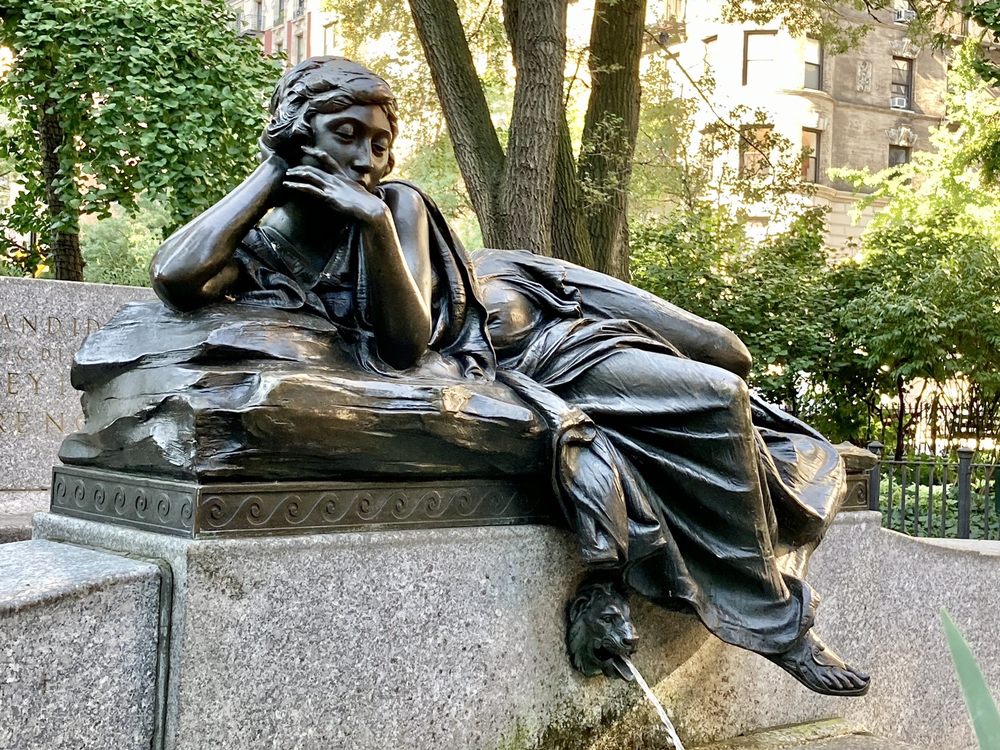
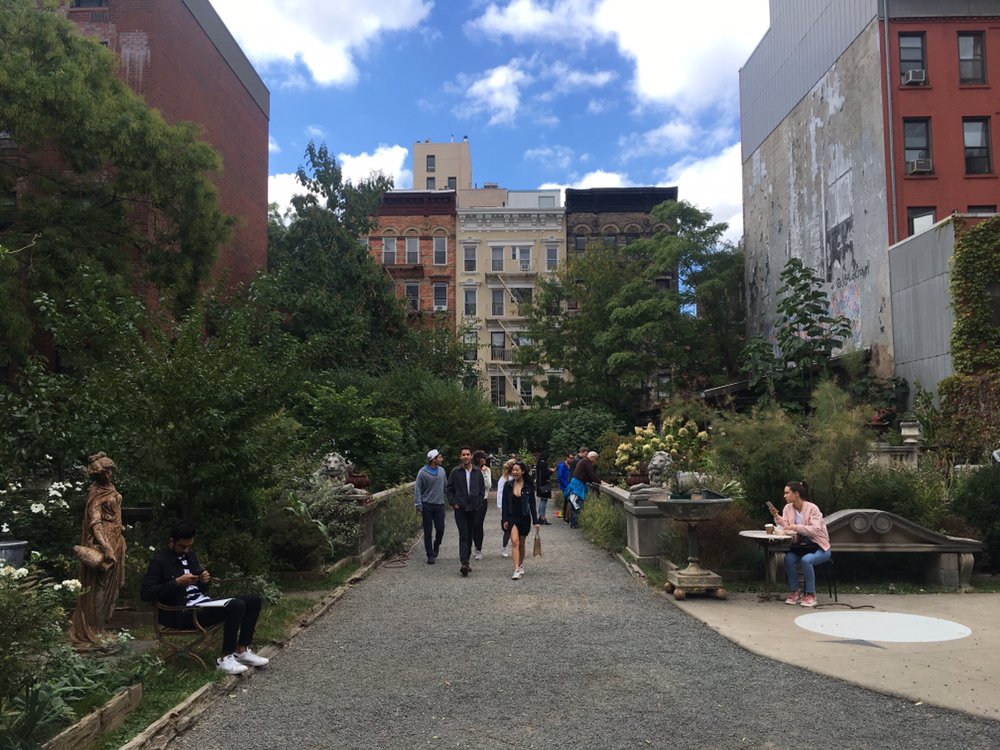
## Chapter One: The Morning of Marvelous Possibilities The sun poured through the kitchen window like warm honey, and I stretched my paws until my velvety white fur practically hummed with anticipation. Today was the day! Today we were going to Elizabeth Street Garden—that magical place Lenny had described as "a secret world hidden behind city walls, where statues come alive in your imagination and flowers wear their colors like ball gowns at a royal feast." I wiggled my entire body—there's no dignified way to contain this much excitement—and scampered into Roman's room without knocking. *Barging is a puggle privilege*, I reminded myself. "Roman! Roman! Roman!" I barked, my voice cracking like a squeaky toy that still had some life left in it. "Is it time? Is it time? Is it—" My older brother emerged from beneath his comforter, hair sticking up like a dandelion gone to seed, and scooped me into his arms. His hands were warm and familiar, the hands that had thrown thousands of tennis balls and scratched exactly the right spot behind my left ear. "Pete, my little dude," he murmured into my fur, his voice still gravelly with sleep. "It's barely seven. The garden doesn't even open until nine." "But the butterflies are already practicing their choreography," I whined, nuzzling his neck. "I saw them through the window. They're doing spiral formations, Roman. *Spiral formations.*" Roman laughed—that deep, rumbling sound that always made me feel like everything in the world was exactly where it belonged. "You've been reading Mariya's poetry books again, haven't you?" "Guilty," I admitted, licking his chin. "She says metaphors are how we turn ordinary moments into magic." Just then, the door swung open, and there stood Mariya herself, radiant as a sunrise in her soft blue cardigan, a canvas tote bag slung over her shoulder already bulging with sketchbooks and colored pencils and, I suspected, at least three different kinds of organic snacks. "Did someone say magic?" she asked, her eyes crinkling at the corners. "Because I happen to know that Pete's favorite human in the entire world—that would be George, for anyone keeping score—is meeting us there with his famous swimming stories." My heart did that funny little flip it always did when George's name came up. George! Roman's friend from the Navy, with shoulders like a harbor and a laugh that could capsize small boats. George, who had swum with dolphins in waters so deep blue they looked like spilled ink, who could hold his breath longer than I could hold a sit-stay when someone opened the refrigerator. "George is coming?" I squeaked, my voice climbing three octaves. "Swimming George? Ocean George? *Our* George?" "The very same," Mariya confirmed, kneeling to scratch between my ears with those gentle fingers that seemed to understand the exact language of my soul. "And he specifically requested that Pete the Brave lead the expedition." *Pete the Brave*. The words settled over me like a cape I wasn't quite sure I deserved. I was Pete the Puggle, yes. Pete the Snuggler. Pete the Treat-Beggar. Pete the Sometimes-Afraid-of-His-Own-Shadow. But *Brave*? "You'll be brave today," Mariya whispered, as if reading my thoughts, which mothers have an uncanny way of doing. "Bravery isn't the absence of fear, my love. It's the decision to keep your heart open even when it wants to close." Lenny appeared in the doorway then, his reading glasses perched on his nose, his smile spreading slow and warm as summer pavement. "Who's ready for an adventure?" he boomed, and I launched myself from Roman's arms into the waiting safety of Dad's chest, where I could hear his heartbeat thumping steady as a metronome keeping time for the whole family. "Me!" I yipped. "Me, me, me!" And somewhere, deep in the part of me that trembled at thunderstorms and hid from vacuum cleaners, a small voice wondered: *But will I stay brave when it matters?* --- ## Chapter Two: The Garden of Whispers and Stone Elizabeth Street Garden revealed itself like a storybook opening its pages one by one. We passed through the iron gate—a threshold between the ordinary world and something shimmering with possibility—and suddenly the city fell away, replaced by a wilderness of sculpture and blossom, of secret paths and hidden nooks that seemed to breathe with ancient, patient life. "Oh," Mariya breathed, her hand fluttering to her heart. "Oh, children, look." I looked. I looked so hard my eyes nearly popped from my skull, which is a distinctly unattractive puggle expression, but I couldn't help myself. The garden sprawled before us like a dream half-remembered: weathered statues standing sentinel among wildflowers, a pond glinting like a fallen coin in the distance, trees arching overhead to form a canopy of dappled green-gold light. "Pete." Roman knelt beside me, his hand warm on my back. "What do you see?" I tilted my snout to catch the thousand scents—jasmine and earth and something mysterious and watery from the pond's direction. "I see..." I began, then paused, wanting to get it exactly right. "I see a place where stories live. Where they're *waiting* for someone to find them." "That's my poet," Lenny said proudly, and I swelled with warmth. We wandered deeper, Mariya stopping to sketch a marble figure of a woman with flowing robes, Lenny reading the small brass plaques that named each sculpture, Roman tossing pebbles that I chased with the solemn dedication of a professional athlete. The garden wrapped around us like a favorite blanket, familiar even in its strangeness. Then I saw the pond. It lay at the garden's heart, larger than I'd expected, fed by a small fountain that created music like silver bells. The water was that particular shade of green that speaks of depth and mystery, of cool shadows where anything might live. And beside it, waving enthusiastically, stood George. "There's my little admiral!" he called, his voice carrying that particular boom of someone accustomed to speaking over ocean winds. George! Even more magnificent than memory allowed—tan from some recent adventure, his smile white as sailcloth, his arms strong as anchor chains as he swept me up and spun me around. "Pete, Pete, Pete," he laughed, and I licked his entire face in the comprehensive greeting he deserved. "Roman tells me you're conquering the world these days. Swimming? Adventures? Facing your fears?" I felt my ears flatten slightly. "I'm... working on it," I admitted, which was perhaps the bravest thing I'd said all day. George's eyes—blue as the open sea, I noticed—softened with understanding. "Working on it is the whole job, little dude. Nobody's born brave. We build it. Like... like sandcastles. One grain at a time." Mariya joined us, hugging George with the particular fierceness she reserved for people who had become family through love rather than blood. "George has promised to teach us about the garden's hidden places," she told me. "There's a grotto, apparently. And a maze of hedges. And—" "A tunnel," George interrupted, lowering his voice to theatrical proportions. "An *underground* tunnel. Dark as a whale's belly. Leads to a secret chamber where the garden keeps its oldest stories." The word *dark* hit my chest like a cold paw. *Dark*. Underground. Secret. My imagination, usually so helpful, suddenly turned traitor, filling with images of being trapped, of not knowing where my family was, of the blackness pressing in like water— "Pete?" Roman's voice cut through my spiral. His hand found my scruff, grounding me. "Pete, breathe. You're here. We're here." I sucked in garden air, sweet with roses. "I'm here," I repeated, and the words felt like a promise I was making to myself. George watched this exchange with something like recognition. "You know," he said casually, "the first time I had to swim at night? Navy training. Pitch black water, couldn't see my own hands. I panicked so bad he practically climbed onto his own partner." He laughed at himself, not unkindly. "But I learned something. The dark doesn't remove the people who love you. It just makes you hold on tighter." I considered this. Held it like a pebble in my mouth, smooth and weighty. "I want to learn," I said finally. "I want to hold on tighter." "Then let's explore," George grinned. "Adventure awaits, and all that heroic stuff." We set off toward the garden's deeper reaches, and I trotted between Roman and George, my family a constellation around me. But I kept glancing back at that pond, its green surface now rippled by breeze, and I wondered what it would feel like to touch that water, to let it close over my paws, to trust it to hold me up. The thought made my heart race with something I couldn't quite name. --- ## Chapter Three: The Maze and the Shadow of Doubt The hedge maze rose before us like a green puzzle, its walls dense and fragrant with boxwood. George led the way with the confidence of someone who had mapped stranger territories, his hand occasionally brushing the leaves as if reading their texture like braille. "Left here," he directed. "Then right at the statue of the weeping cherub. Then... hm, I think another left?" "George," Lenny rumbled, his amusement barely contained, "have you *actually* been through this maze before?" "Technically? No." George's grin was unrepentant. "But I've navigated by stars through waters where compasses spin. A little hedgerow is nothing to fear." I trotted along, my nose working overtime to catalog each turn, each subtle change in the air's composition. The maze was beautiful—there was no denying that—but it was also *confining*, walls pressing closer than I liked, the sky reduced to a ribbon of blue overhead. I stayed close to Roman's heels, my ears swiveling for any sound of distress. "Roman?" I whispered, when the others had pulled slightly ahead. "What if we get lost?" My brother slowed, letting the others gain distance until we stood alone in a small clearing where the hedges formed a natural room. He sat, cross-legged on the gravel path, and I climbed into his lap, grateful for the familiar warmth. "Then we get found," he said simply. "Pete, do you know what I love most about you?" " my flawless ear shape?" He laughed, tugging the ear in question gently. "Well, yes. But also—your heart. You feel everything so *much*. The joy and the fear. It's not a weakness, little dude. It's your superpower." I rested my chin on his knee, considering. "Even when I'm scared of stupid things? Water? Dark places? Being... being alone?" "Especially then." His voice carried the weight of truth. "Because you feel the fear, and then you *choose* anyway. That's what courage is. Not being unafraid. Being afraid and showing up regardless." From ahead came Mariya's voice, musical with discovery: "Children! There's a sundial! And an inscription!" We followed, emerging into a central courtyard where the others had gathered around an ancient stone disc. But as I looked back the way we'd come, I noticed something troubling—the path seemed different, shadows having shifted with the sun's movement, and for a moment, just a moment, I couldn't be certain which turn led home. *Home*, I thought, with sudden sharp longing. *My bed. My people. Safe*. But then George was lifting me to see the sundial's inscription—*"Time flies on wings of light"—*and Mariya was sketching the scene, and Lenny was making some terrible pun about "thyme" and "herbs" that made everyone groan, and the moment of unease passed like cloud shadow over grass. Or so I thought. --- ## Chapter Four: The Pond's Invitation and the Terror Beneath We found the grotto in early afternoon, when the light had turned syrupy and golden. It was beautiful, a small cave hung with vines where water dripped musically into a basin of polished stone. But beside it, the pond stretched wider than I remembered, and something in its surface seemed to beckon. "Pete." George knelt at the water's edge, his hand trailing in the green depths. "Come here, little admiral. Feel this." I approached as one approaches a sleeping dragon—slowly, respectfully, prepared to flee. The water lapped at George's fingers, making small sounds like someone whispering secrets. It looked cool, inviting, utterly alien. "George," I said, my voice smaller than I liked, "I don't... I don't do water. I do *dry*. I do blankets and sunbeams and—" "I know," he said, not pushing, not pulling. Just present. "But the water knows something, too. It knows how to hold you up. You just have to trust it." Roman joined us, rolling his pant legs with methodical patience. "I'll go with you," he offered. "First time I swam, Dad had to practically throw me in. But George taught me. And now..." He waded in, the water rising to his knees, his waist, and then he was floating, his face upturned to the sky, smiling with a freedom that made my chest ache with wanting. "Come on, Pete," he called. "The water's fine. It's more than fine. It's... it's flying, but horizontal." I stood at the edge, my paws trembling. The green surface seemed to yawn before me, deep and cold and *other*. What if I sank? What if something pulled me under? What if— "Pete." Mariya's voice, gentle as the breeze that stirred the willows. "No one will make you. But remember—courage is a muscle. It needs to stretch." I looked at my family—Lenny's encouraging nod, Mariya's hopeful hands clasped at her chest, Roman's patient floating, George's steady presence like a lighthouse. And I thought of all the times I'd let fear shrink my world, all the adventures I'd watched from windowsills instead of living. *Choose*, I told myself. *Choose brave*. I stepped forward. The water was shock-cold, climbing my legs like invisible fingers, and I yelped, I admit it, a high sound of pure startlement. But I didn't retreat. Another step. The bottom dropped away, and I was swimming, paddling frantically, my heart hammering a rhythm of *panic panic panic*— "Roman!" " I've got you, Pete. I've got you." His hands found my sides, supporting, and I stopped thrashing, realizing the water did hold me up, that my natural dog-paddle was enough, that I wasn't sinking, wasn't dying, was in fact *moving*, propelling myself through liquid green light. "You're swimming," Roman marveled, his voice thick with pride. "Pete, you're *swimming*!" I was. Clumsily, fearfully, but truly. The water cradled me, cool and embracing, and I could see light filtering through in shifting patterns, could hear the underwater world humming its ancient song. Terror transmuted to wonder, grain by grain, sandcastle by sandcastle. Then George dove—arcing through the air with the grace of someone who had made peace with depths I couldn't yet imagine—and surfaced near us, his hair plastered to his skull, his smile enormous. "There's a whole world down there," he said, treading water. "Statues the garden sank on purpose. A whole Atlantis of stories." I wanted to see. I wanted to follow. But the thought of going under, of the water closing over my head, of *darkness* and *pressure* and *not being able to breathe*— My panic must have shown, because Roman was guiding me back to shore, his hands never leaving my heaving sides, murmuring comfort all the way. I collapsed on the grass, shivering not from cold but from the aftershock of almost-brave, of *nearly* there. "Next time," George said, climbing out beside me, not disappointed but determined. "There's always next time, little admiral." I wanted to believe him. I wanted to so badly it hurt. --- ## Chapter Five: The Tunnel's Mouth and the Breaking Apart The afternoon waned, shadows lengthening like stretching cats, when George finally led us to the tunnel's entrance. It gaped from a hillside, stone-lined and serious, the darkness within absolute and indifferent. "The secret chamber," George announced, with the flourish of a carnival barker. "Where the garden keeps its oldest stories. Are we ready?" I looked at the tunnel, and the tunnel looked back, and something in me recognized a kinship—we were both afraid, this tunnel and I, both hiding depths that could swallow the unwary. But where my fear made me small, the tunnel's fear made it vast, hungry, *waiting*. "Maybe," I heard myself say, "maybe we shouldn't. Maybe it's too late, or too dark, or—" "Pete." Lenny knelt, his large hands cupping my face. "We don't have to. We can go home. We can always go home." But Mariya was already lighting candles she'd produced from her bottomless bag, little flames that bobbed like fireflies in the gathering dusk. And Roman was shouldering his backpack with the determination that had carried him through school plays and driving tests and all the small brave things that made up a life. And I wanted—*I wanted*—to be the puggle who went in, who faced the dark, who came out with stories worth telling. "Okay," I whispered. "Okay. Together?" "Always together," my family chorused, and even George, who had no blood claim but every emotional one, joined in. The tunnel swallowed us like a giant taking medicine. The candlelight made shadows dance in epileptic frenzy, and every sound—drip of water, scrape of shoe, *thump of my own heart*—magnified into orchestral proportions. I walked between Roman and Lenny, my paws finding rhythm in their familiar gaits. Then the passage split. Forked like a tongue's lie, two paths diverging where before there had been one. "Left," George said, with less certainty. "Right," Lenny countered, studying the wall's moss patterns. While they debated, I smelled something—water, yes, but also Mariya's jasmine perfume, fading, *fading*— "Mariya?" I turned, and she was gone, the candle that had been in her hand now a guttering spot on the floor where someone had dropped it. "Mariya!" Louder now, my voice cracking. Roman's flashlight swept the passage. "Mom? Mom!" Silence. Then, distant, a sound like falling, like sliding, like *departure*. We ran. I don't remember deciding to run, but suddenly my paws were pounding stone, my family fragmented around me, George's voice calling from somewhere behind, *"Wait! Stay together!"* But panic is a current stronger than any George ever swam, and it carried me forward, around a corner, down a slope, into— Blackness. Absolute, complete, the candle extinguished, the flashlight gone, *Roman gone, everyone gone*, and me alone in the dark that had been waiting since the beginning of time to teach me what smallness truly meant. I screamed. I'll admit it without shame—I screamed until my throat burned, and then I screamed some more. The darkness pressed against my eyeballs, my eardrums, my very sense of self. *Where was I? Where was my family? Would anyone ever find me? Would I die here, small and alone and forgotten?* Time became meaningless. I might have been there minutes or hours. I curled into myself, trembling, every fear I'd ever had rising like floodwaters—*water, always water, the drowning dark*—and I understood, with terrible clarity, that courage wasn't a muscle at all. Courage was a choice you kept making, moment after moment, and I was making the wrong choice, had been making it all my life, letting fear shrink my world until it was exactly this: a ball of shaking fur in endless black. "Pete!" The voice came from everywhere and nowhere. "Pete! Answer me!" Roman. *Roman*. "Here!" I tried to shout, but it came out as barely a whimper. "Here, here, I'm here, don't leave me, don't—" Light bloomed, painful, miraculous. And then arms around me, familiar arms, Roman's face above me streaked with something that might have been tears or tunnel-dirt or both. "I've got you," he kept saying, rocking me. "I've got you, I've got you, I've got you." And I wept. Wept the relief and the terror and the aftermath, wept until his shirt was soaked and my eyes were swollen and the worst of the storm had passed. "George found the others," he told me, when I could listen. "They're okay. We're okay. But Pete—" He pulled back to look at me, his face serious in the flashlight's beam. "We got separated because we panicked. Because we let fear split us apart. That's the real danger, little dude. Not the dark. Not the water. Letting fear make us forget we're in this together." I understood. I understood in my bones, in my paw-pads, in the very rhythm of my still-racing heart. The tunnel hadn't been my enemy. My own fear had been. And the only way through was *through*—but together, always together. --- ## Chapter Six: The Finding and the Found George found us by following sound, which he said was "basic navigation, little admiral, the sea teaches you that." His voice in the darkness had been steady, confident, *present*, and I clung to it like a shipwrecked sailor to flotsam. "Your mom's at the tunnel mouth," he told us, leading us through passages that somehow made more sense in retrospect. "Your dad's with her. Everyone's accounted for. And Pete—" He paused, crouching to my level in the cramped passage. "You did good in there. Real good." "I fell apart," I said, honestly. "Yeah. And then you kept breathing. You kept hoping. You kept *being*. That's not nothing, little dude. That's everything." We emerged into twilight, the garden transformed by sunset into something even more magical than before—gold and rose and deepening blue, the statues seeming to breathe with relief at our return. Mariya swept me up, Lenny's arms encircled us both, and for long moments there was only the fact of *family*, of *held*, of *found*. "I'm sorry I ran," I said into Mariya's neck. "I'm sorry we got separated," she returned. "But I'm not sorry we came. Look what we found." She meant, I realized, not the tunnel or the garden's secrets, but this: us, reunited, choosing each other, *finding* each other. The real treasure. George produced sandwiches from his miraculous backpack, and we ate in the last light, watching stars emerge one by one like hesitant promises. And then, because the day demanded it, because I demanded it of myself, I walked to the pond's edge and dipped my paw once more in the cooling water. "Tomorrow," I said, to no one and everyone. "Tomorrow I swim to the statues. The garden's Atlantis. Will you come with me?" Roman's hand found my back. "Always, little dude. Always." --- ## Chapter Seven: The Return to Water and the Self That Emerges Morning broke clear and kind, and we returned to the pond like pilgrims to a shrine. This time, I didn't hesitate at the edge. I walked in, the cold a familiar shock rather than terror, and when the bottom dropped away, I paddled with purpose toward where George had described the sunken statues. "Remember," he called from somewhere behind, "trust the water. It wants to hold you up." And it did. It held me, cradled me, allowed me to duck my head beneath the surface and open my eyes to the green-gold world below. The statues stood there indeed—mermaids and heroes and creatures of myth, their stone faces softened by algae and time, and they seemed to welcome me into their silent company. I surfaced, gasping, triumphant, and Roman was there, and we treaded water together, two brothers in the morning light. "I was so scared," I told him, the truth finally simple. "Of the water. The dark. Being alone." "And now?" "Still scared," I admitted. "But also... also not. Also excited. Also *here*." "That's the growth," he said, and I heard George's influence in his words, the way we shape each other by proximity, by love, by shared brave moments. "That's the becoming." We swam until our limbs grew heavy, then rested on the bank where Mariya sketched our wrung-out, joyful forms and Lenny read aloud from a book of garden poetry, his voice like warm honey over our tired souls. George told stories then—of Navy nights when the ocean seemed endless, of swimming through darkness so complete it felt like flying blind, of the moment he realized that fear was just excitement without breath. "The key," he said, scratching behind my ear in a way that made my leg thump involuntarily, "is to breathe. Fear holds its breath. Courage breathes through it." I thought of the tunnel, of my screaming panic, of the long minutes of believing myself abandoned. And I thought of Roman's voice, cutting through, *I've got you*. The breath that followed, the choice to keep breathing, to keep hoping. "I want to go back," I heard myself say. "The tunnel. With candles and ropes and *together*, this time. I want to face it again." Lenny closed his book, his smile spreading like sunrise. "Then let's plan an expedition. Properly. Together." --- ## Chapter Eight: The Final Passage and the Home That Waits We prepared like explorers of old—Mariya's candles, George's ropes and flashlight, Lenny's carefully drawn map based on yesterday's chaotic wanderings. And I prepared myself, the internal work of breathing through fear, of choosing brave again and again until it became habit, until it became *me*. The tunnel's mouth seemed less forbidding in full preparation, or perhaps I was less forbidding to myself. We entered in formation—George leading, Lenny and Mariya flanking, Roman's hand on my back, my family a constellation around me even in the dark. When the passage split, we paused. Consulted. Chose together, George's flashlight sweeping each option, Lenny's finger tracing moisture patterns, Mariya's intuition humming like a tuning fork. "Right," we agreed. "Together." The secret chamber revealed itself like a gift unwrapped slowly—walls painted with murals of garden history, a spring bubbling from carved stone, the accumulated stories of decades in this hidden heart of green growing. "We did it," I whispered, and my voice didn't shake. "We *did* it." Mariya was sketching. Lenny was already composing his terrible pun for the occasion (something about "underground" and "over-achieving," I could tell). Roman lifted me to see a mural close-up—pugglesque figures, I liked to imagine, brave and beloved and part of something larger than themselves. And George, our George, swam-in-darkness George, knelt beside me where Roman had set me down. "You know what the ocean taught me?" he asked, his voice soft enough for just us. "That we're all afraid of something. The depth, the dark, the distance from shore. But the ones who keep swimming anyway? They're the ones who find the wonders. The bioluminescence. The sunken cities. The *stories*." I looked at my family, scattered through the chamber in their various joys, and I felt the completeness of being *Pete*—not Pete the Fearful or Pete the Brave, but both, and more, and everything in between. The puggle who swam, who tunneled, who loved and was loved, who kept choosing to open his heart even when it wanted to close. "Thank you," I told George, and I meant for everything—for the swimming lessons and the dark navigation and the way his presence had expanded our family, made room for more love, more story, more *us*. "Thank yourself," he returned. "You're the one who kept showing up." We emerged into afternoon, the garden greeting us with renewed brilliance, and made our way slowly toward the gate, toward home, toward the continuing adventure of ordinary days made extraordinary by attention and love. At the gate, we paused. I looked back at Elizabeth Street Garden, this place that had taught me so much about fear and courage, about family and self, about the stories we tell and the braver ones we live. "Ready?" Lenny asked, his hand on the latch. "Ready," I confirmed, and I was. For home, for next adventures, for all the fearful and brave moments ahead. For the becoming that never ends. Mariya scooped me up, her sketchbook bumping my side, her heartbeat familiar as my own. Roman walked close enough that his hand occasionally brushed my fur. George strode beside us, already planning our return, already spinning tomorrow's stories from today's triumphs. "Pete," Lenny said, as we stepped through the gate into the city's ordinary rhythm, "what was the best part?" I considered. The swimming, certainly. The tunnel's conquering, absolutely. But also: this. The walking together. The being found and finding. The family that held me through fear and celebrated me through triumph. "All of it," I said finally. "Every scary, wonderful, together part of it." And as we made our way home, the sunset painting our shadows long before us, I knew with deep and abiding certainty that I would carry this garden within me always—not its statues or its tunnels, but its lessons: that fear is a beginning, not an ending; that courage is a choice made again and again; that love is the light that finds us in our darkest passages; and that family, whether by blood or by choice, is the home we carry with us, always, into every adventure that awaits. *** The End ***
Use these buttons to read the story aloud:


No comments:
Post a Comment