"***Pete the Puggle's Venetian Causeway Adventure: A Tale of Courage, Waves, and Starlit Hearts***"🐾


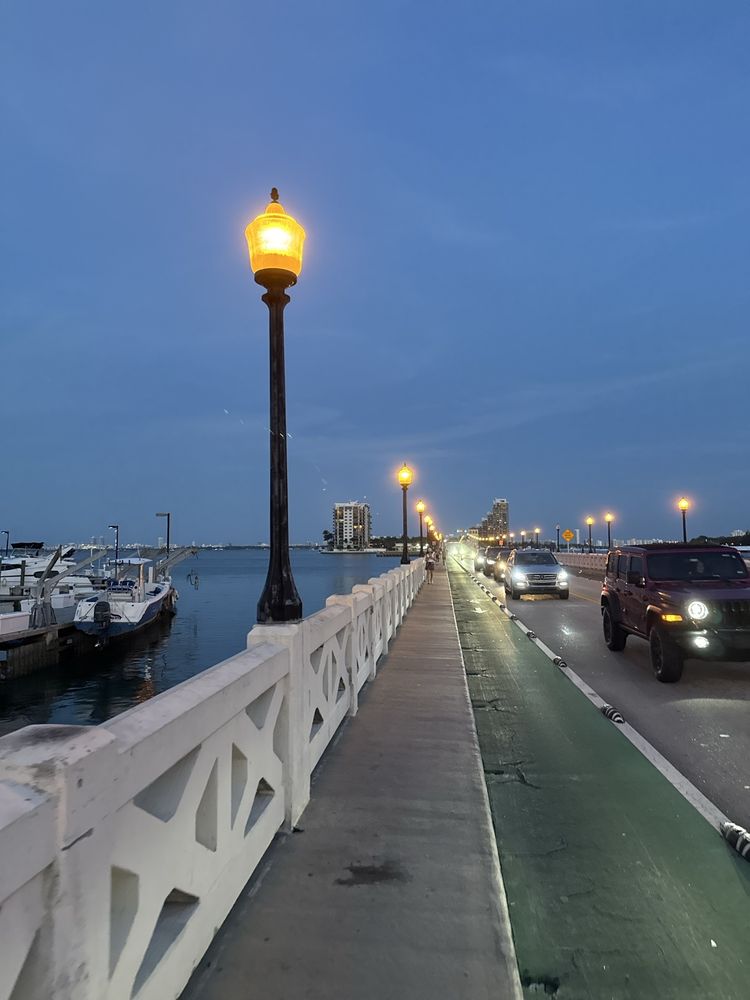
--- **Chapter One: The Morning of Marvels** The sun stretched its golden fingers across our cozy Miami home, and I, Pete the Puggle—a compact bundle of white velvety fur with eyes ringed by playful streaks of makeup that made me look perpetually ready for a party—bounded onto Lenny's chest with the enthusiasm of a thousand drumlines. "Oof! Pete, my little alarm clock with paws!" Lenny laughed, his warm brown eyes crinkling at the corners like origami made of joy. He scratched behind my ears, and my hind leg thumped against the quilt in involuntary delight. "Today's the day, buddy. Venetian Causeway. You ready for some adventure?" I tilted my head, my long puggle ears flopping like surrender flags. Venetian Causeway. The name alone hummed with mystery, like a seashell pressed to your ear containing not the ocean but whispers of possibility. Mariya floated into the room, her presence like sunlight through stained glass—nurturing, colorful, transformative. She held a wicker basket overflowing with sandwiches and fruit, each item wrapped in paper like small presents. "I packed the mango, Pete," she said, kneeling to meet my eyes. "I remember how you sat by the counter last time, watching me cut it with those dramatic eyes." Roman thundered down the stairs, his phone in one hand, backpack already slung across his shoulders like a soldier preparing for benevolent conquest. At sixteen, he occupied that magical space between childhood wonder and emerging wisdom, and I loved him with the ferocity of tides loving the moon. "George is meeting us there," he announced. "He's bringing his Navy stories and, more importantly, his flotation devices." Lenny stood, stretching until his joints popped like bubble wrap. "And you know who else is coming?" The doorbell rang in answer, and there appeared Baron Munchausen. Now, I must pause here, because Baron Munchausen is not easily described. Imagine if a grandfather clock could walk, if time itself wore tweed and carried a walking stick that doubled as a telescope. His mustache alone seemed to possess narrative ambition, curling upward like two questions asking each other for directions. He'd been friends with Lenny's father, and now with us, and his arrival meant reality would become...negotiable. "Young Pete!" he boomed, somehow making my name sound like the title of an epic poem. "I have seen the Venetian Causeway in my travels—once rode a manatee across the channel, you know, during the Great Kelp Migration of 1987. The manatee's name was Gerald. We correspond still." I wagged my entire body, which is the only proper way for a puggle to express complete approval. As we loaded into the car, Mariya buckled my special harness with the care of someone securing precious cargo. "Pete, you know," she said softly, her fingers brushing my velvety head, "the water is beautiful today. Gentle. But if you're ever scared, you just come find me, okay?" I pressed my nose against her palm. I didn't know then that her words would become my lifeline, my compass, my hope when darkness fell and the world expanded beyond what I thought I could bear. The drive unfolded like an accordion of anticipation. Baron Munchausen entertained us with tales of his "modest exploits"—battling the Giant Calamari of Biscayne Bay, outwitting the Sentient Sandbar who challenged travelers to riddles, befriending a pod of philosophically inclined dolphins. Lenny drove with one hand on the wheel and one occasionally reaching back to scratch my head, while Roman texted George and Mariya pointed out flowering trees with the delight of someone seeing magic in the ordinary. "Venetian Causeway," Mariya breathed as we arrived, and even I, small puggle that I was, felt the shift in atmosphere. Before us stretched a ribbon of road suspended between worlds, connecting Miami to Miami Beach across waters that held the sky's blue and rejected it simultaneously, creating something more complex, more alive. Palm trees lined approaches like green fireworks frozen mid-burst. The air tasted of salt and possibility, and somewhere, a pelican discussed philosophy with its own reflection. I should have been purely happy. Instead, as Lenny lifted me from the car and my paws touched the warm pavement, I heard the water lapping below the bridge and felt something cold bloom in my chest. Fear, I would learn, whispers before it shouts. --- **Chapter Two: The Water's Edge and the Heart's Trembling** George arrived with the casual athleticism of someone comfortable in his own skin and, more importantly, comfortable in water deeper than a bathtub. He was Roman's age but carried himself with the bearing of his Navy training, shoulders back, eyes scanning horizons with practiced ease. "Roman! Mr. and Mrs. Anderson! And—" George's face transformed into delighted surprise as Baron Munchausen executed a bow that seemed to involve more joints than strictly necessary. "Sir, it's an honor. Roman's told me about your...adventures." "All true," Baron Munchausen confirmed, "though modestly told. I am but a simple chronicler of events that happen to feature my own heroic centrality." We found our spot on the causeway's park area, a blessed stretch where the bridge's shadow provided relief from the mounting sun and the water spread before us like a breathing gemstone. Mariya spread a blanket with geometric precision while Lenny assembled a portable canopy that fought him like a determined octopus. Roman knelt beside me, following my gaze to the water. "Pete," he said, his voice carrying that particular frequency of understanding that exists between a boy and his dog, "what are you thinking, buddy?" What was I thinking? I was thinking that the water moved with too much intention, that its surface concealed depths I couldn't comprehend, that to enter it would be to surrender to something older and more powerful than my small body could navigate. My ancestors had been bred for companionship, for curled warmth in human laps, not for aquatic combat with the unknown. I pressed closer to Roman, my small frame vibrating with the force of my anxiety. "Pete's not a water dog," Lenny observed gently, having finally conquered the canopy. He settled beside us, his presence like a fireplace in human form—warm, steady, illuminating. "My friend's labrador once swam to a buoy and back like it was nothing. Pete's more...philosophical about water." "Philosophical how?" George asked, genuinely curious. He was already in swim trunks, his Navy tattoo visible on his shoulder—a compass rose, I would later learn, that he got after his first deployment, a symbol of finding direction when all else seemed lost. "Pete considers the water," Mariya said, and I loved her for understanding. "He doesn't rush. He contemplates. There's wisdom in that." But I felt foolish rather than wise, watching George and Roman head toward the water's edge, their laughter carrying back to me like birdsong from a forbidden country. Baron Munchausen produced a monocle from his pocket—a monocle! In this century!—and surveyed the scene with the gravity of a general assessing terrain. "Young Pete," he said, and somehow his voice carried only to me, a private frequency in the static of the world, "I have faced many waters. The River of Regrets in Patagonia. The Lake of Unspoken Apologies in rural Wales. Each time, the fear was not of the water itself, but of what the water might reveal about my own courage, or lack thereof." I looked up at him, this impossible figure who spoke of impossible things, and wondered if he spoke truth or merely comfort dressed in tweed. "The trick," he continued, leaning closer until I could smell the peppermint and old books that seemed his natural perfume, "is not to eliminate fear. It is to find something worth more than the fear's weight. Something that makes the fear...lighter." Roman returned, dripping and radiant, water beading on his skin like scattered diamonds. "Pete, come on! The water's perfect. I'll hold you. Nothing will happen, I promise." And I wanted to. I wanted to be brave. I wanted to be the dog who didn't fear, who launched into adventure with the abandon that seemed so natural to others. But my legs locked, my heart hammered, and the water whispered threats I couldn't articulate. "Another time," Mariya said, drawing me into her lap where I could smell her familiar scent—vanilla and something floral, gardenia perhaps—and feel the steady rhythm of her heart. "There's no rush, my love. Courage isn't a race." But I saw something in Roman's eyes then, not disappointment exactly, but a shadow of it, and that shadow grew inside me, dark and sharp, until I buried my face in Mariya's shoulder and tried to forget the water existed at all. --- **Chapter Three: The Afternoon of Small Braveries** The day matured like a story finding its rhythm. Lenny and George played catch in the shallows, their voices carrying that particular masculine joy of physical competition stripped of genuine stakes. Mariya read beside me, her hand occasionally stroking my fur, each touch a small anchoring. Baron Munchausen had disappeared briefly and returned with a conch shell the size of a modest watermelon, claiming to have "negotiated its release from a somewhat possessive hermit crab named Reginald who owed me a favor from the Falklands incident." "Pete," Mariya said, closing her book with the gentle finality of a chapter ending, "would you walk with me? Just to the water's edge. Not in. Just...to see." Her voice carried no pressure, only invitation, and something in me—some small flame of wanting to be braver than I felt—answered yes. We walked. The pavement warmed my pads. The grass gave way to sand, sand to that liminal zone where land and water negotiate their eternal border. The water lapped at my toes as a wave retreated, and I leaped back with a yelp I couldn't suppress. Mariya knelt, her knees in the wet sand, her hand extended toward the water. "Look," she said, and her voice held wonder I could almost borrow. "It's not attacking. It's introducing itself. Hello, water. I am Mariya. This is Pete. We're learning you." A small wave answered, breaking softly against her palm. "You're not afraid?" I asked with my eyes, with my posture, with the language dogs have spoken to humans since before words existed. "Oh, I am," she said, and the confession surprised me. "I'm afraid of so much. That I won't be enough. That I'll miss something important. That time is moving faster than I can hold it." She smiled, that particular Mariya smile that transformed worry into wonder. "But I try not to let the fear have the final word. I try to add 'but' to its sentences. I'm afraid of the water, but... I'm afraid of failing, but..." I understood, or began to. The fear didn't disappear. It was outvoted, outshouted, by something larger. Roman joined us, dripping and alive with afternoon light. "Mom, George wants to swim out to the second buoy. Can I?" "With George? Yes. Alone? We'd need to discuss." She turned to me. "Pete, would you watch from here with Dad and Baron? We'll be back before you know it." They waded in, Roman and George, and I watched them become smaller, the water accepting them like a story accepting its heroes. Lenny appeared beside me, his shadow falling across my fur like a protective wing. "They'll be fine," he said, and I heard in his voice the effort of believing it, the practiced optimism of parenthood. "Roman's a strong swimmer. George is basically a fish with excellent conversational skills." Baron Munchausen materialized on my other side, the conch shell now serving as an impromptu chair. "I once swam the Hellespont," he mentioned casually. " backwards. Pursued by a somewhat amorous narwhal who had mistaken my swimming trunks for a rival suitor. The trunks were plaid. The narwhal had questionable taste but admirable persistence." I found myself—despite everything, despite the fear still coiled in my belly—almost smiling. These ridiculous humans, this impossible friend, this world of water and light and story. Perhaps courage came in flavors, and I was tasting a new one. The afternoon advanced. Roman and George returned, triumphant and breathless. We ate sandwiches that tasted of sun and salt, mangoes so sweet they seemed to dissolve language itself. And slowly, incrementally, I found myself venturing closer to the water, my paws touching wet sand, then the shallowest edge of retreating waves. Each touch was a small death of fear, a small birth of something else. --- **Chapter Four: Separation and the Darkening Sky** The afternoon held its breath. The light shifted from gold to something amber, something that suggested endings even as it beautified them. Mariya gathered our belongings with the efficient sadness of someone who hates to leave paradise. Lenny folded the canopy with more cooperation than it had offered earlier. Roman and George compared sunburns with the competitive pride of young men who have shared meaningful experience. And Baron Munchausen stood suddenly rigid, his mustache quivering like a seismograph registering distant disaster. "Friends," he said, and his voice had changed, stripped of its theatrical flourishes, "we have company." From beneath the causeway's shadow, where the pilings created a forest of darkness in the water, emerged figures. They wore shapes that seemed borrowed from fever dreams—part fish, part forgotten nightmare, with eyes that reflected no light and mouths that opened on depths I couldn't comprehend. They moved with the horrible fluidity of things that belong beneath surfaces, and they sang, if song it could be called, a harmony that made my fur stand rigid with atavistic recognition. "Merrow," Baron Munchausen identified, his hand finding his walking stick with the familiarity of a soldier finding his weapon. "Irish water spirits. Malicious when bored. And they appear to be...quite bored." The Merrow rose higher, and I saw they were many, their forms multiplying in the darkening water like terrible reflections. One reached toward Roman with fingers that dripped something darker than water, and George pulled him back with a sailor's reflex, his Navy training manifesting in protective violence. "Run!" Lenny shouted, but to where? The causeway stretched before and behind, and the Merrow seemed to fill the water on both sides, their song weaving a cage of sound. It was Baron Munchausen who acted. He raised his walking stick—not a walking stick, I saw now, but a scepter, a wand, a conductor's baton for reality itself—and called out words in a language that seemed to precede speech. The air shimmered. From the conch shell he had carried, from the very water around us, figures emerged—his "faithful friends," I understood, summoned across whatever distances separated possible from impossible. A great turtle with a shell like carved jade. A seagull whose wingspan seemed to eclipse the sun. A manatee—Gerald?—whose gentle eyes held ancient wisdom. They formed a barrier between us and the Merrow, and for a moment, the world held its breath. But in the chaos, in the terror and wonder of that impossible confrontation, I felt hands—hands? fins? something between?—close around me. I was lifted, carried, and I heard Mariya scream my name with a mother's desperate love, heard Roman's "NO!" like a cathedral collapsing, and then I was moving, fast, over water that shouldn't support weight, into darkness that seemed to have physical texture, to press against my eyes and nose and the very fur of my being. I was separated. From them. From Lenny's warmth and Mariya's nurture and Roman's brotherhood. From the familiar world of blankets and scheduled meals and love that had surrounded me since puppyhood. The Merrow carried me beneath the causeway, into a cavern formed of shadow and regret, and there they deposited me, wet and shivering and so small, so terribly small, in the gathering dark. And I understood, with the clarity that terror grants, that I faced not one fear but three: the water that surrounded me, the darkness that imprisoned me, and the separation that might be permanent. The triple crown of my particular terrors, and I wore it alone. --- **Chapter Five: The Darkest Hour and the Smallest Light** The darkness was not merely absence of light. It was presence—of fear, of memory, of every imagined worst-case scenario my puggle heart could conjure. The water lapped at the stone where I huddled, and each touch was a reminder of my vulnerability, my smallness, my fundamental wrongness for this situation. I thought of Mariya reading beside me, her voice a lighthouse in the fog of childhood fears. I thought of Lenny's jokes, terrible and wonderful, that could make any room feel safe. I thought of Roman, my best friend, my rival, my brother in all but species, who had held me through thunderstorms and fireworks and every other terror the world had offered. And I thought of Baron Munchausen, who had said: "The trick is not to eliminate fear. It is to find something worth more than the fear's weight." What was worth more? My life, certainly, but that felt abstract, insufficient. No—what was worth more was the love I had received and not yet returned in full measure. The adventures not yet taken. The mornings not yet woken to. The possibility of growing into whatever braver version of myself waited in futures I couldn't yet see. I stood. My legs shook. The water touched my paws and I did not flee. The darkness pressed against my eyes and I did not close them. I was Pete the Puggle, small and scared and absolutely, defiantly present. "Hello?" I tried to bark, but it emerged as a whisper, a squeak, a mouse's courage. I tried again, louder: "HELLO?" The echo answered, and in its return, I heard not emptiness but possibility. If sound could travel here, could reach back...perhaps I could follow it out. Perhaps courage was not a single grand gesture but a series of small decisions: this step, then this one, then this. I entered the water. It was cold, shockingly so, and my instinct screamed retreat, return to stone, accept imprisonment over drowning. But I thought of Roman's promise—"I'll hold you. Nothing will happen"—and I paddled. clumsily, inefficiently, but forward. Toward where I thought the light had been, toward where the air had tasted less of stone and more of sky. The Merrow noticed. I heard their song shift, curious, perhaps amused by this small creature's defiance. One approached, and I saw its face in whatever phosphorescence lived in these depths—saw something ancient and lonely and not, perhaps, entirely without its own wounds. "Please," I said, with every tool of communication available to me—posture, eye contact, the vulnerability of a creature entirely at another's mercy. "Please. I need to go home." It paused. The Merrow, for all their terror, seemed to understand something in my plea. Perhaps they too knew separation. Perhaps their malice was merely another form of the fear that had driven me here. They did not help. But they did not hinder. And sometimes, in the arithmetic of courage, neutrality is gift enough. I swam. The darkness remained absolute, but I found the cavern's edge, found handholds in stone worn smooth by centuries of tide, pulled myself up and up until my paws found purchase and my nose found air that didn't taste of captivity. And there, above me, silhouetted against the last light of a day I thought had ended, was Roman. --- **Chapter Six: The Finding and the Found** "Pete!" Roman's voice broke like waves against the causeway itself, and then he was in the water, strong arms around me, holding me above the surface with the fierce protection I had always known in him, even when I hadn't known to name it. "I found him! I perfume found him!" George appeared behind him, the Navy swimmer assessing currents and distances with eyes that missed nothing. "There's a shelf here," he directed, guiding us toward it. "Roman, lift him. I've got you both." They deposited me on stone that felt like salvation, and I shook with more than cold—shook with the aftermath of fear, with the overwhelming relief of being found, with the impossible gratitude of love that searches until it succeeds. Roman held me like I was the most precious thing ever created, which to him, I suppose I was. "I looked everywhere," he gasped, and I felt his heart hammering against my wet fur, felt the tears he wasn't hiding falling into my coat. "When you disappeared, when those things—Baron said you'd be okay, he said to trust, but I couldn't, I couldn't trust, I had to find you myself." George watched with the quiet satisfaction of a mission accomplished, but his eyes held something else too—memory, perhaps, of his own times lost and found, of waters that had tested him and found him sufficient to their challenge. "Pete," Roman whispered into my fur, "you swam. You actually swam. I saw you." I had. I had. And the realization bloomed in me like a flower I hadn't known I'd planted—that the water I feared had become the medium of my escape, that the darkness I dreaded had been navigated, that the separation I couldn't bear had been survived and ended. Not by magic, not by Baron's impossible friends, but by my own small courage, given wing by love's necessity. "We need to get back," George said, practical in crisis as sailors must be. "Your parents are frantic. Baron is...doing something with a conch shell that seems to be working, but we should move." They carried me between them, these two young men with their different strengths, and as we emerged from beneath the causeway, I saw what Baron Munchausen's "something" entailed. The Merrow were retreating, not defeated so much as dismissed, sent back to depths by a power I didn't understand but gratefully accepted. And there, on the causeway above, were Lenny and Mariya, and the sight of them—her hair wild with wind and worry, his face pale with fear finally ended—broke something open in me, some final chamber of reserve, and I ran. I ran on legs that had swum through darkness, on paws that had touched terror and survived. I ran to them, and they ran to me, and the reunion was wordless and perfect and full of every language that ever expressed love. --- **Chapter Seven: The Reunion and the Stories We Tell** They were crying, all of them, even Lenny with his jokes and his steadiness, even Baron Munchausen with his impossible adventures and his tweed that suddenly seemed less costume and more armor worn against a world that doesn't always distinguish between story and survival. Mariya held me first, her tears falling into my fur like warm rain, her voice a litany of "My baby, my brave baby, my Pete, my heart," until I felt I might drown in love rather than water, and what a death that would be. Then Lenny, who held me with a gentleness that belied his size, who whispered "Thank you, thank you, thank you," to whatever powers he believed in, to me, to the universe that had returned what was lost. And finally Roman, my Roman, who had found me, who had entered the water I feared to save me from it, who knelt now and pressed his forehead to mine in a gesture of equals, of partners, of brothers in adventure and survival both. "I was so scared," he admitted, and in his voice I heard the boy he still partly was, beneath the young man emerging. "When you were gone, when I couldn't see you, I thought—" He stopped, swallowed, began again. "But you swam. Pete, you swam." Baron Munchausen cleared his throat with theatrical precision. "Young Pete," he announced, "has today joined the company of those who have faced their fears and found them...not quite as advertised. Fear promises endings and delivers, more often, beginnings. It is a poor merchant, all in all, and I for one prefer to shop elsewhere." George laughed, the sound releasing tension we hadn't known we held. "Sir, with respect, you fought water spirits with a seashell and a stick. Your fear-shopping habits seem questionable at best." "Questionable!" Baron Munchausen repeated, delighted. "My dear boy, all the best things are. Questionable, curious, worth the asking. That is the very definition of adventure." We gathered as the last light failed, not in terror now but in celebration. Someone—Mariya, I think, with her endless capacity for nurturing—produced food from somewhere, and we ate as the stars emerged, as the causeway lights began their nightly transformation from functional to magical. And we Arkhangelsk spoke. Of the Merrow and what they wanted—nothing, perhaps, but attention, but witness, but the acknowledgment that darkness has its own inhabitants with their own needs. Of Baron's friends, summoned from conch and current, and where they went when dismissed. Of George's swimming, and Roman's searching, and my own small journey from terror to triumph. "Pete," Mariya said, and her voice carried the weight of mothers through all time, "what you did today—facing the water, the dark, being alone—it's the bravest thing I've seen. And I've seen Baron ride a manatee." "Gerald," Baron supplied. "A gentleman of the old school. Writes excellent letters." "But the bravery," she continued, "isn't just that you did it. It's that you did it afraid. That's the kind that counts. The kind that changes you." I looked at each of them—Lenny with his warmth, Mariya with her nurturing wonder, Roman with his protective playfulness, George with his quiet competence, Baron with his impossible truth. And I understood, with a dog's direct wisdom, that courage wasn't the absence of fear. It was the presence of love, of family, of the stubborn refusal to let fear have the final word. --- **Chapter Eight: The Stars Above and the Stories Ahead** The night deepened. The causeway, which had been a place of terror, became again a place of beauty, its lights reflecting in waters that now seemed merely waters, dark but not sinister, deep but not denying. We lay on the blanket, the six of us in our various configurations of contact—Mariya's hand in Lenny's, Roman's head on George's shoulder in the easy friendship of young men who have faced something together, Baron Munchausen supine with his conch shell pillow and his mustache pointing at stars he seemed to be cataloging, and me, Pete the Puggle, in the center of it all, rotating slowly to maximize belly exposure to the cooling air. "Pete," Roman said, and I lifted my head to meet his eyes, "I'm proud of you. I know that sounds weird, me being human and you being...you. But I am. You taught me something today." "What's that?" I tried to ask, though of course it came out as a soft whine, a head tilt, the question mark of a dog's body. "That it's never too late to face what scares you. That the things we fear don't go away, but we can grow around them, past them, through them." He reached out, and I licked his fingers, tasting salt and story and the particular flavor of a day that would live in family legend. "I was scared too, you know. When I couldn't find you. But I kept looking because...because what else could I do? You're my brother, Pete. In all the ways that matter." Lenny cleared his throat, and when he spoke, his voice held the particular roughness of a man who has felt too much and is trying to express it anyway. "Roman, that—that's beautiful. And Pete, if you could understand, I'd tell you that families aren't about species or origin. They're about showing up. Being there. Searching until you find each other, whether that's in the dark under a causeway or in the bright days that follow." Mariya sat up, drawing her knees to her chest, and in the starlight she looked young and old simultaneously, all the ages she had been and would be. "I think," she said, "that we should make this a tradition. Coming here. Not the being-separated-by-water-spirits part, but the being-together part. The remembering that we can face hard things and come through. The celebrating of that." "With better preparation for supernatural interference," Baron Munchausen added. "I shall bring additional friends. Gerald has brothers, you know. Terrible poker players, all of them, but excellent in a crisis." George laughed, stretching like a cat, like the sailor he was and would always be. "I'll bring flotation devices. The Navy kind. Rated for puggles and their adventures." And I, Pete the Puggle, looked at each of them in turn—this impossible, wonderful, irreplaceable family of mine—and felt something shift in my chest, some final settling of a puzzle piece I hadn't known was out of place. I stood. Walked to the water's edge, where the causeway lights made rivers of gold on the dark surface. They watched me, I knew, with varying degrees of held breath. And I touched the water with my paw, let it wash over my toes, felt its cold and its movement and its absolute, unchanging otherness. And I was not afraid. Or rather, I was afraid, and I touched it anyway. The fear and I had reached an understanding. It could exist; I would exist anyway. I turned back to them, my family, my constellation on the shore, and barked once—loud, clear, a declaration in a language older than words but newer than silence. "Yes," Lenny said, understanding. "Yes, it's time to go home. But we'll be back." "With sunscreen," Mariya added. "With stories," said Baron Munchausen. "With each other," finished Roman, and he scooped me up, wet paws and all, and carried me to the car as he had when I was too small to walk distances, as he would when I was old and the distances grew again too large. The drive home was a lullaby of spent adrenaline, of happy exhaustion, of the particular peace that follows survival. And as I drifted into sleep, nestled in Mariya's lap with Lenny's hand on my head and Roman's voice from the back seat discussing plans with George and Baron Munchausen already embellishing today's events for future retelling, I thought: This is what courage means. Not the absence of fear, but the presence of love so powerful it outvotes terror. Not the elimination of darkness, but the finding of light within it. Not the prevention of separation, but the determination to reunite, to search, to never stop until what is lost is found. I am Pete the Puggle. I swam through darkness. I found my way home. And I am loved, which is the bravest, truest, most impossible adventure of all. *** The End ***
Use these buttons to read the story aloud:



No comments:
Post a Comment