"***The Velvet-Nosed Explorer: Pete's Grand Adventure at Vizcaya***"🐾


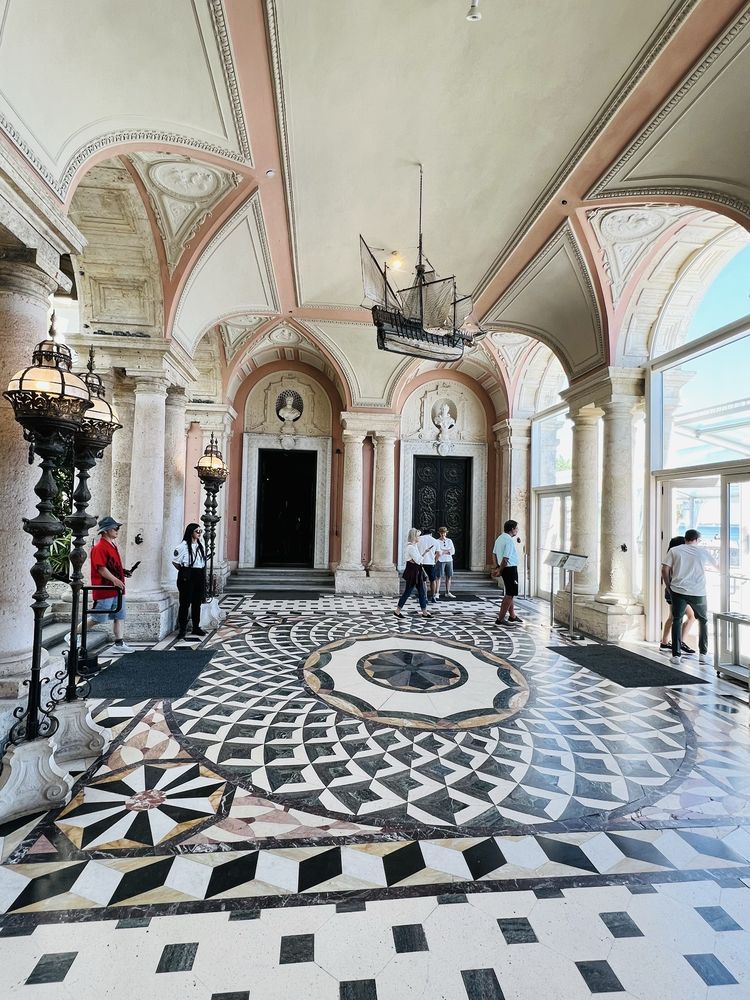
--- **Chapter One: The Morning of Marvels** The sun rose like a golden egg cracking open over our little house, spilling yolky warmth across my short, velvety white fur. I stretched my paws toward the ceiling—each toe spreading like tiny flower petals waking to greet the day. Today was the day. I could feel it in my twitching tail, in the way my ears perked without even deciding to perk. We were going somewhere MAGICAL. "Pete! Pete, buddy, wake up!" Roman's voice tumbled down the hallway like a cascade of marbles, bright and bouncing. His sneakers thump-thump-thumped against the wooden floor, each step carrying him closer to where I lay on my favorite cushion, the one that smelled like every adventure we'd ever had and every snack I'd ever stolen. I bounded from my cushion just as Roman's door flew open. There he was, my older brother, my best friend, my sometimes rival in the great championships of backyard racing. His dark hair stood up like he'd been electrocuted by excitement, and his grin could have powered the whole neighborhood. "Today's the day, Pete!" he announced, dropping to his knees so we were eye to eye. His fingers found that perfect spot behind my ears, the one that made my back leg thump-thump-thump like a drummer in a parade. "We're going to Vizcaya! It's this HUGE old mansion with gardens like something from a fairy tale. Mom says there are secret paths and fountains and—" he paused, leaning closer, his breath warm and minty, "—a real stone barge in the water. Like a boat that never sails." My tail, which had been wagging with the fury of a thousand windmills, suddenly stilled. Water. The word sat in my stomach like a cold pebble. Water meant the thing I couldn't see through, the thing that moved without legs, the thing that tried to swallow my paws when we'd visited the beach last summer. I remembered the wave—higher than a fence, noisier than thunder—crashing over my head, pulling me under, tumbling me like I was nothing but a leaf. I'd coughed and sputtered and Roman had scooped me up, but the fear had planted itself deep, a seed of ice in my warm puppy heart. Roman noticed. He always noticed. His thumb traced the worry line between my eyes, smoothing it away. "Hey," he said softly, "the water's just for looking today, okay? We'll stay on the paths. Promise." I licked his nose—once, twice, a puppy's seal of agreement—and tried to believe the promise would hold. Downstairs, the kitchen hummed with morning symphony. Mariya hummed something that sounded like sunshine, her curly hair escaping its clip as she packed what she called "adventure sustenance"—which basically meant sandwiches and apple slices and something she whispered was "just for Lenny" that smelled suspiciously like cookies. Lenny himself sat at the table, newspaper folded in that way adults do when they're really reading the same paragraph four times because they're thinking about other things. His glasses slid down his nose as he looked up, and his whole face crinkled into a smile like a present being unwrapped. "Pete the Puggle!" he boomed, his voice warm as a fireplace in winter. "Ready to explore a castle?" I barked—because how else does one properly answer such a question?—and performed my signature spin, the one that always made Mariya laugh and Roman roll his eyes in that way that meant he secretly loved it. "Easy there, spinning top," Mariya laughed, catching me mid-twirl and pressing her forehead to mine. Her skin smelled like lavender and love. "Vizcaya has been standing for a hundred years. It'll wait for you to arrive at a normal speed." But I couldn't wait. Adventure was calling in a voice louder than any fear, and I intended to answer. The car ride felt like forever and no time at all, the way dreams feel when you're having the good kind. We passed buildings that grew older as we drove, streets that whispered stories in Spanish and English, palms that waved goodbye to the city and hello to something greener, wilder, more waiting. When the car finally stopped, I pressed my nose to the window—cool glass fogging with my breath—and gasped in puppy language, which is mostly just very intense sniffing. Before me rose Vizcaya. Not just a house. A DREAM made of stone and time and impossible beauty. Turrets reached for clouds like fingers stretching after stars. Gardens spilled down to meet water that glittered not with threat, but with the broken-gold of afternoon light. It was terrifying in its grandeur, this place, the way true beauty always is—demanding something of the heart just to witness it. "Welcome to our adventure, little man," Lenny said, lifting me from the car with gentle hands. "What do you think?" I thought: I am small. I am very small. But I am here. And that, I was learning, was always enough to begin. --- **Chapter Two: The Gardens of Whispered Secrets** The gardens of Vizcaya breathed like a living thing. Not the shallow breath of sleep, but the deep, rhyming inhale-exhale of something ancient and aware. Maze hedges rose around us, green walls that seemed to lean close to share confidences. Paths of crushed shell crunched beneath our feet—mine, Roman's, Lenny's, Mariya's—each step a small breaking, a small becoming. "Look at this!" Mariya breathed, her camera clicking like a mechanical heartbeat. She was always seeing things others missed: the way light fell through a banyan tree like liquid honey, the face of a stone cherub weathered smooth by decades of rain, the precise shade of bougainvillea that existed nowhere else in the world but here, now, in this corner of Vizcaya. "Lenny, look—do you see how the arch frames the water? It's like a painting that chose to be three-dimensional." Lenny looked, really looked, the way he did when Mariya pointed out wonder. His arm found her waist automatically, a habit of love so practiced it had become bone-deep. "I see it," he said, and his voice carried that particular softness it got when he was moved past joking. "I see everything when you show me." Roman made a gagging sound, but he was smiling, and I was too busy rolling in something delightfully earthy-smelling to properly commit to the eye-roll he was performing for no one. "Pete!" Roman's voice sharpened, but not mean-sharp—worry-sharp, the kind that cut through my bliss like a quick blade. "Come on, buddy, stay with us. This place is... it's big. Easy to get turned around." I bounced to his side, shaking dirt from my fur with the satisfaction of a job well done, and we pressed deeper into the garden's embrace. That's when I heard it. Or rather, *her*. The bark was unlike any I'd heard—not the yipping of small dogs with more courage than sense, not the deep warning of guard dogs protecting what was theirs. This was a bark like cello music, rich and resonant and somehow elegant even in its enthusiasm. Curiosity pulled my ears forward like satellite dishes tuning to a frequency I didn't know I needed. Around the corner of a hedge sculpted into impossible swirls, she appeared. An Italian Mastiff, her fawn coat catching sunlight and transforming it into something almost luminous. Her jowls gave her a permanently thoughtful expression, but her dark eyes sparkled with intelligent mischief. She moved with the unhurried grace of someone who knew exactly how much space she deserved in the world. "Well," she said, her voice warm honey over gravel, "you're either very brave or very lost, little white one." I opened my mouth to respond—perhaps something witty about adventure, perhaps simply to introduce myself like a normal puppy—and what emerged was a squeak of such profound awkwardness that I wanted to bury myself in the nearest flowerbed. Roman's eyebrows climbed his forehead. "Pete? You okay, dude?" But I was frozen, caught in the tractor beam of her gaze, my heart hammering against my ribs like a bird trying to escape a cage made of my own shyness. "I'm Luna," she said, settling onto the path with the comfortable solidity of a statue come to warm life. "And you are...?" "P-P-Pete," I managed, then, gathering the tattered remnants of my dignity: "Pete the Puggle. Explorer. Adventurer. Teller of tales." I puffed my chest, which was difficult given that it was approximately the size of a dinner plate. Luna's laugh was like wind chimes in a gentle breeze. "A storyteller? How fortunate. I was hoping for entertainment. These gardens grow tedious when you've memorized every hedge." We walked together then—Luna and I, with Roman keeping pace and trying not to grin at my obvious infatuation, the traitor. Luna showed us hidden corners of Vizcaya that no map marked: a fountain where stone frogs eternally spat streams of water, their expressions of eternal surprise unchanged by decades; a wall where some long-ago gardener had trained jasmine into the shape of a heart, now so overgrown it looked like a green explosion of affection; a secret bench beneath a ficus tree so old its roots had cracked and lifted the very path we walked. "You're different from other puppies I've known," Luna observed as we rested by a koi pond, orange fish moving below like slow flames. "Most your size are... louder. More desperate to prove themselves." I considered this, watching golden light shatter and re-form on the water's surface. "Maybe I'm still deciding what to prove," I said, and the words surprised me with their truth. "And to whom." Luna's dark eyes held mine, and in them I saw something like recognition. "Perhaps," she said softly, "the bravest proof is the one we offer ourselves." Before I could fully process this—before I could decide if it was profound or simply confusing in that way adults and elegant mastiffs sometimes were—Roman's pocket buzzed with the distinct sound of parental concern. "That's Mom's text tone," he said, phone already in hand. "They've found the stone barge. Want to meet them?" He looked at me, then at Luna, then back at me with deliberate slowness. "Unless you two need more... quality time?" I nipped his ankle, gently, the way friends do. Luna rose with that effortless grace, and together we followed the path toward where the gardens gave way to water. But I noticed, even as we walked, how the paths twisted and turned upon themselves like thoughts half-completed. How easy it would be, in the growing dusk, to lose the way back. Some part of me, the part that remembered cold waves and tumbling darkness, whispered a warning I couldn't quite ignore. --- **Chapter Three: The Barge of Stone and Shadow** The stone barge rose from the water like a fossilized dream, its edges worn soft by time and tide and the patient work of weather. Once, Luna explained as we approached, it had hosted real boats at its mooring; now it served as impossible garden, stone sailors eternally frozen in their duties, stone mermaids forever reaching toward horizons they'd never reach. "Oh, Pete," Mariya breathed when she spotted us, her relief like a visible thing, bright and warm as a lantern. "I was starting to worry. This place..." she gestured at the overwhelming grandeur around us, "...it's easy to lose track." "Lost in beauty," Lenny intoned, then winked at me. "Better than lost in the grocery store, which happened to a certain someone last Tuesday." "Dad, that was you," Roman pointed out. "And I found the frozen pizzas just fine, didn't I?" The afternoon had begun its slow surrender to evening, light shifting from gold to something more amber, more precious because it was fleeting. We explored the barge together, Luna included now in the easy way of dogs adopted into human families for an afternoon—Mariya finding her water dish, Lenny offering scraps of sandwich, Roman narrating the history he'd read on the drive over. "The guy who built this, Deering, he wanted to bring Europe to Florida. All the old money, new world stuff." Roman ran his hand along stone worn smooth by countless touching hands. "Kinda beautiful, right? Wanting something so badly you build it from nothing." "Or sad," Mariya said gently, her photographer's eye finding angles of light and shadow that told stories the builders never intended. "Never being able to visit the real thing, so building a dream instead." "Dreams are real enough," Lenny said, and his voice carried that weight it got when he spoke from experience rather than joke. "They're where we practice being brave. Being who we hope to become." I thought of my own dreams—watery, tumbling, breathless—and shivered despite the warmth of the stone beneath my paws. As if summoned by my thought, the sky shifted. Not dramatically, not storm-sudden, but with the gentle inevitability of evening deepening into something closer to night. Clouds that had been decorative grey gathered weight and intention. The first drops of rain found us—gentle, exploratory, then insistent. "Quick!" Mariya gathered her camera into its case with practiced efficiency. "The main house—we can wait it out in the courtyard!" We moved as one, or tried to. But Vizcaya's gardens, so welcoming in sunlight, became labyrinthine in the gathering dusk. Paths that had seemed clear doubled back upon themselves. Hedges that had framed views now blocked them. The rain intensified, no longer gentle but drumming, insistent, a thousand tiny fingers tapping every surface. And then—in a moment I would replay a thousand times in the hours to come—a flash of white deer (or was it a statue come to sudden life? a trick of rain and failing light?) darted across our path. Luna gave chase, her elegant form suddenly all instinct, all motion. And I—caught between my new friend and my family, between wonder and worry—I ran after her. "Pete! NO!" Roman's voice reached me, but I was already committed, already running, paws sliding on wet shell-path, heart hammering with something I couldn't name. The deer—or whatever it was—vanished between hedges too narrow for Luna's broad shoulders. She stopped, frustrated, and I caught up panting, already turning to find my way back. But the rain had washed away scent-marks. The dusk had stolen landmarks. And when I tried to retrace our path, every direction looked equally possible and equally wrong. "Luna?" My voice emerged smaller than I wished, swallowed by rain and growing dark. "Do you know...?" But Luna, city-raised and garden-bored, was already turning in confused circles, her elegant confidence crumbling like wet paper. We were lost. I was lost. The words sat in my mouth like stones. And then the true darkness came—not just the darkness of clouded evening, but the darkness of a power outage somewhere distant, the few garden lights that had begun to glow suddenly extinguished, leaving us in a blackness so complete it felt like being buried alive. My breath came short, fast, panicked. The dark was not just absence of light but presence of threat, of every nightmare I'd ever half-remembered upon waking. And beneath the fear of dark, deeper still, the ancient terror of separation—from Roman, from Lenny's warm laughter, from Mariya's lavender-scented comfort, from the only family I'd ever known. I did not hear Luna calling my name. I did not feel her nosing my trembling form. I was already somewhere else, somewhere smaller, somewhere the world was ending in silence and I could not even scream. --- **Chapter Four: The Valley of Shadows** The darkness had texture, I discovered in my panic. It pressed against my eyes like velvet soaked in ice water. It filled my ears with the amplified sounds of my own breathing—ragged, desperate, the breathing of something small and hunted. It smelled of wet earth and ancient stone and the particular mustiness of gardens left too long untended. "Pete! PETE!" Luna's voice reached me as if from very far away, though I knew she stood beside me, could feel her warm bulk occasionally brushing my trembling shoulder. I wanted to respond, but my voice had retreated to some bunker deep in my chest, hiding from the dark as I longed to hide. "Pete, please," Luna's cultured tones frayed at the edges, revealing the puppy beneath the poise, "we need to move. The rain is slowing. If we follow the wall—" But I couldn't move. My paws had rooted to the spot, grown into the path like the ancient banyan trees we'd marveled at earlier. Every instinct screamed *stay still, stay hidden, predators find the moving ones*—even as my heart shattered with missing my family, with the image of Roman's face when he realized I was gone, the particular way his eyes would crinkle with worry before the smile could reach them. "I can't," I finally managed, the words barely more than exhaled breath. "I can't, Luna. The dark—it's too—" I couldn't finish. The dark was too everything. Too complete. Too much like water, that other terror, in the way it surrounded and consumed without being anything you could fight. Luna settled beside me, her warmth a small island in the freezing sea of night. "I know," she said, and something in her voice made me listen past my panic. "I know, Pete. When I was small—smaller than you'd believe, given my current magnificence—I was trapped in a supply closet. During a thunderstorm. For hours." She laughed, but it held no humor, only the echo of old fear. "The dark became... not just absence. A presence. Something waiting." I turned my head toward her voice, finding the barest suggestion of her form in the slightly-less-black of the rain-slowed sky. "How did you...?" "I didn't," she admitted. "Not really. I still flinch when doors close too quickly. But I learned something, in that closet, waiting for morning. Something your Roman will be learning now, I think." "What?" The word barely qualified as speech, a thread of sound. "That the dark doesn't end things. It just... pauses them. The people who love us don't stop loving us because they can't see us. The sun doesn't stop existing because clouds hide it." She nudged me gently, her jowls soft against my ear. "Your family is looking for you right now. I can hear them, I think, even if I can't see them. Can you try to listen?" I closed my eyes—ridiculous, in darkness already complete—and forced my breathing slower. In. Out. The way Mariya had taught me during fireworks, pressing her calm against my trembling like a physical weight. And beneath the rain's slowing patter, beneath my own thundering heart, I caught it: distant voices, fragmented by garden walls and hedge-mazes, but unmistakable. "—can't have gone far—" "—Roman, stay with your mother, I'll check the—" "—PETE! PEEEEETE!" Roman's voice, cracked with a fear I'd never heard in it before, not even when I'd swallowed the sock that required the emergency vet. Something in me—something that had been frozen, something that had been small—stirred. "They're scared," I whispered, understanding finally cutting through my own fear's thick fog. "They're scared too." "Yes," Luna agreed simply. "And we're scared too." "Also yes." "But..." I stood, shakily, my legs uncertain but functional. The dark pressed, but I pressed back. "But we're not... we're not helping, are we? Being scared here, alone, not even trying to find them or let them find us." Luna rose beside me, her bulk reassuring even in invisibility. "What do you want to try?" I thought of Roman's face when he'd taught me to swim—no, not taught, supported, held me above the water until my frantic paddling found rhythm, until I realized the water could hold me if I stopped fighting it. The memory of that trust, that surrender, warmed something in my chest that the dark couldn't touch. "Your nose," I said, suddenly certain. "It's better than mine in this... this everything. Can you find the water? The barge? We started from there. They'll look from there." Luna's tail—I'd never seen her properly wag it, but I felt it now, brushing my flank like a friendly flag—moved with what I chose to interpret as approval. "The water," she repeated. "Yes. I can find that. Even I, city-bred and garden-bored, can find the sea." We moved together through the dark, Luna leading with cautious steps, me pressed close enough to feel her guidance without sight. The fear didn't disappear—it never does, I was learning, it just makes room for other things. Courage, Mariya would say, isn't absence of fear. It's fear walking forward anyway. The path seemed endless, twisted by darkness into something almost malevolent. Every sound magnified: our own passage loud as thunder, small creatures in the undergrowth sudden heart-attack surprises, the eternal whisper of rain-slowed-to-drizzle on a million leaves. And beneath it all, growing stronger as we walked, the particular sound of water moving against stone. "There," Luna breathed, and we emerged onto a view I almost recognized—the barge's outline visible now against a sky lightening with distant breaking. The storm was passing. The world remained. And on the barge's edge, silhouetted against the barely-there light, a figure I knew even before it turned, even before the voice cracked across the water like hope itself: "PETE!" --- **Chapter Five: The Swim of Trust** Roman's silhouette moved with the desperate grace of someone who has been still too long, who has been hoping against hope and now must act upon that hope's fulfillment. He stumbled across the barge's uneven surface, the same surface we'd explored so casually in afternoon light now treacherous with rain and dark and haste. "Stay there! Pete, stay, I'm coming—" But between us lay water. The water I feared with the whole of my small being, the water that had birthed my nightmares of tumbling and breathlessness. Even as my heart leaped with joy at his voice, my body locked with terror at what separated us. The barge's edge dropped off to blackness, to the unknown depth where stone met sea. I could smell it now—that particular salt-and-stone scent that meant water, meant danger, meant everything my instincts screamed to flee. "Pete," Luna's voice behind me, steady despite her own uncertain journey, "he'll go around. He'll find the path. You don't have to—" But I saw Roman's shape at the barge's edge, saw him gauging the distance, saw his courage matching my own fear and raising it. He would come for me. He had always come for me. The beach, the closet (his, not mine, but fear is fear), the dark times when only his hand in my fur made the world bearable. And I thought: what if I came for him, just this once? The decision moved through me like light through water, slow and refracted and beautiful in its terror. I took a step toward the barge's edge. Another. The stone beneath my paws ended, and there was only the drop, only the waiting dark water, only every nightmare made manifest. "Pete, NO, don't—" But I was already committed, already falling, and the water took me like a cold hand closing, and I was tumbling, tumbling, just like before, but this time I knew how to swim, this time I knew the water could hold me if I let it, if I trusted, if I just— My head broke surface, my paws finding rhythm, and I was MOVING, across the impossible distance, toward the shape that was Roman, that was home, that was everything the fear had tried to make me forget. The swim was eternity and moment, fear and exultation, death and life intertwined like the garden's jasmine vines. Water in my eyes, in my nose, the taste of salt and ancient stone and something else—victory, maybe, or simply the taste of not-drowning, of continuing, of courage's first sweet reward. Then Roman's hands, strong and certain, lifting me from the water's final grasp, pressing me to his chest where I could hear his heart hammering a mirror to my own, where I could feel the shudder that meant he'd been crying, or nearly, the way big brothers do when they're old enough to know they shouldn't. "Pete, you stupid, brave, impossible little—" His words dissolved against my wet fur, his face buried in my neck, and we were both shaking, both breathing, both alive in a way that felt newly minted, newly real. Behind us, Luna's bark—relief, I recognized, the elegant composure cracked to reveal the devoted heart beneath. She'd followed, somehow, found her own path around, and now stood witness to whatever came next. "Your friend?" Roman managed, lifting his face finally, one hand still anchoring me to his chest. "My friend," I confirmed, when I could speak again. We found Lenny and Mariya by following Luna's unerring nose through paths now navigable in the storm's wake. Mariya's cry when she saw us—Roman carrying me, both of us bedraggled and triumphant—would have woken the stone sailors if they had any life to wake. Her embrace encompassed us both, Lenny's longer arms wrapping around all of us, Luna included in the general chaos of relief. "I found the main power switch," Lenny was explaining, even as he held us, "flipped it back on, but by then—" "By then you'd already gone after him," Mariya finished, looking at Roman with something beyond pride, beyond love, something that recognized the adult emerging from the child. "You both did. You both found each other." We made our way finally to the courtyard, where emergency candles flickered (the power still uncertain) and staff moved with the efficient concern of people who'd done this before. Someone brought towels—real towels, for dogs and humans alike—and someone else produced hot drinks that steamed in the suddenly-cool post-rain air. And we talked. Or rather, they talked, and I listened, and Luna listened, and occasionally we contributed observations that went uncommented-upon by the humans who couldn't quite translate. The talking was important, I understood even then. The putting into words of fear and relief and the particular madness of the last hours. "I couldn't stay still," Roman was saying, his hand never quite leaving my fur, as if confirming my continued existence. "Like, physically couldn't. Mom kept saying wait for Dad, wait for the staff, but I kept thinking—what if he's scared? What if he's alone and scared and thinking we don't want to find him?" "And you," Mariya turned to me, her eyes wet with unshed tears or recently shed ones, "you came through the water. You, who wouldn't set paw in the shallows last summer." I met her gaze, then Roman's, then Lenny's where he sat with Luna's massive head in his lap, her eyes closed in bliss at the attention. "I had to," I wanted to say, and perhaps something in my expression conveyed it, because Roman laughed—that particular laugh that meant he'd understood something about me that surprised him. "You had to," he repeated, and pressed his forehead to mine as the rain had pressed earlier, but warm, so warm. "Because you're the bravest little idiot I've ever loved." The night deepened toward something like peace. The power flickered back to full life, making everyone cheer with the particular joy of modern people reminded how much they depend on light. The gardens, visible through courtyard arches, glistened with rain-washed renewal, every leaf a promise, every stone a kept secret. Luna found my paw with hers, pressing gently. "Your family," she said, and I heard the slight wistfulness beneath her grace, "they're worth the water. Worth the dark." "They're worth everything," I agreed. And meant it more than I'd meant anything, more even than my next breath. But the night held one more lesson, one more transformation. Because as we prepared to leave, as Lenny gathered our scattered belongings and Mariya checked her camera for water damage and Roman lifted me for the final time (he thought) into his arms—I saw the real barge again, the one in the water beyond the courtyard, and I asked, with every line of my small body, to be set down. Roman, exhausted, hesitated. But he'd learned something too, in this night of learning. He set me at the barge's edge, where water lapped with gentle invitation, where the dark had retreated to mere night, no longer absolute but friendly, familiar, a blanket rather than a wall. And I walked to where the stone met the sea, and I let the water touch my paw—not the terror of before, not the desperate swim, but simply touch, simply be, simply exist in relation to me without my fear defining that existence. The water was cold. The water was alive. The water was not, I finally understood, my enemy. It was just water. Just one more thing in a world full of things, some frightening, some beautiful, most both at once. I stood there until Roman came and stood beside me, until Mariya captured the moment (camera miraculously functional), until Lenny made some joke about sea puppies that made even Luna's eyes crinkle with doggy amusement. And I knew, as the stars began their slow emergence from cloud-break, that I would carry this night inside me forever. Not as trauma, though it would always be that too. But as proof. As the first chapter of a braver story than I'd known I could live. --- **Chapter Six: The Courage of Return** The days that followed our adventure blurred like watercolors left in rain—beautiful, indistinct, touched with the particular melancholy of experiences too intense to quite believe. We returned to our little house, to routines that should have felt confining after Vizcaya's grandeur but instead felt precious, earned, a home we'd almost lost and therefore valued more. I found myself changed in ways I couldn't always articulate, even to Luna when she visited (her human, it turned out, worked in Vizcaya's preservation department, making her garden-wandering more legitimate than we'd assumed). The water that had been terror became... not comfort, never quite that, but possibility. I could approach the bathtub now without the trembling that once seized me. I could watch rain without retreating to my cushion's supposed safety. But the dark remained. The dark, and something else—the separation, the moment of being alone in a world that suddenly felt too large and too indifferent. These returned in dreams, in sudden moments of panic when Roman left a room without immediate explanation, in the way I'd wake from napping to check that everyone was where they should be, that the family remained intact, that I hadn't been left behind again. "Pete," Mariya observed one morning, finding me checking rooms at an hour when even the sun seemed lazy, "you're carrying something heavy for such a small back." She sat with me on the kitchen floor, cross-legged in her pajamas, and I curled into the space made by her knees, breathing her in—lavender, yes, but also coffee and sleep and the particular scent of morning-before-the-world-demands. She didn't force interaction, simply existed in my presence, her hand finding my ears in that rhythm that had soothed me since puppyhood. "I can't take it from you," she said eventually, and her voice had that quality it got when she spoke truths rather than comforts. "The fear, the memory, whatever happened out there in the dark. But Pete—" she lifted my chin until our eyes met, "—you don't have to carry it alone. None of us do. That's what family means. That's what we learned too, that night. Roman running off alone, your father and me not knowing if—" Her voice caught, the first time I'd heard it, that crack beneath the calm. "We all have our dark water, sweet boy. The courage is in showing it to each other." I pressed closer, understanding and not-understanding in the way of dogs and children and anyone who loves without the protection of full comprehension. She held me until Lenny's footsteps announced coffee-need, until Roman's alarm finally dragged him from dreams, until the house filled with the particular music of family beginning another ordinary day. But the conversation stayed with me, as Mariya's conversations always did, working below consciousness like garden roots seeking water. And when Roman proposed a return visit to Vizcaya—"just to see it in daylight, properly, without the whole almost-dying thing"—I found myself not refusing, not even particularly afraid, but simply... considering. "You're sure?" Roman asked, watching me with the particular intensity he'd developed since our separation. He'd changed too, I'd noticed. Less likely to disappear into headphones without explanation, more likely to announce his movements, to check my location, to make the small reassurances that fear had taught him mattered. "We don't have to. We could go to the beach, or just walk around the neighborhood, or—" But I was already moving toward the door, toward the car, toward whatever came next with the courage of someone who'd already survived the worst and found, on the other side, not just survival but transformation. The drive felt different this time. The same streets, the same growing-old of buildings, the same palms waving their eternal goodbyes. But I watched from Roman's lap rather than pressing nose to glass, observed rather than anticipated, present in a way that felt new and precious. Vizcaya in full daylight, power fully restored, held different magic than our storm-touched introduction. The gardens revealed themselves in detail impossible in dusk and rain—the precise geometry of hedges, the intentional wildness of planted areas, the way every view had been composed like a painting, every path designed to unfold in careful sequence. Luna met us at the entrance, her tail moving with genuine pleasure at the sight of us, her form somehow even more elegant in sunlight's honesty than in shadow's mystery. "Returned to the scene of your triumph?" she teased, but her eyes held something softer, something that recognized the courage of return. "Returned to see it properly," I corrected, and led the way into gardens that had once been maze and now were simply... beautiful. Challenging, yes, in their complexity, but not threatening. The dark corners held no special menace in daylight, and I found myself exploring them with genuine curiosity rather than anxious hurry. We found the barge, its stone sailors still frozen, its mermaids still reaching. The water around it moved with gentle invitation, and this time I accepted—not the desperate swim of before, but a careful wading at the edge, Roman beside me every moment, his hand ready though I didn't need it, his presence enough. "Look," he said, pointing to where small fish moved in the shallows, their scales catching light like scattered jewelry. "You'd never have seen them, before. You'd have been too—" "Scared," I finished, when he couldn't find the word. "I would have missed them." The realization settled like peace into my chest: fear had cost me more than momentary comfort. It had cost me fish like living jewels, the particular cool of water on hot fur, the weightless joy of floating supported by something larger than myself. Not every fear could or should be conquered—some dangers were real, some boundaries worth maintaining. But the fear that prevented experience, that shrank the world to manageable terror rather than expanded it to possible wonder—that fear, I was learning to release. Luna waded beside me, her greater bulk creating ripples that passed me like friendly greetings. "You're different," she observed, not for the first time, but now with something like satisfaction. "Less proving, more being." "Less small puppy," I agreed, "more... I don't know. Is there a word for not-small-but-still-small?" "Growing," she said simply. And we watched the fish together, two dogs in impossible gardens, learning to be brave in new ways each day. --- **Chapter Seven: The Garden of Full Circle** Our final visit to Vizcaya came not by plan but by invitation—a special evening event, the gardens lit by thousands of small lights, music drifting from the main house like invitation made audible. Mariya's photography had caught attention, some local feature wanting to capture the magic of the place under starlight, and we'd been included as her "inspiration team," which basically meant we got to dress up and eat fancy snacks. I should have been afraid. Evening meant darkness, and darkness had been my terror, the absolute absence that swallowed family and hope and self alike. Evening meant separation risk, the possibility of losing my way, of finding myself alone in a world grown suddenly hostile. But I found, as the car carried us toward the familiar grandeur, that the
Use these buttons to read the story aloud:



No comments:
Post a Comment