"*** Pete the Puggle's Brave Adventure at Bay Ridge Promenade ***"🐾


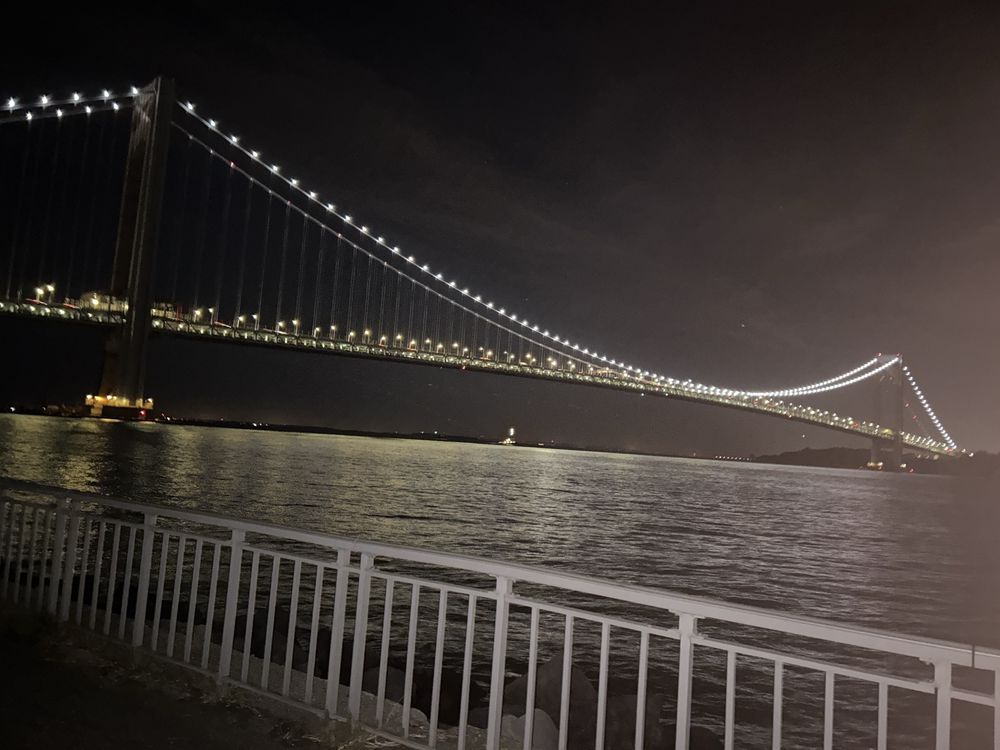
--- ## Chapter One: The Promise of Adventure The morning sun spilled golden light across our Brooklyn apartment like honey dripping from a jar, and I, Pete the Puggle—a compact bundle of white velvet fur with expressive brown eyes ringed by my signature playful streaks of makeup—pressed my nose against the window glass, watching the world wake up. The Verrazzano-Narrows Bridge loomed in the distance, its towers catching the dawn like twin crowns of silver and rust. "Today's the day, little brother!" Roman announced, bursting into my field of vision with the energy of a thousand bouncing tennis balls. At sixteen, my older brother moved through the world with the easy confidence of someone who had never met a wave he couldn't conquer or a basketball hoop he couldn't reach. He ruffled the fur between my ears, and I responded by licking his entire face in one enthusiastic swipe. "Roman, let him breathe," came Mariya's warm voice from the kitchen, where the scent of scrambled eggs and something cinnamon-sweet danced through the air like invisible ribbons. My mother moved with the grace of someone who found poetry in grocery lists and magic in morning routines. Her dark hair was already escaping its braid as she packed what she called "adventure essentials" into a canvas tote bag. "Pete, come see what I found for you." I trotted over, my claws clicking a happy rhythm on the hardwood floors, and she presented me with a tiny orange life vest, complete with a handle on top. "For the bravest puggle in Brooklyn," she whispered, fastening it around my chest. It felt strange, like wearing a hug that hadn't decided whether to squeeze or let go. Lenny emerged from the bedroom, my father's laughter preceding him like a marching band's opening notes. "Well, look at you, Captain Pete! Ready to sail the seven seas?" He knelt down, his weathered hands gentle as he adjusted my vest. His eyes, the color of warm coffee, held that particular twinkle that meant a joke was coming. "Why did the puggle bring a ladder to the promenade?" I tilted my head, playing along because his joy was contagious as spring rain. "Because he heard the bay was *deep*!" Lenny roared with laughter, slapping his knee, and despite myself, I let out a bark that sounded suspiciously like a giggle. Roman's phone buzzed, and his face lit up like the Fourth of July. "George is meeting us there! I told you he'd come." George, Roman's friend from the Navy, represented something mythic to me—a human who had actually lived on the ocean, who spoke its language, who could hold his breath longer than I could hold a squeaky toy. I'd heard stories: George swimming through currents that would swallow boats whole, George teaching rescue techniques, George with shoulders like a harbor wall and a laugh that could charm seagulls. The car ride wove through streets I knew by heart and yet never tired of exploring. Brooklyn unfolded like a storybook—brownstones with their stoops like open arms, bakeries sending out invitations of fresh bread, the park where I'd once chased a squirrel who mocked me from a branch. But today felt different. Today hummed with possibility, with the particular electricity of adventure that made my tail thump against the seat like a metronome set to "excited." "Nervous about the water, Pete?" Mariya asked from the front seat, her intuition sharper than my puppy teeth on a new toy. She glanced back, her eyes catching mine in the rearview mirror's reflection. I wanted to say no. I wanted to be brave, to be the adventurer they believed me to be. But the truth sat heavy as a stone in my belly: I had never been swimming. The bathtub was one thing—that contained world of warm water and rubber ducks. But the actual bay, with its tides that pulled like invisible hands and depths that swallowed the sun's reflection whole? The very thought made my paws sweat. Roman must have felt me tense, because his hand found my scruff, kneading gently. "Hey," he said softly, the way he did when I woke from nightmares of vacuum cleaners and thunder. "George will be there. And me. We've got you." His words were a rope bridge across a canyon, and I held them tight as we turned toward the water, toward the promise and terror of the unknown. --- ## Chapter Two: First Sight of the Bay The Bay Ridge Promenade unfolded before us like a ribbon of hope stretched along the edge of the world. The stone walkway curved with the coastline, lined by black iron railings that stood like sentinels between the civilized world and the wild blue yonder. The Verrazzano-Narrows Bridge dominated the horizon, its cables swooping in majestic parabolas that seemed to sing with the tension of holding two boroughs in conversation. Below it, the Narrows churned—gray-green today, flecked with white caps that danced like scattered pearls. I stood at the edge of the promenade, my paws on the cool stone, and felt the world tilt. The water stretched to a horizon that bent with the earth itself, and I understood in my bones how small I was, how the stories of George's ocean stretched beyond anything my puppy imagination could hold. "Pete! Pete!" The voice boomed like friendly thunder, and I turned to see George materializing from the parking area, all broad shoulders and sun-browned skin and a smile that crinkled the corners of his eyes. He wore a faded Navy t-shirt and shorts that revealed legs carved by actual swimming—muscles upon muscles that made my own stubby limbs feel like pipe cleaners. He knelt before me, proper and respectful, extending a hand for my inspection. "So this is the famous Pete," he said, his voice carrying the rhythm of someone who had shouted against ocean winds and learned to make every word count. "Roman wasn't lying. You do have the most dramatic eye makeup in Brooklyn." I preened, because compliments are like treats for the soul, and this one was particularly well-crafted. "George was a rescue swimmer," Roman explained, his voice threaded with that particular admiration older brothers reserve for their heroes. "He'd jump out of helicopters into storms. He's basically Aquaman." "Retired Aquaman," George corrected, though his grin suggested he didn't mind the comparison. "Now I just swim for fun. And to keep this one from drowning," he added, nudging Roman, who flushed red as a fire hydrant. Lenny and Mariya set up our base camp—a colorful quilt spread on the grass near the railing, a cooler that promised sandwiches and cold drinks, a canvas umbrella that snapped open like a flower blooming in fast-forward. The rhythm of family settled over us: Lenny's humming as he organized, Mariya's gentle commands about sunscreen and hydration, Roman's restless energy that kept him pacing the edge of our blanket like a lion cub at the zoo. I ventured to the railing, drawn and repelled by equal measure. The stone was warm beneath my paws, radiating the morning's accumulated heat. Below, the water lapped against the rocks in a language I couldn't translate—sometimes gentle as a lullaby, sometimes sharp as a warning. The smell hit me in layers: salt sharp enough to taste, something green and growing, the distant perfume of diesel from a passing barge. "Intimidating, isn't it?" George appeared beside me, not looming but present, reading my body language with the trained eyes of someone who had assessed struggling swimmers in dark water. "The first time I saw the open ocean, I was smaller than you. My grandfather took me to Coney Island, and I stood at the water's edge for an hour, just watching." I looked up at him, this giant who had once been small and afraid. "The water doesn't care if you're scared," he continued, his voice dropping to a confessional register. "It doesn't care if you're brave. It just is. The trick isn't to conquer it—that's Navy talk, mission accomplished nonsense. The trick is to learn its language. To move with it instead of against it." He pointed to where the current split around a rock formation. "See how it flows around obstacles instead of fighting them? That's the secret. Not strength. Adaptability." His words nested in my chest like seeds waiting for rain. I wanted to believe him. I wanted to be the kind of puggle who danced with water instead of fleeing from it. "Pete!" Roman's call came, and I turned to see him at the water's edge, shoes off, pants rolled to his knees, waving me toward him with the enthusiasm of someone who had never considered that the ocean might not want to be his friend. "Come feel it! It's amazing!" I stood frozen, my life vest suddenly feeling like a costume on the wrong actor, my courage leaking out through my paws into the warm stone beneath me. --- ## Chapter Three: The Terror Takes Hold I forced my legs to move, one paw in front of the other, the way I'd seen humans do when they approached things that scared them—doctors with needles, children with dark closets, soldiers with letters from home. Each step felt monumental, as if I were climbing a mountain rather than crossing flat ground to reach my brother's outstretched hand. The water reached for Roman's ankles, and he laughed as it retreated, leaving patterns in the wet sand that looked like fingerprints left by some enormous hand. "Come on, buddy! It's not cold at all!" But I stopped at the line where dry sand became wet, where the ocean's breath reached furthest on the inhale. From here, the water was no longer a picturesque postcard or a poetic metaphor. It was alive—pulling, reaching, hungry in a way that had nothing to do with malice and everything to do with the indifferent power of nature. A wave, larger than its fellows, surged forward. It wasn't large by any objective measure—perhaps six inches of foam and follow-through—but to my puppy perspective, it was a wall of liquid glass crashing toward me with the inevitability of bedtime when you're not sleepy. I yelped, a sound that escaped before I could swallow it, and scrambled backward, my claws raking furrows in the sand. "Whoa, whoa, Pete!" Roman was there, scooping me up before I could flee entirely, holding me against his chest where I could hear his heart beating steady as a metronome. "Hey, hey, it's okay. I've got you. I've got you." But I was shaking, embarrassingly, thoroughly shaking, my small body vibrating like a tuning fork struck too hard. The water had touched my paw when I retreated, a cold kiss that lingered like a threat, and now that paw felt wrong, foreign, marked by something I couldn't name. "Maybe not today," Lenny said, appearing with the quiet solidity that defined him, his hand finding the spot behind my ears that always soothed. "There's no rush, Pete. The promenade will be here tomorrow. And next week. And when you're old and gray and telling your grandpups about the time you almost went swimming." His joke landed gently, without force, and I managed a weak tail wag. But inside, a shame spiral wound tight: I was supposed to be brave. I was Pete the Puggle, adventurer, storyteller, the dog who faced vacuum cleaners with relative dignity. And I couldn't even touch water? Mariya appeared with a towel, wrapping me like a burrito, her chin resting atop my head. "My brave boy," she whispered, and I wanted to correct her—*not brave, not brave at all*—but her certainty felt like a blanket I could hide under. George knelt nearby, respecting the family bubble, his expression thoughtful rather than pitying. "You know," he said, addressing me directly, "in rescue training, we learned that panic kills more people than water. Panic makes you fight when you should float, struggle when you should rest. The ones who survive aren't always the strongest swimmers. They're the ones who can calm their minds enough to remember what they know." He pulled a small object from his pocket—a smooth, gray stone with a hole worn through its center. "I found this in Okinawa. During a storm so bad they called off training. I was terrified, honestly. Shaking like you are now. But I held this stone, felt its weight, its reality, and reminded myself: I am here. I am real. The fear is real too, but it's not the only thing that's real." He placed the stone in Roman's palm, who then pressed it into my paws. It was cool, heavier than expected, solid in a way that contrasted with everything the water represented. A hole stone, they called it, or a hag stone—depending on which grandmother's stories you believed. A window, a way through, a reminder that even the most solid things can be shaped by patience. I clutched it as the afternoon wore on, a talisman against the fear that still lurked at the edges of my consciousness. We picnicked on the quilt, George and Roman taking turns throwing a frisbee, Lenny napping with his hat over his face, Mariya reading aloud from a dog-eared novel about faraway places. Normalcy wrapped around me, and gradually my breathing steadied, though I kept one eye on the water, watching it, learning its patterns the way George had suggested. The sun began its descent, painting the sky in watercolors of apricot and rose, and something shifted in the air—a cooling, a settling, the day's accumulated heat beginning to release its hold on the stone. My family began packing, the lazy rhythm of afternoon giving way to the purposeful movements of departure. And then: chaos. --- ## Chapter Four: Lost in the Gathering Dark It happened in the space between heartbeats. Lenny lifted the cooler, Mariya gathered the quilt, Roman turned to call George who had wandered down the beach to retrieve a lost flip-flop. I stood at the edge of our encampment, the stone still clutched in my paws, and something caught my attention—a flash of silver in the water, a fish perhaps, or sunlight on a bottle. I moved to investigate, because curiosity is both my greatest gift and my most dangerous trait. The water lapped at the wet sand, and I followed it, mesmerized by the way the light fractured and reformed. Each step was small, cautious, the memory of my earlier fear still fresh. But the water seemed gentler now, almost inviting, and I found myself at the very edge where the sand grew slick and the world grew wet. "Pete?" Roman's voice, distant, concerned. I turned to respond, to reassure, but my paw slipped on algae-slicked rock, and suddenly I was in motion—not chosen, not brave, simply falling. The water closed over my head like a door slamming shut. Cold. That was the first sensation, shocking as a scream in a library. Then: disorientation, the world become green and formless, sound transformed into pressure and vibration. My life vest buoyed me upward, but my panic fought it, my legs thrashing in patterns that had nothing to do with swimming and everything to do with desperation to find ground where there was none. I broke surface, gasping, and the world had transformed. The promenade was visible but distant, the figures there small and indistinct. A current I hadn't felt from shore tugged at me, persistent as a hand closing around my ankle, pulling me parallel to the shore rather than toward it. "ROMAN!" I barked, but the sound emerged as a water-choked cough. Darkness was falling like a curtain being drawn, the sunset's colors deepening toward something more ominous. The lights along the promenade flickered on, distant stars that seemed to recede as I watched. And the water, which had seemed merely intimidating before, now revealed its true nature: vast, indifferent, capable of holding secrets in its depths for eternity. I thought of George's stone, still somehow clutched in my paw, and his words: *The fear is real, but it's not the only thing that's real.* But what else was real? I couldn't feel anything but cold and fear, see anything but the darkening sky and the lights that marked safety I couldn't reach. A wave lifted me, gentle now, almost soothing, and deposited me against something hard. My paws found purchase—rocks, barnacle-rough and slippery but solid. I clung, trembling, to a small outcropping that emerged from the water like a finger pointing upward. It was barely enough, the waves still reaching for me with each surge, but it was something. It was here. It was real. The dark deepened, and with it came a new fear, older and more primal than the water: the fear of being alone in darkness, separated from my pack, from the warmth and love that defined my world. Every snap of wave against rock became a monster's footfall. Every distant light became a will-o'-the-wisp, promising what it couldn't deliver. "Mom," I whispered into the dark, though no human could have heard. "Dad. Roman." The names were prayer and confession, hope and despair braided together. I thought of Lenny's terrible jokes, delivered with perfect timing. Mariya's hands, capable of anything from surgery to scratching exactly the right spot. Roman's voice, calling me *little brother* as if it were the most natural thing in the world. The stone in my paw grew warm, or perhaps I simply grew cold enough that anything seemed warm by comparison. I remembered George's voice: *Not strength. Adaptability.* I couldn't swim to shore. The current was too strong, my energy too depleted, my fear too fresh. But I could hold on. I could breathe. I could watch the lights and know that somewhere, people were looking for me, missing me, loving me. And in that holding on, in that simplest of acts, I found something unexpected: a kind of courage that didn't feel like courage at all. It felt like exhaustion. Like stubbornness. Like the refusal to let go of a warm stone in cold water. But it was enough. It was here. It was real. --- ## Chapter Five: The Search and the Finding On shore, the world had fractured. "Pete!" Roman's voice cracked across the evening, carrying that particular note of panic that only teenagers and parents truly understand—the sound of a heart recognizing that something loved might be truly lost. "Pete!" He had turned from retrieving George's flip-flop to find empty space where I had been, the quilt already folded, my absence a hole in the world that his mind immediately filled with every nightmare scenario. "He was just here," Lenny was saying, his usual joviality stripped bare, replaced by the focused intensity of a father who would move mountains if only he knew which mountain to move. "I saw him. Two minutes ago. Three at most." Mariya's face had gone pale beneath her summer tan, her hands already moving in that way they did when she was planning, organizing, refusing to let chaos win. "Spread out. He can't have gone far. He—" Her voice caught, a rare falter, before steadying. "He knows not to go in the water. He's scared of the water." The words hung between them, accusation and explanation simultaneously, and Roman felt his heart clench with guilt so sharp it could draw blood. He had pushed. He had wanted me to be brave like George, to love the water the way he did, and he had missed the signs—the trembling, the retreat, the way I had clutched that stupid stone like it could save me from everything. "Flashlights," George said, his Navy training kicking in with the smooth efficiency of muscle memory. "Roman, you check the parking lot side. Lenny, the picnic area. Mariya, stay here in case he comes back. I'll search the waterline." He moved with purpose, but his eyes scanned the dark water with the trained assessment of someone who had looked for bodies before and found them, who knew how quickly hope could become something else entirely. The lights along the promenade cast long shadows, turning the world into a place of edges and darkness, of possibilities that multiplied rather than narrowed. "George!" Roman's voice, high and broken, found him at the water's edge. "I have to go in. I have to—" "You're not a strong enough swimmer for night rescue," George said, not unkindly but absolutely. "And the current's running east. If he's in the water..." He didn't finish, didn't need to. But Roman was already moving, wading into the dark water that had taken his brother, his best friend, the small creature who had taught him more about love than any human ever had. The cold hit his legs, then his waist, and he understood for the first time what I had faced—that shock of temperature, the way the ground suddenly became uncertain, the primal wrongness of being where humans and puggles were not meant to be. "Roman, stop!" George's command carried the weight of authority, but Roman kept moving, swimming now with the desperate energy of someone who would rather drown searching than live with not having tried. George caught him, strong arms wrapping around his chest, pulling him back toward shore despite his struggles. "You can't help him if you're dead," George hissed in his ear. "Trust me. I've lost people. I've found people. Let me do what I know." And in that moment, Roman understood something about his friend that he'd never fully grasped—the cost of those rescue stories, the nights of wondering, the faces of those not found that haunted the faces of those who were. George wasn't being cruel. He was being honest, and in that honesty was a different kind of love. They searched the waterline methodically, George's flashlight cutting arcs through the darkness, illuminating nothing, then nothing, then—"There!" The light caught on white fur, on the orange of a tiny life vest, on eyes that reflected back with the eerie glow of animals in darkness. I was clinging to my rock, shivering so hard my teeth chattered audibly even across the distance, but I was there. I was real. I was found. Roman plunged into the water without hesitation, swimming strongly now with direction and purpose, and I felt my heart crack open with relief so intense it felt like another kind of fear. He reached me, his hands gentle but firm, lifting me onto his chest where I could feel his heart racing as fast as my own. "I've got you," he gasped, treading water, holding me above the surface. "I've got you, little brother. You're safe. You're safe." George reached them, his longer strokes covering the distance efficiently, and his large hands provided additional support, forming a human-puggle float that moved steadily toward shore. I clutched Roman's shirt, my stone still somehow in my paw, my body convulsing with cold and reaction and the delayed terror of what I had survived. The walk back to shore took forever and no time at all. My feet found sand, solid and real and the most beautiful texture I had ever felt. Roman collapsed with me in his arms, both of us gasping, both of us crying in our different ways. "Pete," he kept saying, pressing his wet face against my wet fur. "Pete, Pete, Pete." I had no words, only the capacity to lick his chin, to press my small body as close to his larger one as possible, to absorb his warmth and his living heartbeat and the reality that I was not alone, not lost, not finished with my story. --- ## Chapter Six: The Courage to Return The hospital was warm and bright and full of smells that made my nose twitch—antiseptic and anxiety and the particular scent of humans in waiting. A kind veterinarian had checked me, pronounced me shaken but miraculously unharmed, wrapped me in heated blankets that felt like being hugged by the sun itself. My family surrounded me, a constellation of love and worry. Mariya's hands never stopped moving over my fur, as if confirming again and again that I was solid, present, whole. Lenny's jokes had returned, but strained at the edges, his need to make things okay warring with the reality that some things take time to become okay. Roman sat closest, still in his wet clothes, his hand resting on my back where he could feel my breathing. And George, my unexpected guardian, sat slightly apart until I whined and wiggled until he understood he was needed, was wanted, was part of this circle of relief. "I was so scared," Roman said suddenly, breaking the conversational surface like a diver emerging. "When I thought—when I thought I might not—" He couldn't finish, his voice cracking like thin ice. "I know," Lenny said, and his simplicity carried more weight than paragraphs of philosophy. "We all were." "But I was scared before," Roman continued, looking at George, at me, at the space between us where the water had been. "I was scared of the water too. I just didn't admit it. I pretended to be brave because—because George is brave, and I wanted to be like him." George shifted, uncomfortable with the weight of admiration. "I'm not brave," he said quietly. "I'm trained. There's a difference. Bravery is what Pete did out there. Holding on. Not giving up. I just know techniques." "Bravery is both," Mariya said, her voice carrying the authority of someone who had delivered babies and comforted the dying, who understood the spectrum of human and animal courage. "The trained response and the untrained heart. The willingness to try, and the willingness to admit when you're in over your head." She looked at me, and I met her eyes, understanding passing between us. I had been in over my head, literally and figuratively, and I had survived not because I conquered my fear but because I acknowledged it, worked with it, held onto my warm stone and waited for help. The next morning dawned gray and uncertain, rain threatening in the heavy clouds that pressed down on the city. I woke in Roman's bed, still wrapped in my heated blanket, his arm draped protectively over my small form. The memory of yesterday's terror lurked at the edges of my consciousness, but something else lurked there too—a curiosity, a what-if, the first fragile shoot of something that might grow into courage. "Want to see it in daylight?" Roman asked, reading my body language with the intimacy of shared experience. I did. I didn't. I did. The promenade was different in the gray morning, stripped of yesterday's romantic lighting, revealing itself as simply what it was: a human construction at the edge of a natural force, a negotiation between civilization and wilderness. The water moved under the overcast sky like liquid slate, and I could see now how the current flowed, where the safe edges were, where the dangers lurked. George waited at our spot from yesterday, his posture easy but his eyes alert. "I wondered if you'd come," he said to Roman, then knelt to address me directly. "And I wondered if you'd want to try again. On your terms. No pressure. No expectations." I looked at the water. It was the same water that had nearly taken everything from me, that had shown me darkness and cold and the particular loneliness of being small in a large world. But it was also the water that had carried me to my rock, that had held me up when my legs gave out, that had ultimately brought my brother to my side. The stone was in my paw again, I wasn't sure when I had picked it up. George's stone, warm with memory and meaning. I walked to the water's edge. The wet sand met my paws, cooler than yesterday, the world still waking from night's retreat. A small wave approached, smaller than my fear, and I let it touch my toes. Cold, yes, but not deadly. Threatening, but not in control. I stepped deeper, the water reaching my chest, and felt my life vest begin to lift me. Panic surged, automatic as breathing, but I remembered: *The fear is real, but it's not the only thing that's real.* Roman was beside me, his presence solid and warm. George on my other side, his posture relaxed, ready but not forcing. And I began to move—not well, not gracefully, but moving, paddling, participating in the water's language rather than fighting its grammar. "That's it," George murmured, his voice carrying that particular tone of a teacher watching a student exceed expectations. "Feel how your body floats. Let the vest do its work. You're not fighting the water, you're—" "Being with it," I completed in my mind, the thought clear as a bell in the space where fear had shouted. And in that being-with, I found something unexpected: joy. The same joy I found in running, in chasing, in the perfect catch of a thrown ball. The water became not enemy but partner, not threat but possibility. We didn't stay long. The gray morning and yesterday's exhaustion limited our time. But when I emerged, shaking water from my fur with the particular satisfaction of someone who has faced a fear and found it manageable, I caught Roman's eye and saw my own transformation reflected there. "You did it," he said, and in his voice was no surprise, simply recognition. "You actually did it." "I had help," I wanted to say, and did say with my eyes, with my pressed-against-his-leg body, with the entirety of my small being. --- ## Chapter Seven: Facing the Final Fear The afternoon brought a storm, the kind that Brooklyn summers sometimes produce—sudden, dramatic, theatrical in its intensity. We retreated to a covered pavilion on the promenade, watching sheets of rain obscure the bridge, turning the world into a watercolor left out in the weather. And with the storm came the darkness—not the gradual darkening of evening, but the premature night of thunderclouds, the world plunged into an approximation of evening at three in the afternoon. I felt it building in my chest before I could name it: the fear of darkness that had sent me scrambling for Mariya's bed during thunderstorms, that made every shadow loom with possibility. The pavilion's corners became caves of possibility, each flash of lightning illuminating shapes that disappeared before they could be fully understood. Thunder rolled across the water with the voice of something vast and unimpressed by puggles or their families. Roman felt me tense, his hand finding the scruff of my neck. "Hey," he whispered. "You're safe. We're all here. We're all together." But the words echoed with yesterday's truth: we had been together, and I had still been lost. The darkness, the storm, the water—they could all take me from this circle of love, could all transform safety into its opposite. George pulled something from his bag—a headlamp, which he fastened around his forehead, turning his face into something comically illuminated, like a miner or an explorer or a very dedicated reader. "When I was on night missions," he said, clicking it on so the light cut a small circle in the gathering dark, "the dark was the enemy. You couldn't see threats, couldn't navigate, couldn't connect with your team. But this—" he tapped the light "—this was just a tool. It didn't make the dark go away. It just changed how I related to it." He handed the headlamp to Roman, who fastened it around my forehead, adjusting it until the light sat just above my eyes, illuminating my path without blinding me. "Now you carry your own light," George said. "The dark is still there. But so are you. So is your light. So is your choice about where to look, what to see, how to move." I stood in the center of the pavilion, my small light cutting a brave circle in the darkness, and I understood something about fear that I hadn't before. It wasn't about elimination. It was about coexistence. The water was still deep, still cold, still capable of taking me beyond my depth. The dark was still vast, still concealing, still full of unknowns. But I was still here, still Pete, still loved and loving and capable of carrying my own light. The storm passed, as storms do, leaving the world washed clean and smelling of possibility. The evening settled into a proper darkness, stars emerging shyly from behind departing clouds, the bridge lights twinkling like a constellation fallen to earth. And I found myself at the water's edge one final time, not alone but with my entire family spread around me, George included, all of us watching the moon rise over the Narrows, turning the water into a path of silver that seemed to lead directly to the horizon's promise. "I thought I lost you," Roman said quietly, the words he'd needed to say since yesterday's rescue finally finding voice. "I thought I pushed you too hard, wanted you to be something you weren't ready to be, and I almost—" His voice broke, rebuilt itself. "I almost lost you because I couldn't let you be scared." "I was scared too," I admitted, in the way that dogs admit things, through pressed bodies and soft sounds and eyes that hold more language than humans always recognize. "But you found me. You came for me. That mattered more than anything." The moon climbed higher, and in its light, the water seemed less forbidding, more like a mirror reflecting back the world's beauty rather than a door leading to its dangers. I had faced my fears—not conquered them, not eliminated them, but faced them, acknowledged them, learned to move with them rather than against them. And in that facing, I had found something unexpected: not the absence of fear, but the presence of courage, which turns out to be simply fear that has been held and warmed and transformed by love into something that moves forward anyway. --- ## Chapter Eight: The Heartfelt Reunion and Reflection We gathered the next morning for one final walk along the promenade, the world washed clean by yesterday's storm, the sky a blue so perfect it seemed painted by someone who loved us very much. The stone walkway felt familiar now, welcoming, its curves and vistas no longer foreign but known, mapped by our footsteps and our stories. George would leave soon, back to whatever normal life he lived when not rescuing puggles from their own curiosity. But for this morning, he was fully present, his large hand occasionally finding my head for a scratch that felt like benediction. "I want to thank you," Mariya said to him, her voice carrying the particular emotional directness that made her both beloved and slightly intimidating. "For finding him. For being here. For being part of our family, even temporarily." George flushed, the Navy tough guy momentarily disarmed by maternal gratitude. "Pete found himself, really. He just needed time and circumstance to show himself what he already had." "Still," Lenny interjected, his hand finding George's shoulder with the firm grip of a handshake that wanted to be a hug, "you were the right person in the right place. That matters. That's—" he paused, searching for words that wouldn't dissolve into the emotion pressing at his composure "—that's everything, really." We reached our favorite spot, the curve of railing where the bridge view opened most fully, where the water seemed to stretch to infinity and the city behind us offered its own kind of shelter. Roman lifted me onto the railing's base, my paws secure on the stone, my family surrounding me like a living fortress. "I've been thinking," Roman said, his voice carrying that particular quality of someone about to say something important, "about what I learned. About pushing people, even with good intentions. About confusing my desires with theirs." He looked at me, direct and unguarded in a way that teenagers rarely allow themselves. "I wanted you to love the water because I love the water, because George loves the water. I thought if you just tried hard enough, you'd see what I saw. I didn't—" he swallowed "—I didn't really see you. The scared you. The real you." I nudged his hand with my nose, forgiveness and understanding in the gesture. I had learned something too: that my fear didn't make me less, that my smallness didn't make me weak, that needing help was simply another way of being connected. "I was terrified," George admitted, his voice dropping to confessional quiet. "When I saw you in the water, when I saw Roman going after you. I flashed back to—" he stopped, shook his head. "To other rescues. Other outcomes. The water doesn't discriminate, you know. It takes who it takes. The fact that you're here, that we all are—" he exhaled, a long release of tension he may not have known he held "—it's not something I take for granted. Ever." Mariya's eyes were bright with unshed tears, the accumulation of two days' worth of fear and relief and love too large to contain. "We are so lucky," she said, her voice barely above a whisper. "So lucky to have each other, to have found each other, to choose each other every day. I don't want to waste that. I don't want to—" she reached for Lenny's hand, found Roman's with her other, created a chain of connection that included George, that included me "—I don't want to forget how precious this is. How fragile. How worth protecting." Lenny cleared his throat, the universal father's signal that emotion was about to be managed through humor. "Well," he said, his voice thick, "I think we all learned something. Pete learned to swim—kind of. Roman learned not to push. George learned that he's officially part of this family whether he wants to be or not. Mariya learned—
Use these buttons to read the story aloud:


No comments:
Post a Comment