"***Pete the Puggle's Great Kensington Adventure: A Tale of Courage, Friendship, and Finding Your Brave***"🐾

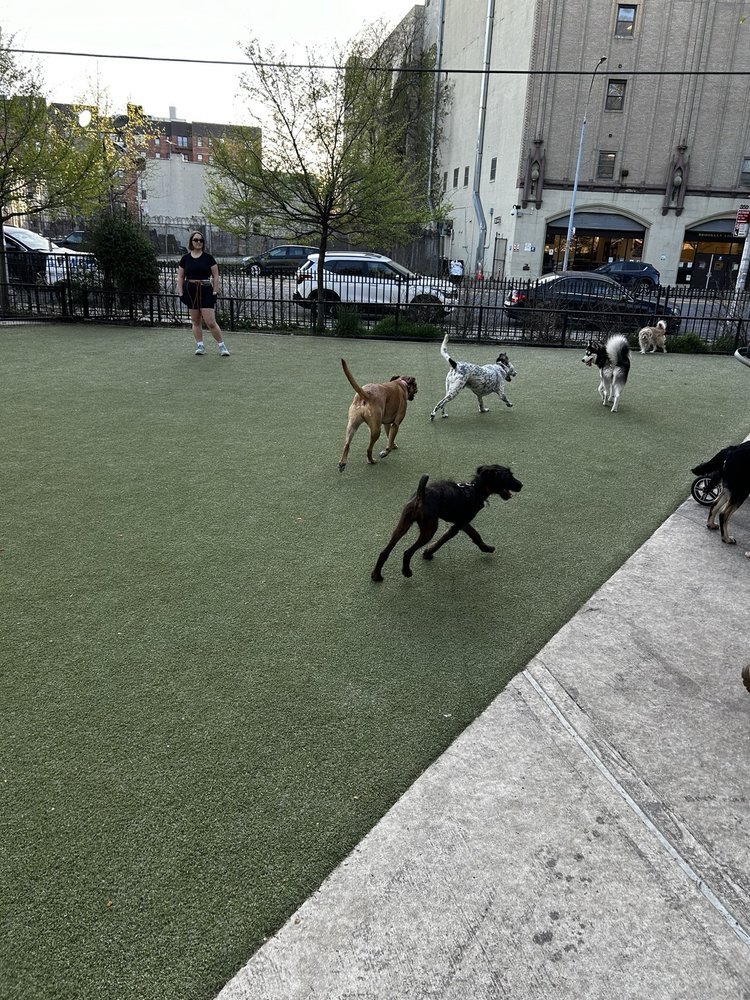
--- **Chapter One: The Morning of Marvels** The golden fingers of morning sunlight stretched through my bedroom window like warm honey, coating my short, velvety white fur in a glow that made me feel positively royal. I stretched my paws toward the ceiling, my pink nose twitching with excitement. Today was the day. THE day. Kensington Dog Run awaited, and I, Pete the Puggle, was ready for adventure. "Lenny! Mariya! Roman!" I barked, my tail a helicopter blade of joy thumping against my quilted dog bed. "The sun is up! The birds are singing! The squirrels are probably plotting world domination as we speak!" Lenny appeared first, his warm brown eyes crinkling at the corners as he laughed—his signature deep, rumbling chuckle that felt like being wrapped in a familiar blanket. "Easy there, Speed Racer," he said, scratching behind my ears with just the right pressure. "We need breakfast first, and you need to let your old man finish his coffee before tackling any squirrel conspiracies." Mariya glided in next, her presence like a gentle breeze carrying the scent of lavender and fresh pancakes. She knelt down, her fingers tracing the playful streaks of what she called my "adventure makeup"—the natural dark markings around my eyes that made me look perpetually ready for a masquerade ball. "My brave storyteller," she whispered, and her voice held that particular quality she used when she saw magic in ordinary things. "What story will you write today?" Roman bounded in last, all gangly limbs and mischievous grin, and I felt that familiar surge of complicated love—my best friend, my sometimes rival, my protector. He scooped me up, and I found myself at eye level with his freckled nose. "Ready to get muddy, Pete?" he challenged, his breath minty from early morning brushing. "Roman," Mariya warned, but she was smiling. The car ride was its own symphony of anticipations—wind through cracked windows carrying city smells, Lenny's old rock playlist, Roman's knee bouncing with barely contained energy. I sat in my special seat, watching Brooklyn blur into Manhattan, each neighborhood a different verse in the city's endless song. Kensington emerged like a secret garden, brownstones giving way to the emerald expanse of Prospect Park. The dog run itself appeared beyond wrought-iron gates: a paradise of fenced freedom where dogs of every size and story converged. The grass was greener than green, the kind of green that makes you want to roll until you're dizzy. Trees stood like ancient guardians around the perimeter, their leaves whispering secrets to one another in the breeze. But as we passed through those gates, I felt it—that first tremor of something beyond excitement. The water feature gleamed at the far end, a shallow pool that caught sunlight and threw it back like scattered coins. It winked at me. It beckoned and threatened simultaneously. My paws felt suddenly heavy, my brave morning resolve thinning like morning mist. "Pete?" Roman noticed, because Roman always noticed. He knelt, his hands cupping my face, his thumbs stroking my velvet cheeks. "What's up, little dude?" I wanted to tell him. I wanted to explain how water had always felt like a living thing to me—unpredictable, deep, swallowing. How even bath time required negotiations and treats. But words failed, and I simply pressed my nose against his palm, breathing in the comfort of his familiar scent. "Hey," he said softly, "we're here together. That's the only thing that matters." And for that moment, with my family surrounding me like human shields of love, I almost believed it was enough. --- **Chapter Two: The Arrival of Unexpected Friends** The Kensington Dog Run was a carnival of canine delights. A Great Dane named Duchess performed elegant loops around her human, each stride like a ballet. A pack of terriers had established an impromptu digging cooperative near the eastern fence, dirt flying with socialist enthusiasm. Somewhere, a beagle howled at a siren, and three other dogs joined in, creating an accidental choir. I trotted beside Roman, my confidence rebuilding with each friendly sniff, each wagging tail. We approached a shaded bench where Lenny had settled with a book and Mariya was unpacking what she called "the essential provisions"—water, collapsible bowls, and enough treats to fund a small nation. "Pete!" A voice like velvet scraped the wrong way cut through the ambient noise. "Pete the Puggle, I presume?" Perched on the bench's armrest, tail wrapped elegantly around his paws, sat a cat of such orange magnificence that he seemed to generate his own sunlight. His green eyes held intelligence and mischief in equal measure, and his whiskers twitched with barely suppressed amusement. "Tom?" I gasped, because of course I recognized him. Everyone knew Tom, the cat from the cartoons, the eternal pursuer and pursued, the survivor of a thousand absurd catastrophes. "The Tom?" "The very same," he purred, leaping down with surprising grace for one so round. "Though I prefer to think of myself as retired. The chasing business is exhausting on the joints." He stretched languidly. "I live with a lovely elderly couple two blocks over. They feed me salmon. I tolerate their existence. It's quite civilized." Before I could respond, a flash of brown darted from beneath the bench, and suddenly a mouse stood between us—stood, mind you, on two legs, with a scrap of red fabric tied jauntily around his neck. "Jerry's the name," he squeaked, tipping an imaginary hat. "Don't worry about the big oaf here. He's mostly harmless. Emphasis on mostly." Tom's eye twitched, but he sighed with the resignation of one who has accepted the inexplicable. "We have an arrangement. An understanding. A—" "Therapy situation," Jerry interrupted, grinning. "He chases, I outsmart, nobody gets hurt, we both sleep better. It's called healthy coping mechanisms, Pete. Look it up." Roman was watching this exchange with the particular delight of a boy who had grown up on cartoon reruns. "Dude," he breathed, "this is the weirdest best thing ever." "Language of friendship transcends species," Mariya observed, and I wasn't sure if she meant me and the new arrivals, or Roman's ability to accept talking animals without missing a beat. The afternoon bloomed around us like a flower. Tom regaled us with tales of his Hollywood years ("The anvils were real, Pete. The pain was not.") while Jerry demonstrated acrobatic feats using a discarded tennis ball. I found myself laughing, truly laughing, the water feature's menacing glint fading from my immediate concern. But as shadows began their slow lengthening across the grass, as the afternoon turned toward evening's threshold, something shifted in the air. A cloud passed over the sun, and suddenly the dog run seemed larger, the trees closer together, the fence farther away. "Pete?" Roman's voice came from somewhere distant. "Pete, where did you—" And then I was running, chasing a squirrel that had no business being so brazen, through a gap in the fence I hadn't noticed, into the wooded beyond, the world tilting into uncertainty. --- **Chapter Three: The Forest of Whispers** The trees closed behind me like curtains after a performance, and suddenly I was alone. Not just physically alone—though that was terrifying enough—but enveloped in solitude so complete it felt like a second skin, tight and wrong. The squirrel had vanished, of course, laughing its bushy-tailed laugh. I was left in a small clearing where light filtered green and strange through leaves that seemed to murmur among themselves. My breath came fast, too fast, my velvety chest heaving. I turned in a circle, then another, searching for familiar landmarks. Nothing. Only trees, more trees, and the growing certainty that I had made a terrible, terrible mistake. "Papa?" I whimpered, using my private name for Lenny. "Mama? Roman?" Silence answered, then the silence itself seemed to breathe. Darkness was coming. I could feel it in my bones, in the way the green light deepened toward something hungrier. The forest wasn't inherently frightening—Kensington's wooded areas were tame by wild standards, known and mapped and safe. But knowing this intellectually did nothing for the ancient panic rising in my chest, the primitive understanding that night in the forest meant predators, meant cold, meant being eaten by something with better night vision. The first true shadows arrived like ink spreading in water. Not yet true darkness, but the promise of it, the threat. My imagination, usually my greatest gift, turned traitor. Every rustle became a wolf. Every silhouette became a beast. The darkness wasn't just absence of light anymore; it was a living entity with appetite and intention. I found a hollow beneath a fallen log, curled myself as small as my puggle body allowed, and trembled. The water fear, the darkness fear, the separation fear—they braided together into something that squeezed my heart until I thought it might stop. I thought of Roman's hand on my face. Of Mariya's magic-seeing eyes. Of Lenny's blanket-warm laughter. "Fear is a story we tell ourselves," I heard Mariya say, but I couldn't finish the story, couldn't find the ending. Hours passed, or minutes—time became as slippery as the darkness itself. The moon rose, casting silver that did nothing to comfort. Somewhere, an owl asked who, who, and I had no answer. Then: "Pete! PETE!" Roman's voice, raw and desperate, cutting through the forest's whispers like a blade through water. I wanted to answer, but my voice had left me, fled with my courage into the night. "Pete, please, please, I hear you breathing, I know you're scared, I'm coming, I'm coming—" A flashlight beam, stabbing through darkness like hope made visible. And then Roman's face, tear-streaked and filthy and more beautiful than any sunrise, and his arms around me, and the world beginning to make sense again. "I've got you," he whispered, again and again, into my fur. "I've got you, little dude. I've got you." --- **Chapter Four: The River of Courage** Roman's flashlight revealed what panic had hidden: we weren't far from the dog run at all, perhaps ten minutes through manageable woods. But between us and safety lay the water feature's larger, wilder counterpart—a stream that fed the park's ecosystem, currently swollen with recent rain, currently spanning between us and the path home. It wasn't deep. I could see that, even in moonlight. Perhaps to Roman's knees at its deepest point, a gentle murmur over stones. But to my fear-soaked perception, it was the Mississippi, the Amazon, all the oceans combined into this single barrier. "Pete," Roman said, and his voice held no command, only invitation. "I know water scares you. I know. But I'm right here. I'll hold you. We can do this together." I thought of Tom, chasing and being chased across cartoon landscapes, never truly defeated. Of Jerry, small and brave, outsmarting giants. Of Lenny's wisdom and Mariya's magic-seeing. Of the stories I told myself about who I could be. "I can't," I whispered, hating the whine in my voice. "Roman, I can't." He knelt in the stream's shallows, not caring about wet jeans, about cold, about anything except being present with my fear. "Remember when I was scared of the basement?" he asked. "The dark, the noises, all of it? You stayed with me. Every single time. You didn't make fun. You just... stayed." His hand extended toward me, palm up, patient as sunrise. "Being brave doesn't mean not being scared, Pete. It means being scared and doing it anyway. For the people you love. For yourself. For the story you want to tell about who you are." The water whispered, but differently now—not threatening, but waiting. I thought of all the stories I'd told about adventures, about courage, about finding your brave in the darkest moments. Could I write myself into this story as the hero? Could I be the puggle I imagined? I placed one paw in the stream. Cold shot through me like electricity, and I yipped, withdrew. Tried again. The second time, the cold was information, not paralysis. Step by trembling step, Roman's hand never more than an inch from my shoulder, I entered the water. The current tugged, gentle but insistent, and for a moment the old panic surged. But Roman's hand finally connected, solid and warm and real, and together we crossed. The far bank received us like a promise kept, and I stood dripping and alive and astonished at my own existence. "I did it," I breathed, and then louder, into the night: "I DID IT!" Roman laughed, that particular wild laugh he saved for genuine joy, and swung me in a circle that scattered water droplets like diamonds. "You absolutely did, little dude. You absolutely did." --- **Chapter Five: The Gathering of Friends** We emerged from the woods to find the dog run transformed. Evening had fully arrived, and with it, some emergency lighting that cast everything in amber and shadow. But more importantly: Lenny and Mariya, Lenny's phone pressed to his ear with obvious relief, Mariya's hands pressed to her mouth, and—impossibly, wonderfully—Tom and Jerry, who had apparently led the search from their vantage of superior senses. "Pete!" Mariya's voice broke as she swept me up, and I was passed from human to human, each embrace different and equally essential. Lenny's solid warmth, his whispered "Papa's here, Papa's here." Mariya's lavender scent, her tears falling like blessing on my head. And finally back to Roman, who had never really let go, his hand finding my wet fur with automatic tenderness. "Tom found us," Lenny explained, his voice still rough with recent fear. "This remarkable cat and his... companion. They heard Roman calling, led us toward the sound." Tom sat with affected nonchalance, cleaning a paw. "It was nothing. A minor diversion. I happened to be passing by." "You happened to be napping on the bench when the humans panicked," Jerry translated, rolling his eyes with obvious affection. "Then you happened to use that spectacular nose of yours—" "Silence, rodent," Tom interrupted, but without conviction. We gathered on Mariya's emergency blanket, the one she kept for "magical moments requiring comfortable seating." The night had developed a chill, but someone produced a tiny dog sweater from the emergency provisions, and I found myself wrapped in warmth both physical and emotional. "Pete," Lenny said, and his serious tone gathered us like a campfire circle, "what you did tonight—surviving, staying calm, crossing that stream with Roman—that's the bravest thing I've ever seen." "But I was so scared," I admitted, the shame still fresh. "I ran. I got lost. I—" "Were afraid," Mariya finished gently, "and kept going anyway. That's what courage is, my love. Not absence of fear. Movement despite it." Tom yawned elaborately, but his green eyes held something soft. "In my former profession, we faced absurd dangers daily. Explosions, falls, piano-related incidents. The fear never disappeared. We simply... continued. Found the next frame, the next scene. One moment at a time." "And you made friends along the way," Jerry added, nudging Tom's paw before the cat could withdraw it. "Weird, annoying friends who never give up on you. Those are essential." I looked at each face in our circle—human, feline, murine, canine—and felt something shift in my chest, a loosening of knots I hadn't known were tied so tight. The darkness still existed. The water remained. But they were no longer the same things. They were challenges that could be faced, stories that could be rewritten, fears that could be transformed into something else entirely. --- **Chapter Six: The Night's Embrace** The decision to wait for proper morning light rather than risk another forest passage was unanimous. Lenny produced additional blankets from some inexplicable reserve. Mariya shared thermos-hot cocoa that steamed in the cooling air. Roman stretched out with me curled in the hollow of his side, and I felt his heartbeat against my back—a steady drum of presence, of not-aloneness. "Pete?" His voice drifted down, sleepy but intent. "Mm?" "Can I tell you something? When you were gone... I was more scared than I've ever been. Like, ever. Worse than spiders, worse than exams, worse than anything." I turned to face him, this boy who had crossed streams for me, who had shouted my name into the dark without certainty of answer. "I'm sorry. I didn't think. The squirrel—" "Was a jerk," he finished, but he was smiling. "Squirrels usually are. But Pete? Even though I was scared, finding you, helping you cross that—that was the best moment of my life. Because we did it together." Tom and Jerry had settled nearby, having apparently decided that our human family was acceptable company. Tom's breathing had slowed to sleep-rhythm, but one ear rotated toward our conversation. Jerry, nocturnal by nature, sat alert as a tiny sentinel. "Your human speaks truth," Jerry observed quietly, not wanting to wake the orange sleeper. "The best adventures are shared. The worst fears, halved by companionship." "Even when companions are natural enemies?" I asked, thinking of chase and escape, of cartoon violence made real. "Especially then," Jerry replied, and his small dark eyes held galaxies of meaning. "Transformation, Pete. That's the magic. Fear into courage. Enemy into friend. Stranger into family." I thought of my transformation—how the puggle who trembled at water's edge had become the piale who crossed streams in darkness. How the puppy terrified of separation had discovered that love persisted across distance, that connection outlasted physical presence. How the storyteller had finally, truly, lived a story worth telling. The night deepened around us, stars emerging between city light's diminishment. Somewhere, genuine wilderness existed—true forests, real predators, absolute dark. But here, in this bounded wilderness of park and human care, I found my own wild courage, my own authentic brave. Sleep took me gradually, Roman's hand resting on my back, Mariya's distant humming of some lullaby, Lenny's soft snore providing bass line to the night's music. I dreamed of water, but differently now—as a pathway, a boundary crossed, a victory claimed. --- **Chapter Seven: The Dawn of Understanding** Morning arrived in watercolor washes of pink and gold, and with it, the full restoration of my family's presence. We gathered our scattered belongings, our additional blankets, our stories of the night. The dog run slowly populated with early risers—dogs and humans who knew nothing of our adventure, for whom this was simply another Saturday morning. But before we could depart, Tom and Jerry appeared, and the conversation that followed would stay with me forever. "We're not saying goodbye," Tom clarified, his tail-tip twitching. "That would be melodramatic. We're simply... acknowledging geographical separation with emotional continuity." "Tom's bad at feelings," Jerry translated cheerfully. "What he means is: you better visit, Pete. We've got a whole park to explore, and you're the only dog we can stand." "I'll visit," I promised. "I'll bring Roman. We'll have picnics. Adventures. Stories." "Speaking of which," Lenny interjected, his wise eyes twinkling, "I believe someone owes us the complete, unedited version. Beginning to end. No heroic omissions." So I told it. The fear, the flight, the forest's whispering darkness. The way panic had felt like drowning on dry land. The gradual discovery of Roman's voice, the crossing of water, the transformation of terror into something else—still fear, but productive, motivational, ultimately surmountable. "And the moral?" Mariya asked, though her eyes held pride that needed no answer. "That courage isn't the absence of fear," I said, the words settling into my bones like truth. "That family persists across distance. That friends can be unexpected. That the stories we tell about ourselves can be rewritten, moment by moment, choice by choice." "And?" Roman prompted, his grin knowing. "And that squirrels are fundamentally untrustworthy," I concluded, and the laughter that followed felt like the best kind of music, the kind that stays with you, that becomes part of your internal soundtrack. We walked toward the exit together, our expanded family momentarily whole. Tom and Jerry peeled off with promises and whisker-touches, and I watched them go—natural enemies made friends through shared experience, through the alchemy of transformation. --- **Chapter Eight: The Circle Closes** The car ride home was different from the journey out. Same route, same music, same wind through cracked windows. But I was different. We were different. Roman's hand rested on my back, and I leaned into it with the comfortable weight of trust fully restored. "Can I tell you something?" Mariya asked, turning from the front seat, her eyes catching sunlight like prisms. "Last night, when we didn't know where you were... I realized how much of my own fear I've been carrying. Not just for you. For all of us. The world is so unpredictable, so capable of harm. But watching Roman find you, watching you cross that stream together... it reminded me. Fear is part of love. Worry is the shadow side of care. And we carry it because the alternative—indifference—that's the true danger." Lenny reached across to squeeze her hand, the gesture speaking volumes of decades together, of fears shared and surmounted. "My wise wife," he said softly. "My wise, magical, seeing wife." "Papa's right," Roman added, and the nickname sat easily on his growing shoulders. "And Pete? You're the wisest of all. You actually did the thing. Crossed the water. Faced the dark. Found your way back." "With help," I emphasized. "Always with help." "That's the point, though, isn't it?" Lenny observed. "Nobody does anything alone. Not really. The myth of solitary heroism, of individual courage... it's just that. A myth. The real story is always about connection. About hands extended in darkness. About voices that don't stop calling." We pulled into our familiar street, our familiar home, and I felt the profound rightness of return—not as retreat, but as completion of circle. The adventure had happened. The transformation had occurred. And now, the integration: the becoming of the new self in the old context, the testing of growth against familiar patterns. Inside, routine reasserted itself with comforting insistence. Dinner preparations, homework discussions, the soft chaos of family life. But beneath, something had shifted, something fundamental and good. Roman found me later, in our shared space, and produced from his pocket a small stone—smooth, water-worn, retrieved from last night's stream. "For when you forget," he said, pressing it into my paw. "Proof. You crossed. You survived. You grew." I held the stone, this small weight of meaning, and felt the story complete itself. Fear into courage. Separation into reunion. Stranger into friend. And always, always, the love that made transformation possible. "Papa?" I called, finding Lenny in his reading chair, the same chair where he'd offered wisdom and silly jokes through my entire puppyhood. "Will there be more adventures? More fears to face?" He looked up, his warm eyes holding galaxies of experience, of stories told and lived. "Undoubtedly, Pete. That's the nature of life, of growth. But now you know something you didn't before. You know your own courage. You know your people. You know that even the darkest forests end, that streams can be crossed, that morning always comes." "And the jokes?" I pressed, because some things must be maintained. He grinned, that particular Lenny-grin that preceded the worst puns. "Why did the puggle cross the stream?" "Why?" "To get to the other side of his fears!" The groan was worth his laughter, worth everything. I carried my stone to the window, watching evening approach in gentler colors than the night before. Somewhere, Tom napped and Jerry plotted and the great cycle of chase and friendship continued. Somewhere, Kensington Dog Run waited for return, for new stories, for the ongoing transformation of ordinary days into adventures worth telling. I was Pete the Puggle. Storyteller. Adventurer. Survivor of darkness, crosser of streams, beloved of family, friend to unlikely companions. And whatever came next—whatever fears, whatever challenges, whatever growth remained—I would face it with stone in paw and love in heart, writing my story moment by courageous moment. The night fell softly, and I did not fear it. The water existed in the world, and I would approach it when necessary. The story continued, as stories do, and I was grateful—profoundly, completely, puggle-gratefully—for every word. ***The End***
Use these buttons to read the story aloud:



No comments:
Post a Comment