"*** The Hill of Stars and the Brave Little Heart ***"🐾
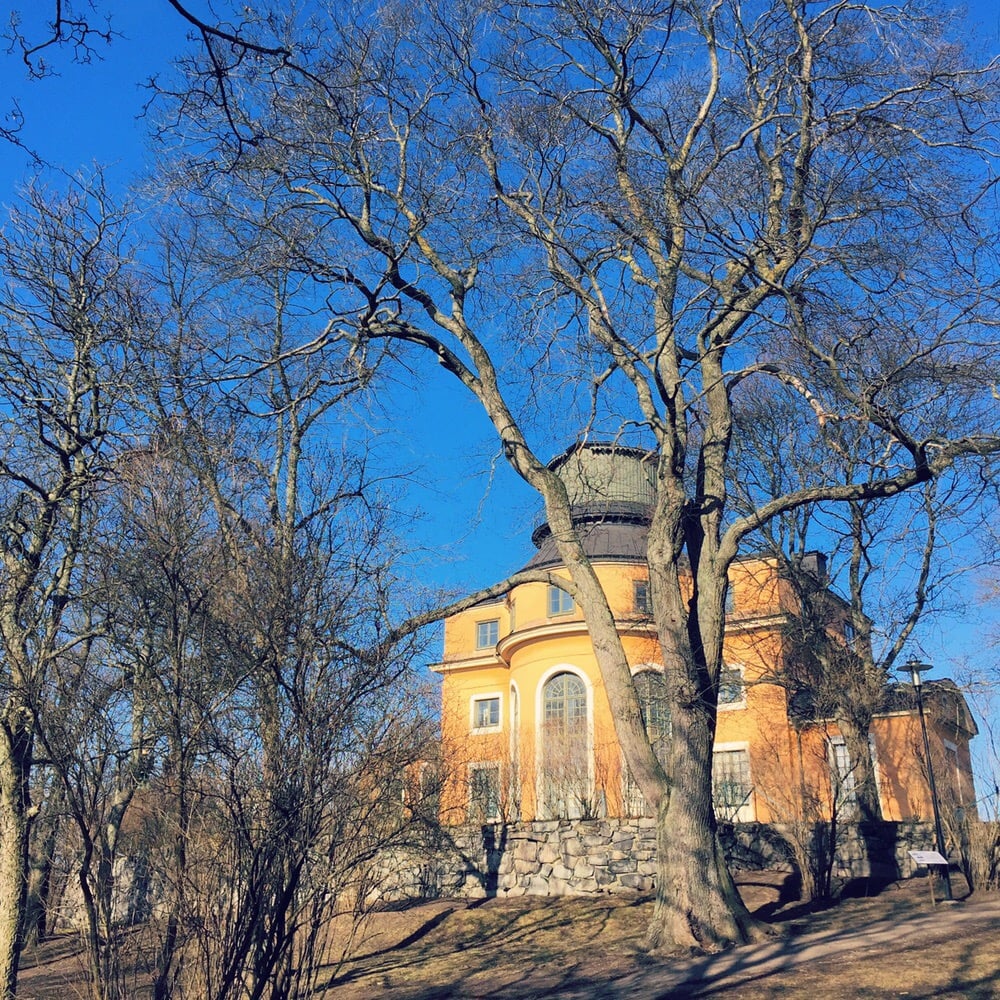
## Chapter One: The Map Under Mariya’s Scarf Morning spilled over Stockholm like honey from a tilted jar, and I, Pete the Puggle, stood on the doorstep with my white fur fluffed by the wind and my eyes—ringed with those playful streaks Lenny calls my “adventure mascara”—wide as saucers. “Today,” Mariya sang, tucking a paper map under her scarf, “we climb to Observatorielunden, where the old observatory keeps its elbow on the sky.” Lenny adjusted his hat and winked. “Remember, Pete: every hill is just a flat road that got ambitious.” Roman bumped my shoulder with his grin. “Try not to bark at the clouds, superstar.” I pretended offense, but my tail betrayed me, scribbling happy punctuation in the air. The park rose ahead in green terraces, birch leaves flickering like hundreds of small hands waving us onward. The observatory sat above the paths, round-shouldered and patient, its copper dome glowing dull gold. Near the gate waited two figures who made my heart do a somersault: Luna, an elegant Italian Mastiff with a coat like moonlit pewter and eyes deep as wells, and beside her, square-jawed and silver-haired, Charles Bronson—our family’s very old friend, the great action star, wearing a scarf, boots, and the calm of a man who had dodged pretend explosions before breakfast. “Well,” Charles rumbled, “you brought the fluffy commando.” Luna leaned down, touched noses, and whispered, “I hoped you’d come, Pete.” My ears became butterflies. Mariya spread the map on a bench. “Paths twist here. We stay together.” Lenny added, “And if fear shows up, we invite it to walk with us, but we don’t let it hold the leash.” I laughed because everyone expected me to, though inside three shadows had already unpacked their bags: water, dark, and the terrible thought of losing my family. Roman must have seen my eyes flick toward Brunnsviken’s shine beyond the trees. “Hey,” he said softly, kneeling, “when your paws get scared, put them next to mine.” I nodded, brave as a teaspoon, and followed them up the winding path while the city hummed below like a giant friendly bee. ## Chapter Two: Luna’s Laugh and the Bronze Dome The hill made my legs sing and my lungs accordion. Luna trotted beside me with the grace of a queen who had secretly buried bones in royal gardens. “Do you always tremble before beauty?” she teased, glancing at my shiver. “Only before hills,” I said, “and mastiffs.” Her laugh rolled over the grass, warm as fresh bread. Charles Bronson pointed toward the observatory. “In my movies, domes like that hid lasers. Here, it hides better treasure—questions.” Lenny sighed happily. “Best line all morning, and I brought jokes.” Mariya touched the old brick wall. “Imagine all the eyes that looked up from here and felt small in the good way.” Inside the courtyard, pigeons debated philosophy in crumbs. Roman challenged me to race around a sundial; I won by cheating adorably, cutting across the shadow while he protested, “That’s not astronomy, that’s crime!” Luna refereed with solemn delight. “Foul,” she declared, “but charming.” Charles demonstrated a movie roll on the soft lawn, slow and careful despite his action-hero reputation, then sprang up with surprising agility. “Body remembers,” he said, tapping his temple, “if the heart keeps the script.” I tried a roll too, became a white croissant, and everyone cheered as if I had landed on Mars. For a while fear slept. Then Mariya said, “After lunch, we’ll walk by the water below the hill.” The word water slipped cold fingers around my ribs. I saw—not the gentle inlet, but a black mouth. I heard—not birds, but gulping. Roman noticed first. “Pete?” I forced a smile shaped like a bridge over a ravine. Luna pressed closer. “You went somewhere,” she murmured. “Come back.” I wanted to tell her that courage felt like a sweater two sizes small. Instead I whispered, “What if I’m only brave when nothing is happening?” Lenny, hearing, put his hand on my head. “Then nothing is the perfect place to practice.” ## Chapter Three: The Picnic and the First Ripple We ate under an oak whose roots gripped the hill like old knuckles. Mariya unpacked cheese, berries, rye bread, and cucumber coins; Lenny produced a thermos “filled,” he claimed, “with courage and cocoa, mostly cocoa.” Charles told a story about filming a boat chase with a director who shouted “Again!” until the lake filed a complaint. We laughed, and for a moment the world was exactly the right size: one blanket, six hearts if you counted mine twice, and crumbs for the bold sparrows. Luna shared my corner of bread with ceremonial gentleness. “For strength,” she said. I ate it as if it were a medal. Then the wind changed. Beyond the slope, Brunnsviken flashed silver through the trees, and a family of ducks arrowed across the bright skin of the water. Roman suggested we explore the lower path before the afternoon tour. “There’s a little jetty,” he said, reading the sign. My paws turned to candles. “Jetty,” I repeated, as if naming a dragon politely might make it vegetarian. Mariya crouched. “We won’t make you step on it.” Lenny added, “But we also won’t pretend it isn’t there. That’s how fears grow beards.” Charles checked the sky. “Storm later, maybe. Best keep moving before the weather remembers its lines.” At the first glimpse of the dock, my body betrayed me: knees locked, breath shallow, tail tucked so far it nearly apologized to my stomach. The boards floated on black-green shine; every ripple looked like a finger beckoning. Luna stood beside me without pushing. “Tell me the truest sentence,” she said. I swallowed. “If I fall, I disappear.” Roman came to my other side. “Then we’ll be the net.” Lenny smiled gently. “And if nets were perfect, fish would write thank-you notes.” I almost laughed; the almost mattered. I placed one paw on the first plank. It creaked like an old door. I did not die. I placed the second. The water held its breath with me. ## Chapter Four: Thunder, Tails, and the Wrong Turn The storm arrived quicker than gossip. Clouds shouldered over the hill, purple-bellied and important, and rain began typing on the leaves. Mariya called, “Back to the observatory side—now!” Charles swept up the basket in one motion. “Move like the scene matters!” We hurried along a fork where gravel paths split like a squirrel’s excuses. In the noise, a branch cracked; Roman turned toward it for one second; Luna lunged after a startled hare purely by instinct; I followed Luna because love makes excellent leashes and terrible maps. When the curtain of rain thinned, our family’s voices were somewhere else—close, perhaps, but folded behind trees. “Lenny? Mariya?” I barked. The hill answered with wet leaves. Luna’s calm narrowed into focus. “They went right. We went left.” Roman crashed back through the brush, soaked and fierce. “Pete! Luna! Don’t move!” But thunder punched the sky, and I moved—oh, how I moved—down toward the boathouse smell, toward the very water I feared, because panic has bad eyesight and wears running shoes. Roman grabbed my collar; Luna braced; for three breaths we were a knot of hearts and mud. Then the path under us gave a treacherous little slide, and we tumbled—not into the lake, thank every star—but behind a curtain of willow into a hollow beneath the old stone steps. Darkness swallowed us in one gulp. Not evening dark, which politely arrives, but cellar dark, pocket dark, the dark that sits on your chest and counts your bones. I heard Roman fumbling for his phone—“Dead,” he groaned—heard Luna say, “Breathe with me,” and heard my own whimper climb out like a lost child. Separated. Water near. Dark everywhere. My three fears held hands around me and sang. Roman found my ear in the black. “Pete, listen. I’m here. You’re not alone inside the scared.” His voice shook too, which somehow made it stronger, like a rope with honest frayed threads. ## Chapter Five: The Cellar of Echoes The hollow smelled of moss, iron, and old rain. Somewhere above, muffled by stone and storm, Mariya called my name; the sound reached us as a thin ribbon. I answered until my throat hurt, but the willow curtain and thunder turned barks into secrets. Luna paced the small space, mapping it with whiskers. “There’s a gap,” she said, “too narrow for me, maybe not for Pete.” Roman’s hand found my back. “No solo missions.” Yet his voice carried the awful mathematics of older brothers: protect, or push toward growth? Charles’s distant whistle—three sharp notes, our family signal—cut through, then vanished. “He’s searching the upper path,” Roman said. “If we climb out wrong, we could slide to the jetty.” My fear of the dark spoke with my own voice, only colder: You are small. White fur shows nothing in blackness. They will leave because everyone eventually leaves the thing that slows them down. I felt the thought bite, and then, surprisingly, I felt anger rise like a tiny sun. “No,” I said aloud. Roman paused. “No what?” “No renting my head to that voice.” Luna’s eyes caught a seam of light; in them I saw myself reflected braver than I felt. “Good,” she whispered. “Fear hates being introduced.” I named them then, out loud: “Water. Dark. Alone.” Each name made a crack in the wall they built. We made a chain—Roman’s hand on my scruff, my nose at Luna’s tail—and edged toward the gap. Stones bit my paws; rain found my spine; the dark leaned close, curious now rather than cruel. Roman murmured, “When I was seven, I got lost in a department store and thought the mannequins were judging me.” Despite everything, I snorted. “Were they?” “Deeply,” he said. “One had a scarf just like Mom’s.” The story loosened my chest. At the gap, Luna could not pass; she would have to go around through brambles and meet us beyond. She touched my nose. “Come find me quickly,” she said. “I dislike finishing adventures without the small white hero.” ## Chapter Six: The Water Learns My Name Beyond the gap lay a narrow ledge above the inlet, slick as a secret. Roman went first, back against stone, arms making a fence. Below, the rain dimpled the water into a thousand gray faces. One plank from the broken jetty knocked softly against the shore: tok, tok, tok, like fear keeping time. My old terror returned wearing a crown. If I fell, the cold would erase Lenny’s jokes, Mariya’s songs, Roman’s shoulder, Luna’s moonlit eyes. I froze so hard I could hear my heartbeat in my teeth. Roman didn’t say “Don’t be afraid.” He said, “Be afraid with your feet moving.” So I moved one inch. The ledge did not argue. Another inch. A pebble dropped and the water accepted it without swallowing the world. “See?” Roman said. “It’s not a mouth. It’s weather wearing a mirror.” I remembered Mariya saying magic hides in ordinary things; maybe ordinary water was only sky that had fallen and needed help standing up. Lenny’s voice floated faintly from above—“Pete! Keep talking!”—and I shouted, “I’m talking!” though it came out as a squeak with ambitions. Charles’s whistle answered nearer now, three notes, then two, our code for almost there. Luna appeared on the far bank, wet and magnificent, having fought the brambles like an empress escaping a bad party. “Pete,” she called, “the water is loud because it is jealous of your heartbeat.” No one has ever said a more useful nonsense sentence. I laughed, and the laugh shook loose one more step. Then my paw slipped. The world tilted; cold kissed my leg; Roman caught me with a grunt that sounded like all our names at once. I did not fall in. I stood dripping on solid mud, trembling, alive, and furiously proud. The water had touched me and I remained Pete. That was the miracle: not the absence of fear, but the presence of me inside it. ## Chapter Seven: Charles Bronson and the Rope of Old Movies Above us, roots tore from the bank in a slow brown zipper. Charles Bronson appeared at the edge like a rumor with muscles, rain silvering his hair. “Nobody rehearsed this,” he said, already looping a bright utility cord from his pack around a birch. Roman blinked. “You carry rope to picnics?” Charles’s mouth twitched. “I carry options.” He moved with that startling agility—half cat, half grandfather clock—anchoring the line, testing knots, scanning the slope. “Mud’s going,” he warned. “When I say go, we become one animal with many legs.” Luna barked once, sharp as a starting pistol. The bank slumped. Mud climbed my ankles with cold thumbs. Roman pushed me toward the rope; Charles reached down, forearm strong as a dock beam. “Eyes on me, kid,” he said—not unkind, not cinematic, simply present. I grabbed the offered strap in my teeth the way we’d practiced in games, Roman lifted, Luna braced behind him, and Charles hauled with a grunt that contained every chase scene and every hospital corridor and every birthday candle he had ever survived. For one suspended second I hung over the black shine, and the dark and water and loneliness all shouted their final argument. I answered by not letting go. Then hands—Lenny’s warm, Mariya’s quick, Charles’s weathered—were on me. Mariya wrapped me in her scarf; Lenny hid tears by blaming the rain; Roman collapsed beside me and immediately accused, “You smell like a haunted pond.” Luna pressed her forehead to mine, and words became unnecessary furniture in a room full of light. Charles coiled the rope, satisfied. “Good scene,” he said. “No stunt doubles.” The storm, embarrassed by our reunion, began to unpack its clouds. A pale blade of sun slid over Observatorielunden, touching the dome, the wet leaves, Luna’s whiskers, and the small white dog who had been afraid and come home anyway. ## Chapter Eight: Stars Before Bedtime We climbed to the observatory terrace as evening rinsed the sky clean. The city below glittered like someone had spilled sugar on black velvet. Though the telescope program was canceled, a caretaker opened the dome for one look at the first brave star. I stood between Roman’s muddy shoe and Luna’s elegant paw, wearing Mariya’s scarf like a cape that had learned humility. Lenny put an arm around everyone he could reach. “Today,” he said, “the hill gave us a quiz.” Mariya nodded. “And we passed with muddy paws.” Charles leaned against the wall, eyes soft behind the legend. “Best endings are the ones where nobody becomes fearless. They become fluent.” Roman nudged me. “You ran left.” “You followed a hare,” I told Luna. She lifted her chin. “It had suspicious ears.” We laughed until the dome seemed to laugh too, a round copper chuckle above Stockholm. Then quieter talk came, the kind that arrives after soup and survival. I told them the exact shape of my fear: water like a mouth, dark like a hand, separation like a door closing in a house I loved. Roman admitted he had been scared too—“Not of losing the path,” he said, “of failing you.” Mariya held his face. “Love is not never slipping. It is coming back with rope.” Lenny wiped his eyes and blamed “allergies to courage.” Before we left, Luna walked me to the terrace edge. Below, Brunnsviken had calmed into a dark mirror holding one early star. “Were you really afraid of me at first?” she asked. “Only of how much I wanted you to like me,” I confessed. She bumped my shoulder. “Then we were both brave before breakfast.” I looked at my family—Lenny making a silly face at the star, Mariya photographing the mud on Roman’s knees, Charles pretending not to be moved—and understood that courage is not a sword; it is a leash we hand to one another, trusting someone will hold the other end when the ground becomes water, when the room becomes night, when the path forgets our names. The moral wagged its tail inside me: fears shrink when spoken, love returns when called, and even a small white dog can be a lighthouse if he keeps his heart on. *** The End ***
Use these buttons to read the story aloud:


No comments:
Post a Comment