"*** The Puggle, the Poseidon Fountain, and the Brave Little Heart ***"🐾
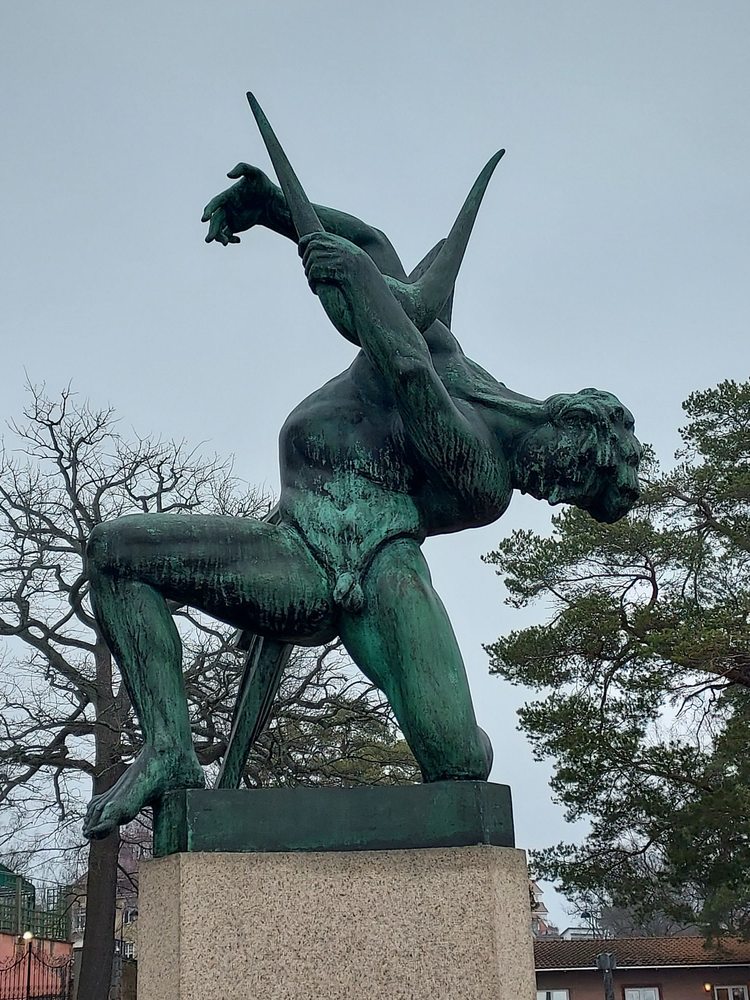
## Chapter One: The Morning the Map Trembled The morning smelled of toasted rye bread, wet grass, and adventure—that wild, invisible spice only dogs can truly taste. I, Pete the Puggle, stood on my hind legs with my white velvety paws pressed against the kitchen window, my tail thumping like a little drum announcing a parade. Outside, Stockholm was waking beneath a pearl-blue sky, and inside, my family was buzzing around the table like bees who had discovered a field of jam. “Today,” Lenny said, lifting his coffee mug as if it were a royal scepter, “we conquer Millesgården.” His eyes twinkled behind his glasses. “Or, at the very least, we conquer the uphill walk without anyone complaining.” “I heard that,” Roman called from the hallway, tying his sneakers with the ferocious concentration of a knight fastening armor. My older brother—human brother, best friend, and occasional rival in the ancient sport of Who Can Throw the Ball Farthest—grinned at me. “You ready, Pete? Sculptures. Fountains. Big water views.” My ears lifted. Then, at the word water, they folded like nervous paper fans. Mariya noticed immediately. Moms always do; they have sonar for feelings. She knelt beside me and stroked the soft streaks of makeup-accented fur around my eyes, the playful lines Roman said made me look like a tiny rock star. “We’ll stay by the railings,” she promised. “No one has to be brave all at once.” I wanted to believe her. I wanted to be the bold hero of every bedtime story I told myself under the blankets. But inside my chest lived three shadows: the black fear of deep water, the cold fear of the dark, and the sharpest one—the fear of losing my family in a crowd and becoming a small white dot swallowed by the world. A knock rattled the door. Roman opened it, and there stood Charles Bronson—our family’s very old friend, silver-haired, straight-backed, with a face carved by a thousand daring sunsets and a coat that seemed to have pockets built for secrets. He had once been a great action movie star, Lenny said, though he spoke about it as casually as other men discuss weather. “Charles!” Lenny boomed. “Right on time.” Charles looked down at me, one eyebrow rising like a drawbridge. “So this is the famous Pete,” he said in a voice low enough to make floorboards listen. “He has the eyes of an explorer and the knees of a philosopher.” “I have the knees of a puggle,” I corrected, though only Roman understood my bark-laugh perfectly. “And today, sir, I intend to be magnificent.” Charles leaned closer. “Magnificence is just fear that decided to wear a cape.” I did not know then how often I would remember those words before sunset. ## Chapter Two: Terraces of Stone and Sky Millesgården rose above the water like a dream someone had built out of sunlight and stubbornness. Terraces climbed toward the house where Carl Milles had once made bronze sing. Statues stood among pines and flowers—musicians without sound, dancers frozen mid-leap, faces tilted toward clouds as if listening for instructions from the sky. Below us, the blue spread wide and shining, beautiful and terrible. I kept close to Mariya’s shoes. Each step released scents: juniper, warm stone, ice cream from a distant kiosk, the metallic breath of fountains. “Look, Pete,” Roman said, pointing toward a sculpture balanced as though wind had taught it to fly. “If I were bronze, I’d want to be that guy.” “If you were bronze,” Lenny said, “pigeons would hold meetings on your head.” Roman pretended offense. “Dad, respect the art.” “I am respecting the pigeons,” Lenny replied, and Mariya laughed so warmly that a nearby sparrow seemed to puff with pride. Charles walked beside me, slow but alert, his cane tapping the path in a rhythm that sounded like courage keeping time. “Your tail is low,” he observed. “I am conserving energy,” I said. “You are negotiating with fear,” he answered. “There is a difference.” Near the lower terrace, water glittered beyond the railing, vast and moving, breathing against the rocks. My paws locked. The sound became a thousand mouths whispering, Come closer, little dog, come see how small you are. My heart turned into a trapped bird. Roman crouched. “Hey. Look at me, not it.” His hand found my chest, feeling the wild flutter. “I’m here. Breathe with me. In… out.” I tried. In came air smelling of salt and pine; out went a tremble. In came Roman’s steady voice; out went a tiny piece of panic. Mariya pointed toward a fountain where bronze figures seemed to dance above spray. “See how the water moves when it has a shape around it? Maybe fear is like that too. It needs edges—names, plans, hands to hold.” “Edges,” I whispered. “I can do edges.” Lenny smiled. “Then we’ll build them together.” For one bright minute, the water became only light again. ## Chapter Three: The Tunnel Under the Roses After lunch on a bench scattered with crumbs and sunshine, Roman discovered a narrow passage curving behind a hedge of roses, half-hidden like a secret the garden had forgotten to keep. A small sign leaned crookedly: service path—authorized only. The gate, however, stood open just wide enough for curiosity. “Absolutely not,” Mariya said. “Definitely not,” Lenny agreed. “Possibly,” Roman whispered to me, because brothers are made of mischief and loyalty in equal parts. Then a gust snatched Mariya’s scarf—red as a cardinal—and carried it over the hedge. It fluttered down the shadowed path like a flag surrendering to adventure. Mariya gasped; Lenny stepped forward; Charles narrowed his eyes at the slope. “I’ll get it,” Roman said. “Not alone,” Charles replied, already moving with surprising smoothness. “Old tunnels dislike solitary heroes.” Before anyone could organize courage into a plan, I darted after the scarf. It was red; it was Mariya’s; it smelled of home. My legs decided before my fears could vote. The passage swallowed us. Stone walls rose damp and cool, roses above knitting a green ceiling that let through only coins of light. The air changed from garden-sweet to earth-deep. Behind me I heard Mariya call, “Pete! Roman! Charles!”—then the voices thinned, stretched, vanished. The tunnel bent. Darkness pooled ahead. My three shadows woke at once. The dark pressed its cold forehead to mine. Somewhere water dripped, tick… tick… tick, like a clock counting down to separation. I imagined my family searching the wrong terrace. I imagined night arriving early. I imagined myself as a lost white pawprint fading from stone. Charles clicked on a small flashlight from his coat—one of those pockets built for secrets—and the beam drew a golden road on the wall. “Dark is only light waiting for instructions,” he said. Roman picked up the scarf and looped it gently around my neck like a medal. “You came for Mom before fear could stop you,” he said. “That means you’re already brave. Don’t argue.” “I wasn’t going to,” I lied. From deep in the passage came a scrape—metal, stone, movement. Charles lifted his cane, not as a weapon exactly, but as a punctuation mark. “Stay behind me,” he murmured. “And remember: courage is loud in the legs, quiet in the mouth.” We stepped forward together. ## Chapter Four: The Gate, the Splash, the Falling Apart The tunnel opened onto a forgotten service landing above a narrow inlet where black-green water slapped stone. A rusted gate blocked the main way back; beyond it, tourists drifted like bright fish along the upper paths, unaware. The scarf around my neck suddenly felt heavier, as if home itself had weight. Then disaster arrived wearing the innocent face of a pigeon. It burst from the hedge with a clap of wings. I jumped. Roman reached for me. The old gate, offended by decades of rust, chose that moment to groan and swing. Charles moved fast—faster than silver hair should allow—hooking his cane around the bars to keep it from slamming shut on Roman’s arm. But the landing shifted; gravel rolled; my back paws slid toward the edge. Water looked up at me with open jaws. I froze so completely that even my whiskers seemed afraid to move. The inlet was not the sea, not truly, but to me it was every wave that had ever lived. Cold spray kissed my belly. My thoughts shattered: I am falling. I am gone. They will not find me. White dog, dark water, no family. “Pete!” Roman’s voice cut through the roar inside my skull. “Eyes on me!” I could not. Charles dropped to one knee with a grunt and extended the cane horizontally across the gap like a bridge too thin for hope. “Roman,” he said calmly, “do not grab. Guide.” Roman flattened himself, reached, and instead of snatching my collar—which might have sent us both tumbling—he pressed his palm beside my paw. “Put it here,” he said. “One paw. Mine next. We’ll be a ladder.” A ladder made of hands. Edges, Mariya had said. Names, plans, hands to hold. I lifted one paw. It shook so hard I felt it in my teeth. I placed it on Roman’s wrist. His skin was warm. Warm was a country I remembered. “Good,” Charles said, holding the gate with one arm and bracing the cane with the other, old muscles standing up like soldiers recalled to duty. “Again.” Second paw. Breath. Third. The water hissed below, furious at losing me. Roman pulled not with force but with faith, and suddenly I was against his chest, his heartbeat hammering into my ear: found, found, found. Behind us the gate clanged shut between the landing and the tunnel, separating us from the path where Lenny and Mariya surely searched. Roman’s face went pale. “We’re on the wrong side.” Charles looked along the ledge, then up at the sculptures above. “Then we stop being lost,” he said, “and start being on our way.” ## Chapter Five: Bronze Guardians and the Black Stair We followed the ledge away from the inlet into a maintenance stairwell coiling up through shadow. It was the kind of dark that has texture—velvet at the edges, stone in the middle, and something watching from the corners that is probably imagination but behaves like a wolf. My fear of darkness returned wearing boots. Roman kept one hand on my back. “Tell me a story,” he said. “Now?” “Especially now.” So I told him about the Moon Kennel, where brave dogs guard dreams and every tail wag rings a silver bell. My voice trembled at first, then found its road. Charles added sound effects with his cane: tap for the bell, scrape for the dragon’s embarrassed feet. Roman laughed, and the dark, insulted by our joy, retreated one step. At the top of the stair we found a door chained from the outside. Beyond it, faintly, came Mariya’s voice calling my name—thin as thread, strong as love. “Here!” Roman shouted. The chain rattled but held. My separation fear roared up, huge and familiar: They are there; I am here; the world is a locked door. I pressed my nose to the crack and smelled Mariya’s perfume—orange blossom and rain. My whole body ached toward it. Charles examined the chain, the hinges, the frame. “Old doors respect leverage more than anger,” he said. From his coat came a compact multi-tool, a coil of cord, and—Roman’s eyes widened—a folded grappling hook no bigger than a sandwich. “Is that legal?” Roman whispered. “Retired,” Charles said. “Like me.” He looped cord through the hinge gap, braced his cane as a fulcrum, and nodded to Roman. “Pull when I say. Not like a movie. Like a family.” “Now,” Charles said. Roman pulled; Charles leaned; I barked the rhythm—one-two, one-two—until metal complained, wood surrendered, and the door opened just enough for Roman to squeeze through and unhook the chain. Light rushed in. So did air. So did the distant music of fountains. For a moment none of us moved. We had crossed water’s edge, darkness, and a locked door, and yet the bravest thing felt simpler: we had kept speaking to one another through fear. Charles put a hand on Roman’s shoulder. “Your brother will remember this,” he said. Roman looked at me. “So will I.” Above, footsteps hurried closer. Lenny’s voice thundered, “Roman! Pete!” And my heart leapt so high it nearly needed a passport. ## Chapter Six: The Fountain Trial We emerged near the great fountain terrace, where water leapt from bronze hands and fell in white ropes into basins shining like mirrors. The sight should have been beautiful. It was beautiful. It was also water—moving, splashing, surrounding the path in silver noise. My old terror lifted its dripping head. Mariya and Lenny were across the terrace, separated from us by visitors, strollers, and the fountain’s wet applause. Mariya saw me first. Her face broke open like sunrise. “Pete!” I ran three steps and stopped. Between us lay a shallow crossing where overflow sheeted across stone, clear and cold and ankle-deep to a human, chest-deep to a puggle with an imagination the size of Sweden. Lenny started around the long way, but the crowd thickened. Charles assessed the crossing. “Short path is wet,” he said. “Long path is worry. Choose.” Roman knelt beside me. “You don’t have to be unafraid,” he said. “You only have to decide who gets louder—fear or us.” Inside me, water spoke in its old hungry accent. It showed me visions: slipping, sinking, vanishing beneath bubbles while hands reached too late. I heard the inlet hiss. I heard the tunnel drip. I heard the locked door laugh. Then I heard Roman breathing beside me, matching mine. In… out. Mariya’s scarf warmed my neck. Lenny lifted one hand—not waving, promising. Charles stood behind like a mountain that had learned manners. I named the fear aloud, because names are edges. “Water,” I said. “Dark. Lost.” My voice came out as a small bark, but in my chest it was a speech. “You may visit. You may not drive.” I stepped into the sheet of water. Cold seized my paws and climbed my legs like icy ivy. I whimpered; Roman entered beside me, shoes flooding, not caring. “Left paw,” he said. “Right paw. Terrible. Brave. Again.” The fountain roared; bronze faces watched without judging; spray jeweled my white fur until I glittered like a dog made of stars. Halfway across, panic bucked. I stopped. Roman stopped too, proving love knows how to stand still. “Look up,” Mariya called. I did. She was smiling through tears, not because I was unafraid, but because I was crossing anyway. Three more steps. Four. The far stone rose dry beneath my toes, and Mariya’s arms closed around me with the familiar earthquake of home. Lenny wrapped us all in one of those Dad-hugs that smell like coffee and solve minor crimes. Roman collapsed beside us, soaked and triumphant. Charles tipped an imaginary hat to the fountain. “Well,” Lenny said, voice thick, “that was either courage or excellent choreography.” “Both,” said Charles. ## Chapter Seven: What the Statues Kept As afternoon leaned toward gold, we sat on a bench overlooking the terraces while pigeons conducted serious business and the water softened into blue silk. Lenny bought warm cinnamon buns that tasted like forgiveness. Mariya dried my paws with her rescued scarf, now slightly heroic and definitely damp. Roman kept touching my ear as if making sure I had really returned. Charles told us, in his low fireside voice, about a film set long ago where a stunt went wrong and he had been afraid to cross a rope bridge above a gorge. “Everyone thought courage meant not shaking,” he said. “My hands shook so hard the bridge learned rhythm. I crossed because a friend stood on the other side holding the rope and refusing to leave.” “Who was the friend?” Roman asked. Charles smiled into the distance. “A dog, actually. Scruffy little fellow. Better actor than most humans.” I sat taller. “Dogs often are.” Lenny laughed, then grew quiet in that wise way of his. “I was terrified today,” he admitted. “When we lost sight of you, my mind became a museum of every bad ending.” Mariya nodded. “Fear makes us imaginative in the wrong direction.” Roman stared at his wet shoes. “I almost grabbed Pete too fast at the landing. Charles stopped me. I keep thinking—what if helping wrong is worse than not helping?” Charles’s gaze softened. “Helping wrong is how we learn to help right—if we listen afterward.” I watched the statues glow in late light. They seemed less frozen now, more patient, as if bronze had all the time in the world to become brave. I thought of the tunnel’s black throat, the locked chain, the shining skin of water over stone. Each fear had promised to erase me. Each had instead introduced me to a stronger Pete hiding underneath the frightened one. “I used to think brave dogs never felt cold,” I said, mostly to Roman, though the family leaned in because families are good at hearing dog-thoughts. “Now I think brave dogs feel cold and keep their paws moving.” Roman pressed his forehead to mine. “That’s my brother.” A breeze carried fountain mist over us, gentle this time, like the garden applauding very quietly. ## Chapter Eight: The Road Home Carries Light We left Millesgården as lamps began to bloom along the paths, each one a small moon leashed to a pole. The water below no longer looked like a mouth; it looked like a story still being written. I rode partway in Lenny’s arms because my legs were tired and because being carried after courage is one of life’s underrated medals. At the overlook, we stopped. Stockholm shimmered; boats drew silver lines; the sculptures behind us stood guard over memories we had not known we were making when morning began. Mariya wrapped the red scarf around her neck, then looped one end around mine so we were connected by color. “Today you faced water, dark, and being apart,” she said. “Which was worst?” I considered honestly. “Being apart,” I said. “Because water and dark are outside. Lost feels inside.” Lenny nodded. “Yet even lost, you were loved. That part never stopped.” Roman bumped my shoulder. “And even brave, you were scared. That part counts double.” Charles rested both hands on his cane. “When I was young, I thought heroes were people who won fights,” he said. “Now I think heroes are the ones who come back to the bench and tell the truth about their knees shaking.” We laughed softly, the tired kind of laugh that lives near tears. Then Roman said, “Next adventure, can it involve less unauthorized tunnels?” “No promises,” I replied, and everyone groaned happily. On the walk home, my paws touched pavement with a new music: not fearless, not foolish, but faithful. Courage, I learned, is not the absence of trembling; it is trembling in the direction of love. Family is not never being separated; it is becoming findable again and again. And fear, when named and held by many hands, shrinks from a monster into a teacher with muddy shoes. That night, curled between Roman’s arm and Mariya’s scarf, with Lenny snoring like a friendly tractor and Charles’s flashlight left by the door “just in case,” I dreamed of fountains that obeyed my bark and dark rooms that opened when I sang. If a wave rose in the dream, I did not run. I looked for the ladder of hands. *** The End ***
Use these buttons to read the story aloud:



No comments:
Post a Comment