"*** Pete the Puggle and the Greenway of Brave Hearts ***"🐾
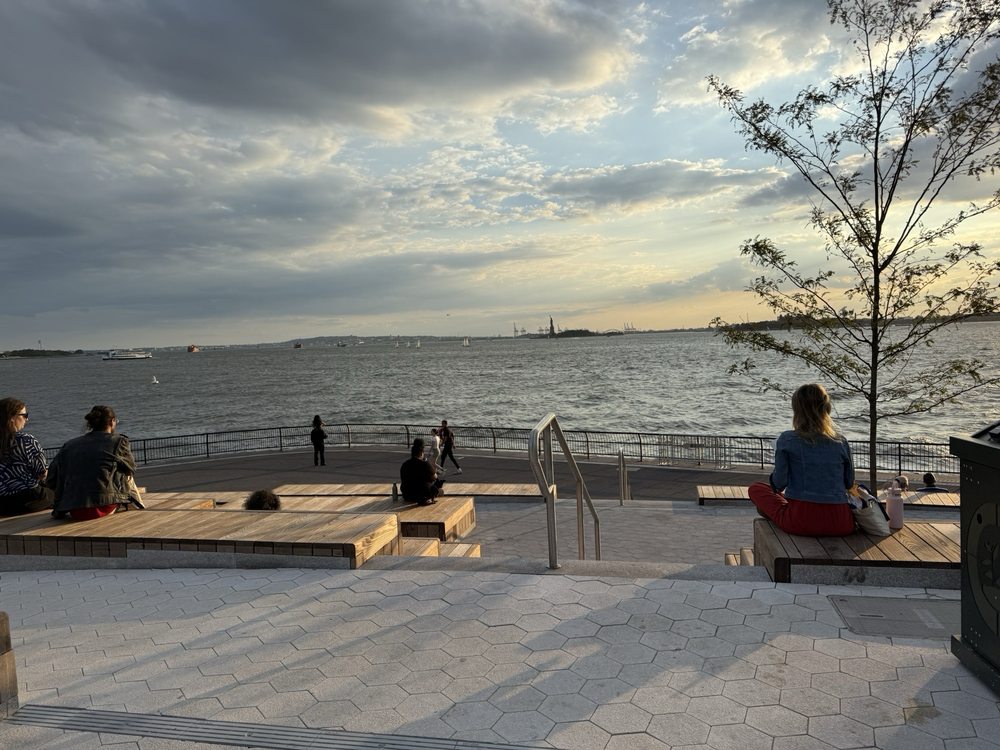

## Chapter One: Ribbons on the Hudson Morning spilled over the Hudson like honey from a tilted jar, and I, Pete the Puggle, stood at the edge of the NYC Greenway Path with my white velvety fur fluffed by river wind and the playful streaks around my eyes tingling as if they knew adventure before I did. Cyclists whispered past in bright helmets, joggers counted breaths, and beyond the rail the water flashed silver-blue, beautiful and terrible. “Smell that?” Mariya said, kneeling beside me, her curls catching sun. “Salt, pretzels, hot pavement, and possibility.” Lenny adjusted my little red harness and winked. “Pete, today the city is our storybook. Try not to chase the plot pigeons.” Roman laughed and bumped shoulders with George, his broad-shouldered friend home from the Navy, whose calm eyes seemed to measure waves even on land. Then Luna arrived—elegant as a shadow wearing moonlight, an Italian Mastiff with a slate-gray coat, solemn amber eyes, and a gait so graceful the path seemed to straighten for her. My heart did a somersault and landed in my paws. “Ciao, little cloud,” she said, voice low and warm. “Are you afraid of the river? It sings loudly here.” I lifted my chin, though my knees disagreed. “Afraid? Me? I am practically part dolphin.” Roman snorted. “You hid from the bathtub last Tuesday.” George smiled gently. “Fear is honest. It means the water matters.” Luna leaned closer; her breath smelled faintly of rosemary. “Then let it matter,” she murmured, “without letting it rule.” We set off beneath sycamores stitched with light, the skyline rising beside us like a choir of glass. Mariya pointed at cormorants drying their wings and called them “tiny vampires of the sea,” which made Lenny declare he’d name his boat *The Tiny Vampire* if he ever had one. Roman and George talked about currents and discipline, about how the Navy taught George that panic is a wave you must not marry. I trotted between Luna and Roman, pretending the vast Hudson was only a very ambitious puddle. But inside me, a small cold pebble rattled: water, darkness, losing my family—three old ghosts leashed to my ribs. Still, when Luna glanced back and said, “Stay near, Pete,” I would have followed her into a thundercloud wearing tap shoes. ## Chapter Two: The Tunnel Under the Laughing Light By noon the Greenway curled toward a shaded underpass where traffic hummed above like bees trapped in stone. Pigeons burst from the rafters; murals bloomed—blue whales, subway doors, a cat wearing a crown. The air cooled, and my paws clicked on concrete painted with arrows. “Race you to the other side!” Roman shouted, and before Lenny could say, “Buddy, maybe not,” Roman and George darted ahead with Luna flowing after them like a banner. I sprinted too, because joy is a leash that pulls harder than fear—until the lights flickered. Darkness dropped over us, thick as ink in a bottle. My breath became a trapped moth. I froze. The city vanished; the path vanished; even my white fur felt stolen from me. “Pete?” Mariya’s voice trembled somewhere behind, then footsteps, then Lenny’s steady hand finding my harness. “Here, here. We’ve got you.” But Roman’s voice came from farther ahead, warped by echo: “Pete! Keep talking!” I tried, yet only a squeak came out. Luna returned through the black, her eyes catching a thread of emergency light. “Little cloud,” she whispered, “darkness is only light resting. Do not mistake the rest for the end.” George’s palm touched my back, firm as a dock. “In the Navy,” he said, “we learned to name five things we can feel. Harness. Floor. Air. Friend. Heart.” I named them too, each one a candle: harness, floor, air, Luna, heart. When the lamps buzzed alive, everyone laughed too loudly, the way people do when fear has just left the room and forgotten its coat. Lenny pulled me close and whispered, “Brave isn’t no shaking. Brave is shaking forward.” Roman looked sheepish, protective and guilty all at once. “I shouldn’t have run ahead,” he said. “I forgot the dark gets you.” I wanted to say I was fine, but honesty felt warmer. “It got me,” I admitted. Luna touched her nose to my ear. “Then next time, we get it back together.” We emerged into daylight blinking, the river flashing beyond the rail like applause, and I noticed the cold pebble inside me had cracked—only a crack, but light knows what to do with cracks. ## Chapter Three: Pretzel Winds and a Warning Near a pier where kayaks bobbed like bright beetles, we shared pretzels and lemonade while ferries shouldered across the Hudson. Mariya fed me a crumb and said, “New York is a pantry of smells; choose wisely.” Lenny pointed toward the Statue of Liberty, green and solemn in the distance. “She’s holding a torch,” he said, “and still finds time to photobomb every dream.” George scanned the water with a swimmer’s respect. “Current’s quicker than it looks. If anyone falls in, don’t jump after them—throw, reach, call.” Roman nodded, suddenly older than his sneakers. Luna sat so close our shoulders touched, and I hoped the streaks around my eyes looked heroic rather than sweaty. A park ranger rolled by and warned of an incoming summer squall: “Fast wind, fast rain, maybe thunder. Keep dogs leashed and away from the edge.” The sky, which had been blue porcelain, began bruising at the corners. Runners tightened their laces; sailors folded sails; gulls argued with the wind. I felt the Hudson change its voice from song to growl. Waves slapped the bulkhead and sent spray over the rail, cold commas on my fur. My old water-fear uncurled, showing teeth. “I don’t like how it grabs,” I whispered. Luna answered, “Then admire its strength from here. Courage can begin at a respectful distance.” But Roman, ever half hero and half firecracker, had spotted a red ball trapped against the rocks below the path—my red ball, nudged loose from my pack by the jostling crowd. “I’ll get it,” he said, climbing down one step too eagerly. George barked, “Roman—wait!” A gust slammed the pier; the ball spun into the churning gap; I lunged before thought could put on its shoes. My paws hit slick stone. The river opened its gray mouth. I did not fall—not quite—but terror poured through me like ice water, and in that instant the leashes tangled, the crowd surged, thunder cracked, and my family’s voices scattered into rain. ## Chapter Four: The Squall Takes the Map The storm arrived all at once, as if the sky had been holding its breath and finally shouted. Rain needled the path; umbrellas turned inside out like startled flowers; the Hudson heaved dark green shoulders against the seawall. “Pete!” Mariya cried, but wind stole the name and carried it downtown. Lenny grabbed for me; George grabbed for Roman; Luna, loyal and lightning-fast, lunged to keep me from the edge. Somehow—by leash, luck, and the violent choreography of panic—Luna and I were swept down a service ramp away from the stairs, away from Lenny’s whistle, away from Mariya’s outstretched hand. Roman’s face flashed between bodies: horrified, reaching, gone. We skidded beneath an old pier where the city noise muffled into a wet heartbeat. Chains dripped. Barnacles clung to pilings like pale knuckles. The river breathed in and out, black between boards. I shook so hard my tags played frightened music. “We’re lost,” I gasped. “I lost them. I always lose them in my head, and now it’s true.” Luna planted herself before me, broad as a doorway. “Look at me. Not the water. Me.” Her eyes were lamps. “Your family is not a place you can drop. They are a pack. Packs search. Packs return.” Thunder rolled; I flinched; she did not. “But I’m small,” I said. “And the dark under here is hungry.” “Then we shall be impolite to hunger,” she replied, and despite everything, I laughed. From above came George’s whistle—three short blasts, a Navy signal sharp enough to cut rain. Luna answered with a deep bark that made the pilings hum. We waited, but the whistle moved away, swallowed by the storm’s wrong turns. My chest caved. Luna nudged me toward a narrow ledge where the water slapped close enough to kiss my paws. “We cannot stay,” she said. “When the tide rises, this shelf will become a mouth. We must go along the edge, slowly, toward the ladder.” I stared at the moving black inches from my claws. Every instinct screamed *run*, but there was nowhere to run except into the thing I feared. Luna stepped first. “Do not be brave for the whole river,” she whispered. “Be brave for one paw.” ## Chapter Five: One Paw, Then Another I put one paw on the ledge. The river hissed like a thousand kettles. I put another. Rain made the stone slick as soap, and beneath us the current dragged at the world, impatient to be elsewhere. “Eyes on me,” Luna said, moving sideways with the calm of a queen crossing a ballroom. “If you look down, the water becomes a story with no ending. If you look at me, I am the next sentence.” I looked. Her gray face, rain-beaded, was the bravest sentence I had ever read. Above, muffled voices called our names; below, the Hudson flexed. My fear spoke in my father’s silly voice, my mother’s soft gasp, Roman’s laugh turned sharp: *You’ll slip. You’ll sink. You’ll disappear.* I answered aloud, because fear hates being witnessed: “I am Pete. I am held. I am moving.” Halfway along, a loose board snapped under Luna’s weight. She lurched; her hind leg splashed; the river caught her scent and pulled. I screamed and bit gently but firmly into the loose skin at her shoulder, anchoring while she hauled herself up with a mastiff’s mighty chest. “Grazie, little cloud,” she breathed, trembling now too. That changed something in me: the elegant one could shake; the brave one could need help; love was not admiration from below but teeth and trust side by side. “We’re even,” I said, though my voice wobbled. “You were brave for me. I get to be brave for you.” At the ladder, rusted rungs rose into light like the spine of a metal dinosaur. Water surged over our paws, cold and insistent. I froze again, because endings can frighten as much as beginnings. Then I heard Lenny’s whistle—our family’s ridiculous tune, the one he used for barbecues and lost socks—floating through rain. Hope has a sound; ours was off-key. I climbed. Each rung burned my legs; each breath tasted of iron and river. Luna pushed from below, steady as a tide gone kind. My head rose above the pier into storm-light, and there—soaked, wild-eyed, sprinting through silver rain—came Roman. ## Chapter Six: Roman in the Rain Roman skidded to his knees so hard water fanned around him. “Pete!” he shouted, half sob, half trumpet. He hauled me up by the harness and crushed me to his chest, then reached down with George—who appeared like a rescue made of shoulders—to lift Luna’s heavy grace over the edge. For a moment nobody spoke; the storm did all the talking. Then Roman pressed his forehead to mine, rain mixing with tears I pretended were weather. “I saw the leash. I saw the ramp. I thought—” His voice broke. “I thought I raced ahead in the tunnel and taught you to be alone.” George put a hand on Roman’s neck. “Breathe. You found them. That’s what matters now.” Lenny and Mariya arrived wrapped in a ranger’s yellow tarp, Mariya crying and laughing at once, Lenny holding my red ball like a recovered moon. “Somebody,” he said, voice thick, “owes this ball a stern lecture.” Mariya cupped my face. “My little Pete, your heart must be tired.” “It is,” I said, “but it learned a shortcut.” Luna bowed her head to Mariya, regal even drenched. “Your puppy carried me when the board broke.” Roman stared at me with new eyes—not older brother to nuisance, but witness. “You saved Luna?” I looked at the river, still fierce but no longer infinite. “We saved each other in installments.” The ranger led us to a sheltered boathouse where towels appeared like flags of surrender. George checked everyone for shock with practiced gentleness. “Fear after danger is the body filing paperwork,” he said. Roman sat beside me, shoulder to shoulder, and confessed he’d been afraid too—of the dark tunnel, of failing as protector, of the moment George’s whistle faded. I admitted I had imagined the family dissolving like sugar in rain. Mariya said, “Love is not sugar. It’s salt: it survives the sea.” Lenny nodded. “And if lost, follow the silly whistle.” Outside, thunder packed its bags. The Hudson softened from roar to murmur, and my three ghosts—water, dark, separation—stood smaller in the doorway, no longer allowed to choose the furniture of my mind. ## Chapter Seven: The Golden Hour After Rain Storms in New York often leave like embarrassed guests, suddenly polite, opening curtains of gold. We walked back along the Greenway as sunset poured copper over the water and turned puddles into fallen skies. The path steamed; leaves released green perfume; somewhere a saxophone resumed being brave. Luna limped slightly, and I stayed close enough that our shadows married on the pavement. “Do you still think I am elegant?” she asked. “More,” I said. “You have a heroic limp.” She laughed, a low bell. “And you, little cloud, have eyeliner streaks that survived a hurricane.” I decided then that if my heart were a tail, it would never stop wagging near her. George told us about the first time he jumped from a ship into black ocean, how the water had felt like the whole planet exhaling. “Courage,” he said, “is not a wall. It’s a door you oil by opening.” Roman kicked a pebble, thoughtful. “I used to think protecting Pete meant running faster than danger. Today it meant following, listening, admitting I caused part of the mess.” Lenny draped an arm around him. “Apology is a leash that brings everyone home.” Mariya pointed at the skyline mirrored in the Hudson. “Look—the city is upside down and still standing.” I understood: I had been upside down too, and had not vanished. At a quiet lawn above the river, we spread the damp tarp and ate emergency granola bars that tasted, by miracle, like feast. Luna lay beside me while the sun lowered itself into New Jersey as if into a bath. I told her about the bathtub, the dark closet I once barked at for an hour, the dream where my family walked away without turning. “Now,” I said, “when fear tells the story, I interrupt.” She touched noses with me, brief and electric. “Then perhaps, Pete, one day you will swim.” I looked at the Hudson glowing like a tame dragon. “Perhaps,” I said, and meant one inch of it. Roman overheard and grinned. “First lesson: dog paddle. Second: don’t marry panic.” George saluted with a granola bar. “Third: always bring snacks.” ## Chapter Eight: Home Is a Whistle You Carry We returned to the path’s beginning as blue evening gathered between buildings and lights came on one by one, each window a small promise kept. The Greenway no longer seemed a line beside danger but a ribbon tying river to city, stranger to friend, fear to courage. Lenny lifted me onto a bench so I could see the water from safety; Mariya leaned against him; Roman sat cross-legged at my paws with Luna’s great head resting near his knee. George stood watching the current, peaceful as a lighthouse that had decided to visit land. “Best part?” Lenny asked. Roman said, “Finding them.” Mariya said, “The whistle.” George said, “Nobody married panic.” Luna said, “One paw.” I said, “All of it, even the terrible middle, because it introduced me to me.” Roman cleared his throat. “Pete, I’m sorry I ran into the dark and down to the rocks. I kept thinking being older means being first. Today you were first in the brave way.” I bumped his chin with my nose. “You found me. That’s a kind of first too.” Mariya’s eyes shone. “Fear visited us today wearing three costumes—water, darkness, being lost. We did not invite it to dinner, but we learned its names.” Lenny nodded solemnly, then ruined it beautifully: “Its middle name is Kevin.”
Use these buttons to read the story aloud:



No comments:
Post a Comment