"*** The Puggle Who Learned the River’s Song ***"🐾

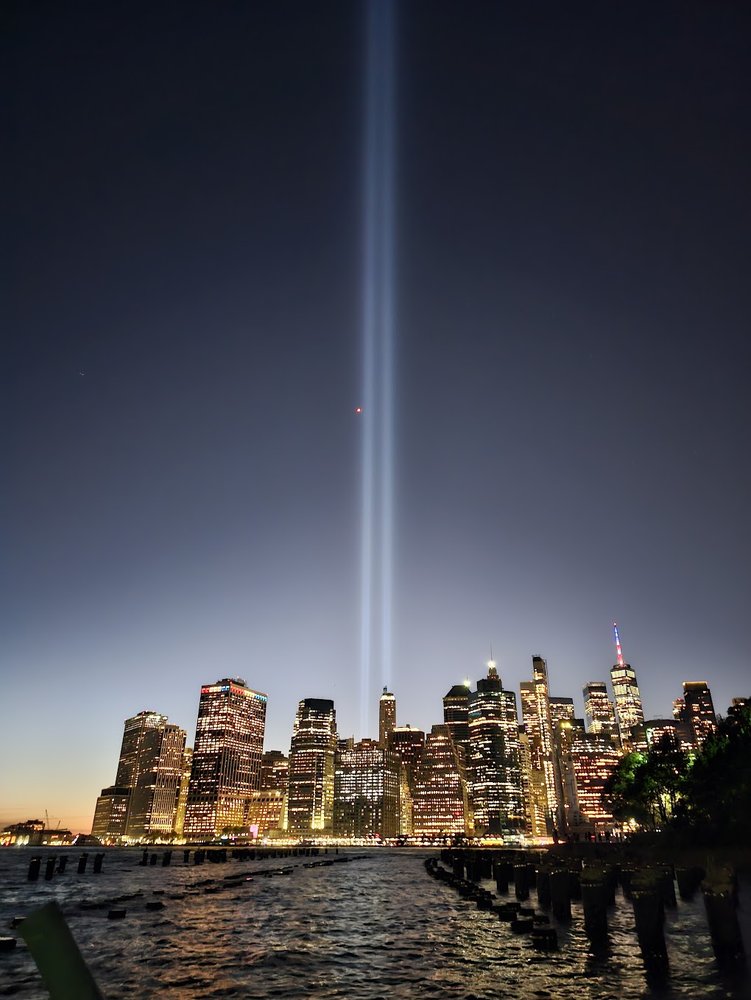
## Chapter 1: The Morning the Bridge Called I woke with my nose pressed to the window and my tail thumping like a little drum. Beyond the glass, Brooklyn glittered after rain, every rooftop rinsed silver, every puddle holding a piece of sky. I am Pete the Puggle, white as fresh laundry, bright-eyed, with playful streaks around my eyes that make me look as if I have already heard the punch line of the world. That morning, though, my courage felt thin as a cracker. We were going to Brooklyn Bridge Park, which meant grass, boats, gulls, pizza smells—and water. Lots of water. The East River would be there, wide and breathing. “Pete,” Lenny said, kneeling to clip my leash, “a brave heart is not a quiet heart. It is a noisy one that goes anyway.” His eyes warmed like toast. Mariya tucked a blue bandana around my neck and whispered, “The river is only a long mirror that has learned to move.” Roman bumped my shoulder with his shoe. “Race you to the elevator, slow snout.” I growled playfully, but when the elevator doors slid open with a sigh, my paws turned to careful stones. Outside, the city sang in taxi horns and bicycle bells. The bridge arched ahead like a giant cat stretching over the river. I loved its cables, silver whiskers in the sun. Then the wind brought me the smell: salt, oil, wet rope, the green breath of deep places. My ears dropped. Water was not a mirror to me; it was a mouth. Roman noticed and softened. “Hey,” he murmured, crouching so our eyes were level, “we don’t have to be brave all at once. We can be brave in bites.” I licked his knuckle, tasting soap and peanut butter, and thought: perhaps courage could be shared like a sandwich. By the time we reached the park entrance, Bruce Lee was waiting beneath a maple, sunglasses shining, calm as a closed door. He was our old friend, an actor whose hands could move faster than pigeons and whose smile made danger reconsider its life choices. “Pete,” he said, bowing with theatrical grace, “today the river will audition. You do not have to clap yet.” I barked once, half laugh, half tremble. The bridge hummed above us, and I stepped onto the path with my family gathered around me like four walls of a moving house. ## Chapter 2: Lawns, Laughter, and the First Cold Edge Brooklyn Bridge Park opened before us in green ribbons. Lawns rolled down toward the promenade; gardens nodded with purple coneflowers; children blew bubbles that rose like tiny planets and popped into nothing. Mariya named every cloud. “That one is a turtle wearing a hat. That one is Lenny before coffee.” Lenny clutched his chest. “I am wounded, yet accurate.” Roman tossed a bright orange ball, and for a while I forgot the river entirely. I ran until my legs were exclamation points, until the ball was mine, until I dropped it only because a butterfly insulted me by floating past. Then we reached the railing near Pier 1, and the water spread out beyond the granite edge, dark blue and muscular. Waves slapped the stones: chuff, chuff, like a beast licking its lips. A ferry groaned in the distance. My body became a small drum skin tightened over fear. I backed away so fast I sat on Roman’s foot. He did not laugh. “I’ve got you,” he said, one hand between my ears. “Look at me first. Then look at the water for one second. One. That’s all.” I tried. One second became two. The river flashed with sun scales. A gull screamed like a rusty gate, and I yelped. Bruce Lee stood beside us, watching not the water but me. “Fear is a bad director,” he said. “It yells ‘cut’ before the scene begins. We will let it speak, then we will change the script.” Lenny nodded. “When I was a boy, I feared basements. So I carried jokes down there until the dark got tired of being scary.” Mariya crouched and pointed to a line of ants carrying crumbs near my paw. “See? Even small things travel over big ground.” Her voice made the world gentle enough to touch. Still, when a speedboat slapped past and spray jumped the railing, I bolted behind Lenny’s legs, shaking so hard my tags chimed. Roman sat right down on the warm stone and pulled me into the basket of his arms. “You’re not a failure because you’re scared,” he whispered into my fur. “You’re a story that hasn’t turned the page.” I wanted to believe him. The river breathed. The bridge held the sky. My family made a circle, and inside that circle I stopped trembling long enough to eat half a treat and pretend it tasted like victory. ## Chapter 3: Bruce Lee and the Lesson of Still Water Bruce suggested we practice at a shallow inlet where kayaks rested like bright beetles and the water came only to our ankles—human ankles, which meant my belly. The inlet was fenced by smooth boulders, and beyond it the river flashed with traffic: ferries, barges, a red tug pushing its heavy nose through the day. Bruce removed his shoes and rolled his cuffs. “A stunt begins before the jump,” he told me. “It begins in the mind. If your mind says ‘fall,’ your body obeys. If your mind says ‘balance,’ your paws become wise.” Roman waded in first, jeans rolled, grinning despite the chill. “Cold! Cold! Pete, it’s like the floor after bath time, only bigger.” Lenny followed with comical dignity, arms lifted as if carrying invisible soup. Mariya dipped one toe and gasped. “Oh! It tickles like a secret.” I stood on dry stone, every muscle arguing with every other muscle. The water touched a rock and withdrew, touched and withdrew, patient as a lullaby. I hated its patience. It could wait forever. I could not. Bruce held out his hand, palm up. “Do not enter for them,” he said softly. “Enter for the Pete on the other side of this moment.” That sentence lit a candle in me. I imagined another Pete—wet paws, ridiculous ears, laughing. I put one paw in. Cold snapped up my leg like a rubber band. I squeaked. Roman cheered so loudly that two joggers looked over. “Again,” he said, not pushing, only inviting. Second paw. Third. The water swirled around my chest, and panic rose black as ink. I saw myself swallowed, carried under a barge, turned into a story told in past tense. Then Mariya began to hum the song she sang during thunderstorms, the one with no words, only round sounds. Lenny said, “If you sink, I shall become a submarine named Dad.” I laughed, and laughing loosened the knot. Bruce moved beside me, slow as moonlight. “Breathe in courage,” he said. “Breathe out the old map.” I took one more step. The river did not devour me. It held me, cool and astonished, while Roman’s hand stayed under my belly like a bridge made of brother. ## Chapter 4: The Fog That Ate the Path By afternoon we had wandered toward the quieter stretch near the old pilings, where weathered posts leaned from the water like the ribs of some forgotten whale. The sun hid; fog slid in from the harbor, soft and gray, erasing the far towers until Manhattan became a rumor. Sounds changed their clothes. A bicycle bell came from nowhere and vanished. Gulls appeared as white punctuation marks, then were swallowed. I stayed close to Roman’s heel, proud of my earlier bravery yet alert. Brave in bites, I reminded myself. Bites could still be swallowed. A crowd gathered near the carousel, and in the shuffle a loose scooter clattered across the path. I jumped sideways; someone’s picnic blanket billowed; Mariya called, “Stay!” but a golden retriever bounded past wearing a bandana exactly like mine, and for one blink I followed the wrong flash of blue. When I turned back, the fog had thickened into soup. No Lenny’s laugh. No Mariya’s red scarf. No Roman’s tall shadow. Only Bruce was near, then even he stepped toward a child crying by the railing and was gone behind gray curtains. My fear of separation did not roar; it whispered, which was worse. It said: They have become air. It said: You are too small to be found. It said: The dark is coming early inside this fog. I ran left, then right, claws skidding on wet stone. Every bench had the same empty face. Every trash can wore a black mouth. I barked until my throat hurt. “Roman!” The name came out broken. “Mariya! Lenny!” The fog stole the sounds and handed back only water. I crouched beneath a bench, shaking. Above me the bridge cables vanished upward into nothing, as if the world ended after twenty feet. Then I remembered Roman’s hand under my belly. I remembered Bruce saying the mind chooses the script. I pressed my nose to the ground and smelled rain, pretzel salt, goose droppings, hot dogs, and—faint but dear—Roman’s sneakers: rubber, grass, and the orange ball. I lifted my head. A trail can be a thread, and a thread can hold a family. I followed it into the white unknown, heart banging like a door I refused to lock. ## Chapter 5: Darkness Under the Old Pier The scent led me away from the bright paths, under a weathered pier where boards made a low ceiling and the light fell in pale stripes. It was not night, yet the dark gathered there early, thick as velvet curtains. My old fear of darkness uncurled from my puppy memories: the laundry room door once shut by accident; the thunder that cracked the sky; the closet where shadows stacked chairs into monsters. Under the pier, every shadow had teeth. Water dripped from beams: plink, plink, counting my heartbeats. “Pete,” I whispered to myself, because sometimes a hero must be his own audience, “dark is only light that forgot its glasses.” It was Lenny’s joke wearing my voice. I almost smiled. Then something moved—a plastic bag crawling along the stones, ghostly and blind. I froze. A rat rustled behind a post; my bark came out small. Beyond the pier, the fog pressed close, and beneath me the river knocked on the wooden bones: let me in, let me in. I wanted Roman with a wanting that hurt like hunger. I heard footsteps and flattened myself, ears back. Bruce Lee emerged from the fog like a calm sentence in the middle of shouting. He did not grab me. He sat on the lowest beam and looked into the same dark. “When I film a night scene,” he said, “the set is full of monsters made by lamps. A cable becomes a snake. A coat becomes a man. The camera believes what the light tells it. So we change the light.” He clicked a tiny flashlight. The dark did not disappear, but it showed its edges: posts, ropes, barnacles, a crab walking sideways like a grumpy comma. “Come,” Bruce said. “Not because it is harmless. Because it is known.” I crept to him. He lifted me onto the beam where the air moved freer. From there we saw a silver gap in the fog and heard, faintly, Roman shouting my name. Joy stabbed through me so sharply I almost fell. Bruce smiled. “Fear narrows the world. Love gives it back its width.” I barked toward the voice, again and again, each bark braver than the last, while the pier creaked and the dark, defeated for the moment, made room. ## Chapter 6: The Tide, the Gap, and the Leaping Heart Roman’s voice came from beyond a service gate that had swung shut between the pier and the lower rocks. The tide was rising, and water hurried through a gap where stones had once made a dry crossing. It was not wide—perhaps three human steps—but to me it looked like the whole river had lain down in my path. On the other side I glimpsed Roman’s red sleeve through fog. He was calling, climbing, slipping, calling again. Behind him Lenny and Mariya appeared as shapes, then faces, then hands reaching through the gate bars. “Pete! Stay there!” Roman shouted, though his eyes begged me to move toward safety. A wave slapped over the rocks and withdrew, leaving them shining and treacherous. Bruce assessed the gap, the current, the gate. “I can carry him,” he said. Lenny shook his head, rain or spray bright on his cheeks. “The footing’s bad. If you fall with him—” Mariya pressed her lips together, then called to me, “Pete, remember the inlet! Cold is not danger. Moving water is a rhythm. Find the rhythm.” The old terror returned wearing many costumes: water, dark, separation, all three holding hands. I saw myself failing; I saw Roman lunging; I saw the river close over white fur. My legs shook so hard the beam hummed. Then Bruce knelt beside me. “A jump is a promise,” he said. “You do not promise the water. You promise yourself.” Roman stretched his arm through the gate, fingers open. “Bites, Pete,” he called. “Brave in bites. One rock. Then me.” I looked at the first stone, black and wet. I looked at Roman’s hand, which had held me in bathwater, in thunder, in the first winter snow. I stepped down. The tide grabbed my paws and tried to teach them to dance away. I leaned into the rhythm instead: slap, breathe; pull, step; slap, breathe. Bruce moved along the beam beside me, silent, ready, a guardian made of balance. Halfway across, a surge lifted me off my feet. I yelped. Roman’s hand closed around the loose skin of my neck—not roughly, but surely—and Lenny’s longer arm caught my chest, and suddenly I was over the gate, wet, alive, and held so tightly I could feel four hearts arguing about who loved me most. ## Chapter 7: Found in the Brightening Air The fog loosened as if embarrassed by our reunion. Roman wrapped me in Mariya’s spare scarf, which smelled of lavender and home. I licked his chin until he laughed despite the tears standing in his eyes. “You followed my shoes,” he kept saying. “You actually followed my shoes.” Lenny hugged us both and declared, “I have aged seven years and become twelve percent more handsome from stress.” Mariya kissed the top of my head and whispered, “You were lost, but you were not gone. Those are different countries.” Bruce Lee stood a little apart, giving our family the center of the moment. When I wriggled free and ran to him, he bowed low. “You crossed,” he said. “Not perfectly. Truly.” I barked that truly was better. Around us the park returned by degrees: a saxophone near the promenade, pretzel salt warming the air, children chasing bubbles that had survived the gray. The bridge reappeared cable by cable, like a harp remembering its strings. Manhattan sharpened across the river, windows catching late sun and tossing it back in gold coins. We sat on a bench while Roman inspected my paws for cuts and found only courage, which cannot be bandaged. I told them—through looks, whines, tail sentences, and the solemn placement of my chin on each knee—about the fog’s whisper, the under-pier dark, the plastic-bag ghost, and the tide that tried to steal my rhythm. They answered in the language of listening. Lenny admitted he had once gotten lost in a museum and pretended he was “curating solitude.” Mariya confessed that fog still frightened her because it made even familiar trees into strangers. Roman stared at his hands. “When I couldn’t see you,” he said, “I understood that being protective isn’t holding tight. It’s teaching you how to come back.” That sentence settled into me like a warm stone after cold water. I had thought love meant never leaving the circle. Now I saw love also meant learning the path home. Bruce watched the river, calm and bright. “Every fear you met today wore a mask,” he said. “Under the mask was an invitation: to trust, to breathe, to choose the next paw.” The sun broke fully then, and the park flashed green around us, ordinary and miraculous at once. ## Chapter 8: The River Sings Us Home Before leaving, we returned to the railing where the day had begun to frighten me. The East River moved below, no kinder, no crueler, only itself—vast, busy, shining under the enormous patience of the bridge. Boats drew white signatures across the blue. A kayaker lifted a paddle in greeting; somewhere a dog barked from an apartment window as if reporting the news: Pete crossed, Pete crossed. I stood with my front paws on the lower rail, Roman beside me, Lenny and Mariya behind, Bruce at the end like a period that made the sentence complete. “Are you still scared?” Roman asked. I considered lying, but heroes should not become actors unless they are Bruce. I told the truth in my puggle way: ears half back, tail half up,
Use these buttons to read the story aloud:



No comments:
Post a Comment